Associate Sponsors

Co-sponsor

Sovereignty, pragmatism, and choices: India balances risks in neighbourhood

The "foreign hand" was always American. Its adversaries, the Soviet Union and its allies, were natural friends
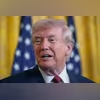
Donald Trump
President Donald Trump (Photo:PTI)
Shekhar Gupta
7 min read Last Updated : Feb 21 2026 | 9:30 AM IST
It’s early days in 2026, but the word “sovereignty” is already the most likely frontrunner for the word of the year. It’s now a key buzzword in Indian politics. And it gets radioactive whenever US President Donald Trump makes any reference to India. Or when something as normal and reciprocal as his ambassador, Sergio Gor, visiting the Western Command headquarters at Chandimandir happens.
 
Mr Trump has brought sovereignty back in fashion. He’s broken three decades of globalisation consensus that persuaded nations to see benefit in sharing sovereignty with their friends and allies, in groupings and alliances. This is over. Mr Trump has persuaded every nation, especially his allies or partners – from Canada to India – to rediscover that “S” word.
 
In India, it only recently reawakened latent emotions. You could see it as the end of the era of complacency, or a test of our national wisdom. India’s short era of strategic pragmatism is being put to the test.
 
You can attribute it to our colonial history. Or subsequent victimisation by the West (read America) as Pakistan became its treaty ally. Later, the wounds were made deeper and the fortress mentality stronger as India faced successive sanctions and technology denial after the two Pokhran tests in 1974 and 1998.
 
All the pressures on our nuclear and missile programme in the infamous “cap, rollback and eliminate” era also came from Washington. India’s larger, philosophical concept of sovereignty, therefore, came to be defined as defiance of America. This lived experience produced a nationalism that was as thin-skinned as the suspicion of the US was deep.
 
The “foreign hand” was always American. Its adversaries, the Soviet Union and its allies, were natural friends. That was until one day the Soviet Union and its bloc vapourised in 1990-91. Since then, India has been exploring the new, unipolar world and steadily building a perch for itself in this unfamiliar terrain. The larger result has been a steady but decisive tilt towards the West. From P V Narasimha Rao to Narendra Modi through Atal Bihari Vajpayee and Manmohan Singh, every Indian leader has wrestled with the same strategic dilemma: How to build relationships in the post-Cold War era without joining any camp.
 
India’s fraught neighbourhood places multiple constraints on its strategic choices. Broadly, let’s look at a dual constraint. Because India is always in a hair-trigger situation with Pakistan and always worries about when the Chinese make the Line of Actual Control (LAC) active. It leaves no time to take a deep breath, lean back and reset. Americans like to underline the challenge of walking and chewing gum. For India, the China-Pakistan alliance produces a much greater complexity.
 
Here’s why we call it a dual constraint. First, India needs its armed forces to always be battle-ready and significantly deployed. A lot of the hardware is still of Soviet/Russian origin, and that dependence cannot be wished away. Further, Russia is critical to some of India’s most sensitive and strategic programmes – the nuclear submarines (SSNs), for example. Second, to avoid a two-front challenge, it needs stable ties – even trade compromises – with China.
 
Managing this relationship means it cannot say anything rude about Russia over Ukraine or even publicly accept Mr Trump’s claims that it has committed to stop buying Russian oil. The complexity is evident in the fact that, before the Ukraine war, when Europe and America wanted India to buy Russian oil at a price ceiling to help maintain global energy prices, India was buying almost no crude from Russia. Forget being critical to India’s energy security, it did not even figure in the conversation. Now there’s pressure from public opinion not to stop buying. Tell them you are sovereign.
 
The defiance Indian governments of the past showed to American pressure is being invoked often, reminding us how Indira Gandhi showed Richard Nixon and Henry Kissinger their place. That’s a reality, but only half the story.
 
The other half is that while Indira Gandhi defied one bloc, she made India nearly (or partly) a member of the other. From 1969, when she needed the pro-Moscow Communist Party of India (CPI) members of Parliament to keep her minority government in power, her tilt to Moscow became pronounced. From August 9, 1971, India became a treaty-bound ally of the Union of Soviet Socialist Republics. It wasn’t your vanilla security treaty; buried in much text of platitudes was also Article IX, which amounted to a mutual security guarantee.
 
It came in handy as the US 7th Fleet sailed to foil India, guaranteed a Soviet veto in the UNSC and enabled India to build military hardware very quickly, including several hundred T-55 tanks from Poland. All this even as China, the new friend of the US, rearmed Pakistan.
 
The 1971 victory was the peak of glory for Indira and India and a humiliation for the Nixon administration as their ward was dismembered. But did this mean India had total sovereignty? On one issue after another, it had to side with the Soviets, whatever the moral argument. Kampuchea/Cambodia and Afghanistan tested India’s claims to morality. At least one of these, Afghanistan, created a strategic mess for India. It revived the US-Pakistan alliance, seeded the jehadi culture and created space for Islamabad to nuclearise.
 
Did this phase in our history, say from 1969 to 1989, see our sovereignty compromised? The answer is no. Sovereignty is not something hallmarked like gold. Sovereignty for any nation, the US and China included, is relative. In essence, it means a nation must have the space to make its choices, even compromises. In the Cold War era, India’s sovereign choice was to tilt towards Moscow. Afterwards, there’s been a slow linkage with Washington. At the same time, the relationship with Russia has been nursed, stability has been sought with China, and deterrence has been built with Pakistan. At the same time, however, Russia has become an ironclad ally of China. That’s because Vladimir Putin makes sovereign choices, too. No country is ever fully sovereign, not even neutral Switzerland. They all make their choices and compromises. Opportunism becomes a valid tool in the hands of the wise, and there is no shame.
 
The upshot is, in the Cold War era, India had to put up with Soviet misdemeanours — Afghanistan being the most important. Some of our responses to the US are a mirror image of that.
 
So strong was our anti-Americanism that in no city of India was any landmark named after an American until Revanth Reddy decided to name one after Mr Trump in Hyderabad. In New Delhi, even now, there’s none but Roosevelt House, the US Ambassador’s residence. We didn’t even name an avenue after Martin Luther King.
 
Today, we live in a globalised world of inter-dependencies, and the idea of sovereignty needs greater flexibility. All nations are seeking new alliances, and shared vested interests are the only guiding principle. Ideology and morality are out. A good personification of this change will be seen in New Delhi in a week, when Canadian Prime Minister Mark Carney comes by to repair a relationship his predecessor tore up. His choice: Put up with Mr Trump’s threats to Canada’s sovereignty, or hedge with relationships elsewhere.
 
As a student of Indian politics, one of my most memorable Walk the Talk interviews was with then CPI(M) General Secretary Harkishan Singh Surjeet. You’ve backed governments that continued improving ties with the US, I asked. How do you justify that?
 
“Dekhiye,” (please see), he said, India needs technology. We used to get it from the Soviet Union, which doesn’t exist now. So, we need America. We have to do what our national interest demands.
 
This is a short tutorial on sovereignty from the great Left ideologue. I could’ve simply told you this story upfront rather than making you read 1,200 words.
 
By special arrangement  with ThePrint


One subscription. Two world-class reads.

Already subscribed? Log in

Subscribe to read the full story →
*Subscribe to Business Standard digital and get complimentary access to The New York Times

Smart Quarterly

₹900

3 Months

₹300/Month

SAVE 25%

Smart Essential

₹2,700

1 Year

₹225/Month

SAVE 46%
*Complimentary New York Times access for the 2nd year will be given after 12 months

Super Saver

₹3,900

2 Years

₹162/Month

Subscribe

Renews automatically, cancel anytime

Here’s what’s included in our digital subscription plans

Exclusive premium stories online

  • Over 30 premium stories daily, handpicked by our editors

Complimentary Access to The New York Times

  • News, Games, Cooking, Audio, Wirecutter & The Athletic

Business Standard Epaper

  • Digital replica of our daily newspaper — with options to read, save, and share

Curated Newsletters

  • Insights on markets, finance, politics, tech, and more delivered to your inbox

Market Analysis & Investment Insights

  • In-depth market analysis & insights with access to The Smart Investor

Archives

  • Repository of articles and publications dating back to 1997

Ad-free Reading

  • Uninterrupted reading experience with no advertisements

Seamless Access Across All Devices

  • Access Business Standard across devices — mobile, tablet, or PC, via web or app

Topics :BS OpinionShekhar GuptaNATIONAL INTERESTUnited States

Next Story


