
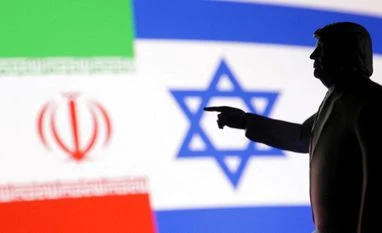
Donald Trump floats the idea of regime change in Iran after US bombings
This idea of a regime change came after the US bombed Iran's nuclear sites but before that country retaliated by firing its own missiles at a US base in Qatar
 "Donald Trump floats the idea of regime change in Iran after US bombings")
Explore Business Standard

Associate Sponsors
This idea of a regime change came after the US bombed Iran's nuclear sites but before that country retaliated by firing its own missiles at a US base in Qatar
As President Donald Trump floats the idea of regime change in Tehran, previous US attempts to remake the Middle East by force over the decades offer stark warnings about the possibility of a deepening involvement in the Iran-Israeli conflict.
If the current Iranian Regime is unable to MAKE IRAN GREAT AGAIN, why wouldn't there be a Regime change??? Trump posted on his social media site over the weekend.
This came after the US bombed Iran's nuclear sites but before that country retaliated by firing its own missiles at a US base in Qatar.
White House press secretary Karoline Leavitt on Monday insisted that Trump, who spent years railing against forever wars and pushing an America first world view, had not committed a political about-face.
The president's posture and our military posture has not changed, she said, suggesting that a more aggressive approach might be necessary if Iran refuses to give up their nuclear program or engage in talks." Leavitt also suggested that a new government in Iran could come about after its people stage a revolt not necessarily requiring direct US intervention.
If they refuse to engage in diplomacy moving forward, why shouldn't the Iranian people rise up, she asked.
That's a perilous path that other US administrations have taken. And it's a long way from Trump's past dismissal of "stupid, endless wars," and his scoffing at the idea of nation-building championed by his Republican predecessors including in Afghanistan and Iraq, where the US helped overthrow governments.
US special forces and Afghan allies drove the Taliban from power and chased Osama bin Laden into Pakistan within months of the September 11, 2001, attacks. American tanks rolled into Baghdad weeks after the 2003 invasion that toppled Saddam Hussein in Iraq.
But then, both wars went on for years.
The Taliban waged a tenacious, two-decade insurgency and swept back into power as the US beat a chaotic retreat in 2021. The overthrow of Saddam plunged Iraq into chaos, with Sunni insurgents and Shiite militias battling each other and US forces.
Israel has so far largely succeeded in taking out Iran's air defences and ballistic missiles and the US strikes on three sites with missiles and 30,000-pound (13,600-kilogram) bunker-buster bombs has wrecked its nuclear program, Trump says.
But that still potentially leaves hundreds of thousands in the military, the Revolutionary Guard and forces known as the Basij, who played a key role in quashing waves of anti-government protests in recent years.
Ground forces are key but don't guarantee success Airstrikes have never been enough on their own.
Take, for example, Libyan dictator Moammar Gadhafi. His forces withstood a seven-month NATO air campaign in 2011 before rebels fighting city by city eventually cornered and killed him.
There are currently no insurgent groups in Iran capable of taking on the Revolutionary Guard, and it's hard to imagine Israeli or US forces launching a ground invasion of a mountainous country of some 80 million people that is about four times as big as Iraq.
A split in Iran's own security forces would furnish a ready-made insurgency, but it would also likely tip the country into civil war.
There's also the question of how ordinary Iranians would respond.
Protests in recent years show that many Iranians believe their government is corrupt and repressive, and would welcome its demise. But the last time a foreign power attacked Iran the Iraqi invasion of 1980 people rallied around the flag.
At the moment, many appear to be lying low or leaving the capital.
Be wary of exiled opposition groups Some of the biggest cheerleaders for the US invasion of Iraq were exiled opposition figures, many of whom had left the country decades before. When they returned, essentially on the back of US tanks, they were marginalized by local armed groups more loyal to Iran.
There are several large Iranian opposition groups based abroad. But they are not united and it's unclear how much support any of them has inside the country.
The closest thing to a unifying opposition figure is Reza Pahlavi, the son of the shah who was overthrown in the 1979 Islamic Revolution that brought the theocracy to power. But many Iranians have bitter memories of repression under the shah, and others might reject Pahlavi over his outreach to Israel, especially if he tries to ride to power on the back of a foreign invasion.
Chaos is practically guaranteed In Afghanistan, Iraq and Libya and in Syria and Yemen after their 2011 uprisings a familiar pattern emerged when governments were overthrown or seriously weakened.
Armed groups emerged with competing agendas. Neighbouring countries backed local proxies. Weapons flowed in and large numbers of civilians fled. The fighting in some places boiled over into full-blown civil war, and ever more violent extremist groups sprouted from the chaos.
When it was all over, Saddam had been replaced by a corrupt and often dysfunctional government at least as friendly to Iran as it was to the United States. Gadhafi was replaced by myriad militias, many allied with foreign powers.
(Only the headline and picture of this report may have been reworked by the Business Standard staff; the rest of the content is auto-generated from a syndicated feed.)
First Published: Jun 24 2025 | 6:55 AM IST

