


A feminist renunciation
Book review of Why I am Not a Hindu Woman
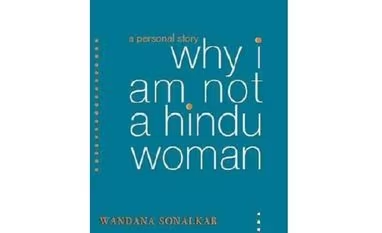 "Book cover")
premium
Book cover of Why I am Not a Hindu Woman
5 min read Last Updated : Dec 29 2020 | 11:23 PM IST
Since the second wave of feminism, the motto “personal is political” has been a rallying cry for feminists around the world. They assert that the political and personal lives of women are inextricably linked; the former shaping the latter and vice versa. This quintessential feminist motto runs throughout Wandana Sonalkar’s courageous memoir Why I am Not a Hindu Woman.
Ms Sonalkar, a retired professor of women’s and gender studies at the Tata Institute of Social Sciences, offers a scintillating account of her decision to reject Hinduism — a personal decision with far-reaching political implications in an increasingly Hindu India.
She clearly articulates two distinct arguments based on which she disavows Hinduism. The first is a rejection of political Hinduism or Hindutva. She unequivocally rejects this “new face of Hinduism” being propagated by the current government that posits a Hindu India at the cost of a secular nation. The second is a rejection of Hinduism as a religious ideology. She argues that “Brahmanical power and patriarchy are integral to Hinduism as it is practiced in our society” and she rejects such a religion. For Ms Sonalkar, both registers operate concomitantly. It is the inherent inequities in the religion of Hinduism that allow the political ideology of Hindutva to thrive.
Unique to Ms Sonalkar’s rejection of Hinduism is her standpoint as an upper-caste Hindu woman. She points out that autobiographical writing on caste is expected to come from those who are directly impacted by its inhumanity. Upper caste scholars rarely write on the topic and when they do it is tainted by the ignorance of their positionality. Upper caste feminists particularly write about patriarchal atrocities, leaving out the critical intersection of caste. Ms Sonalkar’s work seems to be targeted at such upper-caste Hindus and is intended to invite them to examine not just patriarchy but Hindu patriarchy. This self-reflexivity makes Why I am Not A Hindu Woman a profound autobiographical work much needed in India today, especially for the upper caste feminist trying to introduce some intersectionality into her praxis.
Why I am Not a Hindu Woman
Author: Wandana Sonalkar
Publisher: Women Unlimited
Price: Rs 350
Ms Sonalkar’s conversational writing style and vulnerability soften the blow. Her openness about her own life allows her to establish a sense of trust with her readers, making them more receptive to her arguments. For example, in her examination of the Hindu family, Ms Sonalkar critiques her own “overtly unhappy and dysfunctional family.” She talks about her father's affair with a woman named Mrs S that lasted till he died. Ms Sonalkar situates her father’s adultery and her mother’s decision to remain with her father as a product of a larger Hindu discourse. The Manusmiriti, a religious Hindu text, subjects the woman to the control of the male patriarch. It asks wives to obey the husband even if he is “destitute of virtue, or seeking pleasure elsewhere [.]” The Manusmiriti even contains caste-based rules for men who want to have more than one wife. Thus, for Ms Sonalkar it is the “hovering spirit of Manu” that allowed her father’s affair to remain an unspoken yet acceptable fact and shaped her mother’s decision to remain subject to the choices of her father. The biggest takeaway from the book, which makes it disturbing for the Hindu reader, is Ms Sonalkar’s conflation of Hindutva and Hinduism. She refutes the claim that “the Hindutva being propagated today by the ruling party and its followers is not the Hinduism [we] believe in.” She digs into what “the sacred texts of Hinduism have to say about war” and relates these teachings to the “war mania” being propagated by the Hindutva project against Muslims. For example, in the Bhagavad Gita, Krishna convinces Arjuna to go to war. Arjuna is taught to follow his “Kshatriya dharma” and kill even his relatives to perform his duty. The text states “killing one’s enemy is not a sin, because one kills only the body and not the soul.” The Hindutva project appeals to this religious sensibility and makes “attacking Muslims...a ‘religious’ act for Hindus.”
The reader might well question how the malaise of Hinduism is any different than that of other religions. Ms Sonalkar argues that “while they all [other religions] had patriarchal values at their core, especially with regard to marriage and family, religions other than Hinduism had some notion of the equality of human beings before one’s creator….” Ms Sonalkar recounts her encounter with Christianity through her years spent in a convent and with Islam in the “composite culture of Aurangabad.” Abrahamic religions differ from Hinduism in that they espouse a universal ethic, she writes. Hinduism, on the other hand, is built on the notion of dharma that differs according to one's social status and gender. This inequity makes Hinduism incompatible with liberal democratic principles of equality.
The book is radical and unceremonious in declaring Hinduism to be the root cause of our country’s problems. It is unlikely that its arguments will be universally accepted. Yet, it is the unease that the book creates that makes it a must-read for anyone who identifies as Hindu in India today.