


Studio stories
Kolkata's Bourne & Shepherd, the world's oldest photography studio, has shut down after chronicling India's history for over 150 years
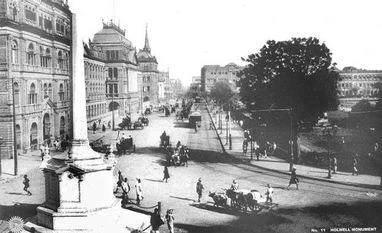 "An old photograph of the Holwell Monument and Writers' Building taken by Bourne & Shepherd")
An old photograph of the Holwell Monument and Writers’ Building taken by Bourne & Shepherd
The year is 1856. The East India Company is all set to march into Lucknow, and banish its ruler, Wajid Ali Shah, to Calcutta. Two noblemen, Mirza Sajjad Ali and Mir Roshan Ali, rakishly handsome and courteous to a fault, sneak out of the city to enjoy a quiet game of chess. There is an altercation between them and a pistol shot is fired that draws no blood. The two are ready to kill over a game of chess, yet they lift not a finger to defend Lucknow.
As the two realise how their debauchery has emasculated them, the credit begins to roll for Satyajit Ray's 1977 masterpiece Shatranj Ke Khiladi, based on a short story by Munshi Premchand, where Mirza Sajjad Ali is played by Sanjeev Kumar and Mir Roshan by Saeed Jaffrey - the last name to appear on the screen is Bourne & Shepherd.
The kurtas, where the chest is outlined by a piping, worn by Kumar and Jaffrey were referenced by Ray from some old photos at Bourne & Shepherd.
"Ray visited the studio three times: for Shatranj Ke Khiladi, Charulata (1964) and Goopy Gyne Bagha Byne (1969). He had an eye for detail and would spend hours going through old photographs. He was interested in the costumes of the time," recalls Jayant Gandhi, one of the current owners of Bourne & Shepherd.
In his trademark baritone, Ray asked Gandhi to send him the bill for the hours he spent at the studio digesting every bit of history that he could capture from its iconic photographs. Gandhi realised it would make more sense to ask for acknowledgement. That's how the name Bourne & Shepherd made it to the credit list of Shatranj Ke Khiladi.
Ray had a special connection with Bourne & Shepherd. "I got a call when news of the fire (which destroyed the studio's archives) broke in 1991 from Manikda (Ray). He asked me to rush to the spot. When I saw the ravaged sight, I broke down. They had an excellent colour lab and we would get all our colour prints done from Bourne & Shepherd," narrates Nemai Ghosh, Ray's unofficial photographer.
An old photograph of the Holwell Monument and Writers’ Building taken by Bourne & Shepherd
Ghosh remembers how two colour prints of Ray's Ghare Baire (1984) made it to the office of the Cannes Film Festival. "One was of Soumitra Chatterjee and Swatilekha Sengupta and the other featured Victor Banerjee and Swatilekha," he says. Both the prints were developed at the Bourne & Shepherd studio on SN Banerjee Road in Kolkata.
Bourne & Shepherd became the window to history for many film directors and novelists and is intrinsically linked to their works. In the late-1960s, Bengali novelist and poet Sunil Gangopadhyay spent a significant amount of time at the studio to recreate the period of Bengal Renaissance for his epic novel, Sei Samay.
What made it possible was its treasure trove of photographs dating back to the 19th century: black-and-white prints of sahibs and memsahibs, royalty and commoners, monuments and streets.
The first Bourne & Shepherd studio was set up in Shimla in 1863; in a year's time, the Calcutta studio also became operational.
It all started when Samuel Bourne, an amateur but promising photographer, came to India from England; he was joined by Charles Shepherd, a well-established photographer in India, and Bourne & Shepherd came into being.
Its body of work was monumental as its photographers chronicled the rise and fall of the Raj. The Bourne & Shepherd page on indiabooks.co.uk says that the studio documented the Delhi Durbars in 1877, 1903 and 1911, producing a range of images of the ceremonies and portraits of the participating Viceroys and Governors.
Everyone who was anyone in British India had their portrait done by Bourne & Shepherd. Such was its fame that most people wouldn't mind the journey to its studio to get clicked.
And if the British could patronise it, how could the Indian nobility be left behind? The list of Bourne & Shepherd's India customers was no less illustrious: from Rabindranath Tagore who was a frequenter of sorts to writer, painter and composer Upendra Kishore Roy Chowdhury (Satyajit Ray's grandfather) and much later Bengali novelist Sarat Chandra Chattopadhyay.
The most iconic of these photographs was the one of Sri Ramakrishna Paramhansa shortly before he died: it had a halo around his head. The story goes that the halo was caused by an accident when one of the hands at the studio dropped the glass plate and caused it to crack.
Gandhi affirms that he too has heard the story but is unaware of its authenticity. Lean and with a full mop of grey hair on his head, Gandhi, 72, is unassuming: his tall frame appears tired from fighting a long battle to keep a rich heritage alive. The owner of the world's oldest studio doesn't want his pictures taken.
Indiabooks says that the studio in Shimla was closed in 1910 and the entire business of Bourne & Shepherd moved to a new studio in Calcutta. A series of ownership changes followed: Arthur Musselwhite took over in 1930; then the partnership of William Walker, Varjiban Jaitha and SJ Suraiya ran it from 1955 till 1957 when it was bought by Qimat Rai Jindal; finally, the current owners, KJ Ajmera and Gandhi, took charge in 1964.
Business in those days was good. "We started with black and white work and later switched to colour. We would also shoot short films for advertising agencies like Clarion and J Walter Thompson," says Gandhi.
The photograph of AAK Niazi (centre) signing the instrument of surrender in 1971 was printed by Bourne & Shepherd
Bourne & Shepherd played a role in documenting modern Indian history as well. In 1971, when Pakistan surrendered to India at Dhaka, the famous photograph that went to the press, in which AAK Niazi signs the instrument of surrender in the presence of Jagjit Singh Aurora, was processed and printed by Bourne & Shepherd.
"I got a call from the army officer who had taken the photograph and immediately had it picked up by my man from Bhawanipur. We opened the studio and around 200 copies that went to the press were printed at midnight," says Gandhi.
Today, Bourne & Shepherd is a sad relic of a glorious past. The Gothic heritage building looks straight out of a horror flick: unkempt and broken. Mostly deserted, the burnt clay bricks on the building, ironically with Photographe written on them, stare you on the face.
The soul of the studio died in the wee hours 25 years ago when a fire caused by a short circuit destroyed many of its iconic photographs. "It was the time of the Kuwait War and there was a strike in Kolkata," Gandhi recalls.
A historic photograph of the Howrah Station taken by Bourne & Shepherd
History captured by Bourne & Shepherd was kept in an iron safe. "That safe was completely burnt. The glass plates in the safe were a pile of ruin when we opened it," Gandhi says. With it went the photograph of Sri Ramakrishna, many portraits of Tagore and lots more.
The fire shrunk the studio by 1,500 square feet - an entire floor was ravaged. In a way, the fire marked the beginning of the end for Bourne & Shepherd.
"The digital slow poisoning started from 2000. The smartphone had a share in the decline of the business too. Sharing photographs is important, not printing. Who prints photographs these days," Gandhi says matter-of-factly.
"Bengalis had a love for clicking portraits. Earlier, parents would come with daughters to get their photographs clicked for getting them married. Then they would come after the wedding to get a photograph done for keepsake. None of these things are relevant today," he adds.
The only business that Bourne & Shepherd was left with was printing photographs for passports: mechanical click, print and cut job.
What compounded the problems was the rent demanded by Life Insurance Corporation which owns the building where the studio is housed. "The rent LIC is asking for works out to around Rs 3 lakh a month," Gandhi says.
Bourne & Shepherd has been fighting it in the courts for the last 14 years. The final blow came after it lost in the Supreme Court recently. The curtains finally came down on the studio last week.
An old camera with Gandhi, possibly Samuel Bourne's, is testimony to a studio of a different era. "It's a typical studio camera from the late 19th century that used glass plates and later dry plates," says Aditya Arya, known for collecting, curating and archiving rare collections of photographs through the India Photo Archive Foundation.
Arya is currently building a museum dedicated to camera and photography history called the Museo Camera, Centre of Photography, in collaboration with the Municipal Corporation of Gurgaon, spread over some 15,000 square feet.
He has offered space in the museum to Gandhi for showcasing his collection of historical photographs, whatever is left from the fire.
Gandhi hasn't made up his mind yet and wants to put all the court cases behind him first. But does he have enough photographs to create his own archive? "We have quite a bit, though it may not be enough to create a museum or make our own archives," Gandhi says.
Gandhi may or may not have all the photographs but Ranu Roychoudhuri, a historian of photography, says the British Library in London has a sizeable collection of Bourne & Shepherd's work.
That's hardly surprising: Britain, after all, is the custodian of global history. As British comedian John Oliver said when the demand to return the Koh-i-noor was made late last year, "the entire British Museum is an active crime scene".
Back home, Gandhi shows a personalised mug that has the photograph of the decrepit Bourne & Shepherd building embossed on it. That could be replaced by some of the iconic photographs still left with Bourne and Shepherd as Gandhi contemplates monetising it one day.

Don't miss the most important news and views of the day. Get them on our Telegram channel
First Published: Jun 25 2016 | 12:30 AM IST