


Insurance Gazette: What lies ahead of insurers in post-pandemic world
Having emerged from the pandemic largely unscathed, the sector is set to benefit from an unprecedented pick-up in demand. Where it goes from here, however, depends on its ability to innovate
 "Insurance")
premium
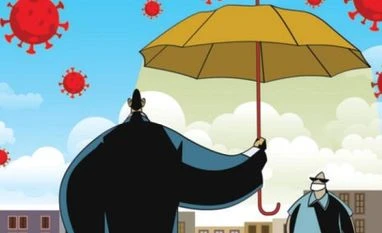
Illustration: Binay Sinha
7 min read Last Updated : Dec 14 2021 | 6:10 AM IST


"Never let a good crisis go to waste", they say, and, perhaps, the Indian insurance industry might not want to let go of the opportunity that the pandemic has presented to it on a platter. While insurers have struggled with huge unanticipated Covid-related claims over the past 18 months, the pandemic has also heightened awareness around risk to both life and health. Consequently, for the first time in the history, insurers have not had to push their products aggressively, as there is an underlying demand for insurance products in the current market.
Having said that, industry insiders are of the opinion that despite the opportunity at hand, it is up to the insurers how they capitalise on this demand and transform their businesses to cater to the ever-evolving needs of the customers. If the industry rests on its laurels, the opportunity might go begging.
Experts also reckon that the industry may have come out of the pandemic better-than-anticipated, but it surely has dealt some body blows to the capital-intensive (capital guzzling) sector. The large companies, backed by big banks, finance companies, or corporates, have managed to sustain healthy solvency levels, despite suffering huge losses. But, the smaller companies, both in the life and non-life industry, have seen some merger and acquisition activities in the past few months.
Among two big deals are ICICI Lombard’s acquisition of Bharti Axa General Insurance for over Rs 2,500 crore and HDFC Life’s acquisition of Exide Life in a deal worth Rs 6,687 crore, which shows that bigger players are looking at inorganic growth to increase their share of the pie. Besides, Axis Bank and its subsidiaries, too, have taken a 13 per cent stake in Max Life Insurance, with an option to raise it to a fifth.
The government’s decision to increase foreign direct investment in the insurance sector to 74 per cent also suggests that there could be more equity changing hands going ahead.
Consolidation may gather steam
Mounting claims, rising costs and the need to grow have led to an increasing need for capital. Industry estimates peg Covid-related claims for non-life insurers at over Rs 25,000 crore since the beginning of the pandemic, and over Rs 14,000 crore for life insurers.
But, more than this, the insurance industry is attracting a lot of interest due to the huge opportunity it presents because of the significantly under-penetrated Indian market. Apart from banks, financial institutions and corporates, the sector is seeing interest from a number of private equity firms.
Experts have indicated that the merger and acquisition activities are expected to go up in the near future, though the reason for consolidation could vary.
Nilesh Sathe, former Irdai member, said, "The consolidation taking place in the industry may not be a consequence of the pandemic. The solvency levels of the companies were not seen to be impacted to such an extent that the promoters had to pump in additional capital which they found difficult and hence thought of exiting.
Mergers and acquisitions are more of a strategic decision. Some promoters may have felt the need to exit the insurance sector in order to unlock their capital."
"The industry is dominated by a few players that have a strong backing of banks. If they desire to grow inorganically and the promoters have capital to do so, more acquisitions will happen," Sathe said.
Ashvin Parekh, managing director (MD), Ashvin Parekh Advisory Services, also believes that there will be further consolidation in the industry. "Unlike banking, in insurance, there was no restriction on the entry of corporates but what needs to be understood is that corporates go through a business cycle and when the corporates are going through a tough period, they will always look to sell off their non-core assets."
According to Parekh, both the life and general insurance industry has seven to eight top players, who control almost 70 per cent of the private insurance market. Then the remaining eight or so players are fighting for the rest of the market. Pre–pandemic, the smaller players had a false sense of hope that they may get valuations in the range of what the larger players got, during their listing. But, post-pandemic, that has changed.
"So, we will see more and more consolidation take place because the expectations have rationalised and there is a price discovery in the market. Also, a few of the promoters have realised that this is the best time to get out, if they want to. Hence, perhaps, in the long term, we will end up with 10 – 12 private companies in each of the sectors — life and non-life," he added.
Industry leaders, too, are seeing a move towards consolidation in the sector in the medium term.
"We are seeing two trends. One is the natural tendency of migration of value towards four-five companies. At the same time, right now we are seeing a lot of interest in the sector. There is a lot of capital that is coming in. There are changes in the shareholders in some of the companies and that is preventing the consolidation in the sector at a pace it could have happened otherwise," Bhargav Dasgupta, MD & chief executive officer (CEO), ICICI Lombard, had said in an interview to Business Standard earlier.
In the medium term, I still believe it will be a consolidation story, moving to four-five players who will deliver more value, adds Dasgupta.
Opportunity of a lifetime
The industry has always lamented that insurance is a "push" product, but the pandemic has changed this perception considering that the demand for pure risk products such as health insurance and term insurance has shot up.
For instance, health insurance has become the largest business segment for non-life insurers, dethroning motor insurance from the top position. Also, within health, it is the retail segment that is driving growth. Surprisingly, more and more people are not just buying insurance but they are also enhancing coverage (sum insured). Similarly, in life, most insurers were happy to sell unit-linked products, but after the pandemic, term insurance has hogged all the limelight. For once, according to experts, people are buying insurance not as a savings/tax-saving product, but as a pure risk product.
Although a few claim that much of the euphoric demand for insurance products was because of the initial fear of the pandemic, experts suggest that even if the fear subsides, the demand for pure risk products may continue, thus providing insurers with a huge opportunity in a highly under–penetrated market.
But, in order to capitalise on the opportunity, insurers have to recalibrate their business models, bring about innovation in their products, use technology efficiently to improve services, reach out to country’s under–insured regions, build awareness, and customise services according to consumer needs. They have to go beyond covering risks, and actively participate in the risk mitigation process of the consumer as well.
"Thanks to the enhanced awareness of life insurance, it is imperative for all insurers to build scale to manage larger business volumes. Instant and automated issuance of policies without manual underwriting and intervention using AI and fraud prediction models to prevent anti-selection will enable rapid scaling up of business without compromising on the quality of the portfolio," said Rushabh Gandhi, deputy CEO, IndiaFirst Life Insurance.
The pandemic has revolutionised the industry, with greater demand coming in from the semi-urban and rural region. When catering to these segments, the average ticket size of the insurance product will go down and the cost of physically reaching out to these customers will rise. Insurers can tap this challenging market potential by adoption of digitalisation and automation, including a completely digital customer onboarding process, says Gandhi.
According to Vibha Padalkar, MD & CEO, HDFC Life, this is an inflexion point but it is up to the insurers on what they want to do. "We should not waste a pandemic; innovation is key. If we rest on our laurels to say that as an industry we have come through this relatively unscathed, I think we would lose this opportunity," she said at Business Standard’s BFSI panel on Life insurance.