


Gas EGoM to finally meet
The ministry of petroleum and natural gas is likely to inform the EGoM that the current production level is not even sufficient to meet the core sector allocation
)
After 15 months of being non-functional, the empowered group of ministers (EGoM) on natural gas is likely to meet shortly, with re-prioritisation of consumers one of the main items on the agenda. Though a decision on a revision of natural gas pricing was expected to also be a focus of the meeting, officials said the contentious issues were not confined to pricing.
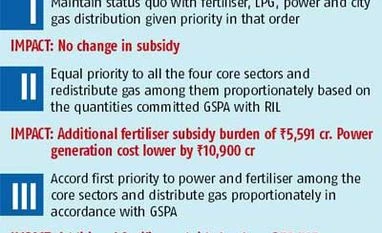
The exercise could see an additional subsidy burden of Rs 5,591 crore annually on account of imported gas-based urea production, since supply to power and city gas distribution sectors would increase at the cost of fertiliser and liquefied petroleum gas (LPG, or cooking gas).
Besides, the EGoM is likely to consider the ministry of power’s recommendation to allow natural gas supply to GMR’s Tanir Bawi power plant in Andhra Pradesh. In its meeting last year, it had instructed that gas allocation to the company be cancelled if it did not sign long-term power purchase agreements (PPAs) for seven years. “Such PPAs require gas sales and purchase agreements (GSPAs) for more than seven years, though a GSPA with RIL (Reliance Industries) is ending March 2014,” said an official.
With the power and fertiliser sectors clamouring for a higher share in the shrunk natural gas pie, the ministry of petroleum and natural gas is likely to go to the EGoM, proposing three scenarios on allocation priority. The options include maintaining the status quo, where fertiliser, LPG, power and city gas distribution are, in that order, given priority as part of the core sector. Under the current policy, fertiliser is given priority among the four core sectors in allocation of gas, since the government subsidy for this sector is linked to the cost of production.
An option is to accord equal priority to all the four core sectors and redistribute gas among these proportionately, based on the quantities committed under the GSPA signed with RIL. Another would be to accord first priority to power and fertiliser among the core sectors and distribute gas proportionately in accordance with the GSPA.
The government has since 2009 allowed firm allocation of 63 million standard cubic metres a day (mscmd) of gas, of which RIL had signed a GSPA with customers for almost 60 mscmd. According to official figures, the gas availability from RIL’ss KG-D6 block has reduced to around 15 mscmd from 35 mscmd in February 2012, when the previous EGoM meeting took place, with Jaipal Reddy as petroleum minister.
The exercise could see an additional subsidy burden of Rs 5,591 crore annually on account of imported gas-based urea production, since supply to power and city gas distribution sectors would increase at the cost of fertiliser and liquefied petroleum gas (LPG, or cooking gas).
Besides, the EGoM is likely to consider the ministry of power’s recommendation to allow natural gas supply to GMR’s Tanir Bawi power plant in Andhra Pradesh. In its meeting last year, it had instructed that gas allocation to the company be cancelled if it did not sign long-term power purchase agreements (PPAs) for seven years. “Such PPAs require gas sales and purchase agreements (GSPAs) for more than seven years, though a GSPA with RIL (Reliance Industries) is ending March 2014,” said an official.
With the power and fertiliser sectors clamouring for a higher share in the shrunk natural gas pie, the ministry of petroleum and natural gas is likely to go to the EGoM, proposing three scenarios on allocation priority. The options include maintaining the status quo, where fertiliser, LPG, power and city gas distribution are, in that order, given priority as part of the core sector. Under the current policy, fertiliser is given priority among the four core sectors in allocation of gas, since the government subsidy for this sector is linked to the cost of production.
An option is to accord equal priority to all the four core sectors and redistribute gas among these proportionately, based on the quantities committed under the GSPA signed with RIL. Another would be to accord first priority to power and fertiliser among the core sectors and distribute gas proportionately in accordance with the GSPA.
The government has since 2009 allowed firm allocation of 63 million standard cubic metres a day (mscmd) of gas, of which RIL had signed a GSPA with customers for almost 60 mscmd. According to official figures, the gas availability from RIL’ss KG-D6 block has reduced to around 15 mscmd from 35 mscmd in February 2012, when the previous EGoM meeting took place, with Jaipal Reddy as petroleum minister.
The ministry of petroleum and natural gas is likely to inform the EGoM that the current production level is not even sufficient to meet the core sector allocation of 52 mscmd.
The EGoM is also likely to take a decision on the fertiliser ministry’s inability to work out guidelines to stop priority allocation at subsidised rates to Deepak Fertiliser, Gujarat State Fertiliser and Chemicals and Rashtriya Chemicals & Fertilizers, in proportion to the market-linked production of phosphatic and potassium fertiliser.
A senior government official said the EGoM meeting has not been scheduled as yet but was likely to take place this month.
A decision on the gas price formula suggested by the Rangarajan committee is also expected to be taken, though unanimity among the petroleum, finance, fertiliser and power ministries is yet to be achieved.

Don't miss the most important news and views of the day. Get them on our Telegram channel
First Published: May 13 2013 | 12:50 AM IST