JPL’s equity value works out to Rs 4.36 trillion after Facebook’s investment, making it the fifth most valuable company in the country, behind its parent Reliance Industries (RIL), Tata Consultancy Services, Hindustan Unilever, and HDFC Bank.
Considering the market value of RIL and JPL, the Street is valuing RIL’s remaining but core businesses of refining and petrochemicals and others such as retail at a lesser number of Rs 4.28 trillion. This makes JPL more valuable than the rest of RIL.
JPL, a fully-owned subsidiary of Reliance Industries Ltd, houses many digital platforms like Jio Saavn and Radisys, besides the biggest disruptor in the Indian telecom scene, Jio.
As part of the deal, Facebook will get a board seat in JPL and an observer seat without voting powers. At a concall, a couple of hours after the news broke, Facebook India CEO Ajit Mohan said, “the very fact that we are announcing the deal during Covid-19 is a reflection of our commitment to invest in the country.’’
However, both sides made it clear that they will continue to compete in many areas where they have their own digital products. For instance, while Jio Pay is already operational, Facebook is awaiting permission for its digital payment platform. Also, Reliance has Jio Chat, which competes with WhatsApp directly.
“We will collaborate, not integrate. And in some areas, we will also compete as we have our own product lines. The deal is also not exclusive,” said Anshuman Thakur, head of strategy at Reliance Jio. He also pointed out that Jio or JPL could go public, but only in the medium term, in about three to four years.
What is being termed by analysts as a ‘win-win deal’, is expected to help the Reliance group not only to reduce its debt but to collaborate with the tech giant in areas including e-commerce and enterprise solutions for small and medium enterprises. RIL shares jumped 10.3 per cent, to close at Rs 1363.35 on the BSE.
The transaction could possibly help Facebook find new ways to monetise WhatsApp and make a dent in the enterprise business where its competitors like Amazon and Google are ahead. A stake in JPL is also likely to give it a strong toehold in the digital sweepstakes in India where it competes with the big boys like Google. Facebook India Online Services revenues were at Rs 892 crore in FY19 against Google India’s Rs 4,147 crore.
Big businesses have supported the deal in the midst of the pandemic crisis. Says Anand Mahindra, chairman of Mahindra & Mahindra, said the deal was good not just for the two of them. Coming during the virus crisis, it’s a strong signal of India’s economic importance, according to Mahindra.
"It strengthens the hypothesis that the world will pivot to India as a new growth epicentre,’’ he pointed out. Harsh Goenka, chairman, RPG Enterprises, called the deal a great confidence booster for India, India Inc and for Reliance.
On the other hand, US citizens were not happy with the deal, questioning why Facebook hadn’t taken similar initiatives for US-based small businesses. Some in India questioned the privacy repercussions of the deal too.
Others though backed the timing of the deal. Sanchit Vir Gogia, founder and chief analyst at Greyhound Research, said the deal could not have come at a better time as post Covid-19 advertising, which is the main source of revenue, is going to take a hit.


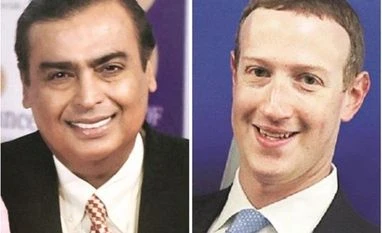 "Mark Zuckerberg, Mukesh Ambani")