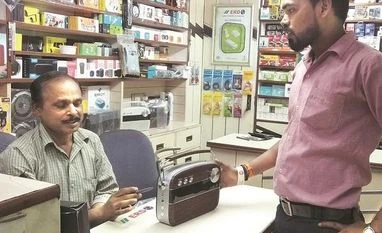
The first task has been accomplished: When Saregama introduced Carvaan in end 2017, the recording industry, hit by rampant music piracy and falling music sales, was going through a terrible time. Music cards and paid online downloads were still very small and couldn’t do much to lift the mood. In came Carvaan, an easy-to-operate alternative, and the prerecorded music boxes started flying off the shelves. Last December, Carvaan sales breached the 1 million mark and the company has been aggressively adding new retail touch points since then.
But now comes the more difficult part: Keeping the momentum going by improving the device’s desirability and increasing the footprint and availability. Saregama India says sales in the towns beyond the Top 10 cities will now hold the key. From adding product features based on feedback from these centres to pushing the distribution through innovative channels, the company is trying all the permutations and combinations to build on the early gains.
Vikram Mehra, managing director, Saregama India, says going to smaller towns is a natural progression for the brand. The company has stepped up efforts in these markets in the last four months. In this period, Mehra adds, the share of sales from smaller cities and towns has jumped from 36 per cent to 43 per cent. This phase, he says, will also pave the way for deepening of the device’s footprint into more remote areas at a later stage.
Mehra identifies simplicity as the chief selling point for Carvaan. The battery back-up of six to seven hours would be make or break in any new market, he adds. “If it was digital marketing in the beginning when it was launched in the bigger cities, word of mouth publicity will create interest and propel sales in smaller markets.” The company is demonstrating the product at marketplaces and other high-traffic venues through outdoor promotional activities. Mobile handset and consumer electronics shops would be the main outlets in these markets, unlike in the bigger cities where it sells a substantial chunk through gift shops.
The product itself has been tweaked. Mehra says the addition of FM and medium wave radio in the device was also done keeping the listener in the smaller towns in mind. “Bigger cities never asked for it. There, people mostly focused on the convenience of the device, but in smaller towns, we first went with the FM feature and then added the medium wave because we realised that there were people who wanted their device to double up as their transistor,” he adds.
Similarly, he adds, the USB slot feature — which allowed the same device to play music other than the preloaded ones — was also added as it was seen as a small-town requirement. “And we improved the bass of our Carvaan Mini because the feedback from the smaller towns was that the people there wanted it to be used as a Bluetooth speaker as well.”
Pricing of the product isn’t a perceivable hindrance. The product, which started its life as a box with preloaded old Bollywood songs, now offers two more versions. The original Carvaan music player costs around Rs 6,000; the two variants introduced later are the Carvaan Mini (Rs 2,500) and the Carvaan Go (Rs 4,000). Mehra says the value proposition that a consumer looks at for the money she is paying is different for different areas. The two later variants are important planks of its diversification strategy. “This gives us a pool of 27 million homes for the Rs 6,000 Carvaan. The moment I take the price point to Rs 2,500 or Rs 4,000, the net only widens.”
The company is not bothered about the penetration of smartphones and the improved data connectivity in smaller towns and villages that has turned handheld phones into mini entertainment units for users in these places. Mehra says Carvaan is primarily for the consumer who wants to sit back, relax and enjoy music without taking the trouble of changing the song every now and then. “So I choose my artiste, say a Mohammad Rafi, and let the music play. An analogy can be the customer who is looking for a cup of coffee and doesn’t want to answer whether he wants a cappuccino or a latte, with sugar or without... And this is across the urban-rural divide.”
What has encouraged the company to move to a higher gear is the potential of the Indian market. The average internet user in the country spends 21.5 hours every week listening to music. However, veteran radio presenter Yunus Khan from Vividh Bharti, who has decades of experience catering to audience requests on music-based programmes, says Bollywood songs from the yesteryears (the “software” of the Carvaan device) have seen some decline in popularity in recent years. “That said, they reflect different moods an individual can connect with which extends their appeal beyond pure nostalgia,” he adds.
Mehra acknowledges diverse content is important in India. The company started with Hindi and as it moved beyond the metros, it launched the Tamil, Punjabi, Marathi and Bangla Carvaan; the Carvaan Mini later added Kannada and Telugu to the mix.
Last week, it also launched a Bhagwad Gita Carvaan, a Gurbani Carvaan and a Hindu devotional Carvaan. “So if someone is looking for a specific kind of music for the kitchen or the pooja room, we have an offering there too,” he says, hinting the company is looking to sell more than one device per household, if possible.

)