


Solar equipment makers keen on export
Global demand grows and a home market turns competitive on the rates front
 "Solar")
premium
Solar
Last Updated : Jul 10 2017 | 1:51 AM IST
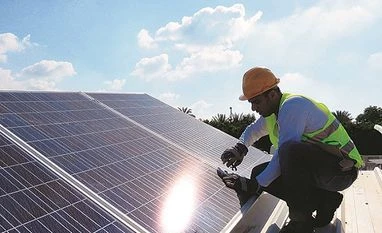
Solar energy equipment manufacturers in the country are increasingly looking at the export market, with the domestic ones having capacity constraints and a dependence on imports.
Most have steered clear of venturing into China, the world’s largest market in the segment. However, they are exploring elsewhere — Latin America, West Asia, Africa and Japan have all seen Indian manufacturers raising their presence.
Sterling And Wilson, for instance, is implementing the world’s largest single-location solar photovoltaic (PV) plant in Abu Dhabi, of 1,177 Mw capacity, both construction and maintenance . A Shapoorji Pallonji subsidiary, it is now looking to expand in North America. It started looking at exports after 2010 and has a presence in Asia, Africa, Australia, Europe and Latin America.
“With developments on global front, primarily driven by the Paris Agreement (on climate change), nations are setting renewable energy (RE) targets to reduce their carbon footprint. Coupled with the reduction in tariffs (rates), solar has become pivotal to transition towards a future of sustainable and renewable energy. We see international orders to constitute 80 per cent of our cumulative order book, on a sustainable basis, in the foreseeable future,” said Bikesh Ogra, president and chief executive of its RE segment.
KEC International plans to foray into the solar fabrication export market. The company plans to target Saudi Arabia, (UAE and others in West Africa and the Southeast Asian region for these projects, it said in April this year.
The rationale for export markets vary — looking at higher margins, emerging as a global brand or derisking the business through multiple-country exposure.
“Expanding to export markets helps derisk the business, as solar is a policy driven sector,” said Nimish Jain, head of global sales at Vikram Solar, which also aims at export expansion. At present, 30 per cent of their orders are through export and, “we plan to increase this ratio to 60:40 this year”. They supply solar panels.
In India, solar energy rates have been on a downward trend, with bids touching Rs 2.44 a unit in May, it’s lowest ever. According to industry officials, this trend of aggressive bidding has put the margins for equipment supply in India under pressure.
The 2017 Edition of the REN21 Renewables Global Status Report listed China, America, Japan, India and Britain as the top five in terms of annual investments being made in solar PV capacities.
In fact, solar PV now accounts for more additional capacity, net of decommissioning, than any other power generating technology. In 2016, it was 47 per cent of newly installed RE capacity; wind energy and hydro power accounted for most of the remainder, at 34 per cent and 15.5 per cent, respectively.
According to the report, the number of countries with RE policy targets rose from 173 in 2015 to 176 in 2016, with solar PV the world’s leading source of additional power generating capacity. Overall global capacity of solar PV rose to 303 Gw in 2016 from 228 Gw in 2015.