


Home / India News / Innovation or gimmickry - what defines molecular gastronomy in India?
Innovation or gimmickry - what defines molecular gastronomy in India?
Molecular gastronomy remains a complex - and sometimes dangerous and misunderstood - science
 "graph")
premium
graph
Last Updated : Jul 28 2017 | 11:34 PM IST
A colourless liquid created by two Polish physicists at Jagiellonian University on April 15, 1883. A cocktail that is often linked to the name of a bartender who first concocted it at New York’s Knickerbocker Hotel around 1912. And, an 1890 recipe book titled Fancy Ices, authored by one Agnes Marshall.
Apart from the obscure coincidence that involves American businessman John Jacob Astor IV, who built the Knickerbocker Hotel and perished when the Titanic sank on the morning of April 15, 1912, if you bring the three abovementioned things together, you get a dash of modern molecular gastronomy: a martini infused with liquid nitrogen.
While the elements that helped string together the outlandish notion of molecular gastronomy are more than 100 years old, the perils attached to them are more recent. If you don’t quaff your drink just right, you can find yourself in hospital, as a man in New Delhi recently discovered. Guzzling his cocktail before the smoke generated by the chemical could fully evaporate, the unwitting visitor developed a hole in his stomach. Liquid nitrogen is highly combustible: it expands more than 500 times when it goes from liquid to gas, and when inhaled, can explode in the gut.
To the unknowing food consumer, despite it being in existence for some years now, molecular gastronomy remains a complex — and sometimes dangerous and misunderstood — science. For most, its use of carbon dioxide and various hydrocolloids, and a finicky fixation with texture traits such as viscosity and surface tension, is more confounding than enchanting. Its true allure, as some will concede, lies elsewhere. Often, it gives rise to optical theatrics that are greeted with breathtaking applause from a dumbstruck audience.
What American food scientist Harold McGee introduced in his 1984 book, On Food and Cooking: The Science and Lore of the Kitchen, and Heston Blumenthal and Ferran Adrià artfully mastered at their respective restaurants, The Fat Duck and El Bulli, now commands the Indian food scene like never before. A little over five years ago, Gaggan, the eponymous restaurant run by Gaggan Anand in Bangkok, was one of the few Indian restaurants using molecular gastronomy. That number has swelled drastically in the past couple of years.
In several Indian restaurants, for instance, it’s nearly impossible to find a dish these days that doesn’t come with a layer of foam, or a sphere. Desserts surrounded with liquid nitrogen foam, doughnuts with syringes stuck in them, deconstructed coffees (what does that even mean?), fruit sphericals with sodium alginate, ethereal ice creams — the menus read more like a list of science experiments.
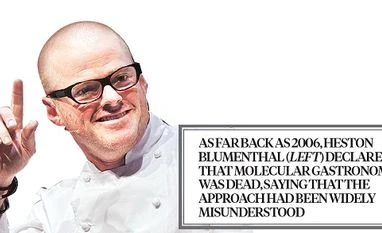
However, the mindless use of such smoke-and-mirror effect, all in the name of innovation, ceased to impress the pioneers a long time ago. In 2006, Blumenthal, Adrià, McGee, and American chef Thomas Keller declared that molecular gastronomy was dead. “We feel that this approach has been widely misunderstood, both outside and inside our profession. We do not pursue novelty for its own sake,” they wrote. The new idea that they proposed was to wean the diner away from hypnotic visuals of fancy garnishes and bring the spotlight back on to the craft of fine cooking. Their style, based on openness, excellence and integrity, was now defined as modernist and avant-garde.
“The term ‘molecular gastronomy’ is a bit of misnomer; that’s why we don’t use it,” says Josh Hermias, head chef at minibar by José Andrés, a two Michelin-starred restaurant in Washington “We always put our guests before our own curiosities. But techniques are simply the best way to best showcase or elevate an ingredient or an idea.”
But India, even after all these years, is still clutching on to the illusions of molecular gastronomy.
Manu Chandra, executive chef at Bengaluru’s Olive Beach, feels that there is a marketing reason behind that. “It sells,” he says. “It started as a science experiment by a couple of food scientists to help people cook better at home. Then some chefs usurped the idea and used it to create illusions and deception.”
To perform intricate experiments, you require sophisticated science labs, a role now increasingly being performed by kitchens. For instance, at restaurants such as Masala Library by Jiggs Kalra — run by Zorawar Kalra’s Massive Restaurants — some of the favourites include thandai served as a bubble on a ceramic spoon with saffron milk, and the wild mushroom chai — a mushroom consommé (dehydrated mushrooms and truffle oil crumbs) presented like an English tea service. Kalra has managed to make use of these techniques in a safe and responsible way.
But in a somewhat rigid, traditionalist food nation like ours, molecular gastronomy’s intended benefits have often been misplaced — and the necessity of its very use has come under scrutiny. Well-intentioned, purposeful innovation has perhaps been replaced by inessential, visual gimmickry. “In an ideal sense, molecular gastronomy involves understanding the physical and chemical nature of food, so the visual impact is just a small part of it,” says Wasim Mohideen, the man behind the blog, Chennai Foody. “But unfortunately, a lot of chefs have just stuck to the gimmickry and forgotten all about the concept’s value.”
Chandra is not a critic of the techniques but of the ways in which they are being used. “One needs to ask oneself if the passion fruit caviar is relevant to the dish or is it on the plate just to show that you can do this, too.”
Moreover, it remains unclear if Indian cuisine, which relies on age-old traditions and is already high on complexity and technique, really benefits from the principles of molecular gastronomy. “Whichever be the cuisine, one has to create different sensorial perceptions. And, one has to evolve by using new techniques,” says chef Sanjeev Kapoor. He cites the example of the sizzler, which first wowed the Indian diner through its sound and smell some 30 years ago. But it had a functional benefit as well: the hot plate kept the food warm, keeping in line with the preference of the Indian diner.
Three years ago, Nandini Maheshwari, a banker in Mumbai, made her way down to a five-star hotel to celebrate her 25th birthday. After shelling out a hefty amount as cover charge, Maheshwari was pressed into trying one of the free cocktails on offer: a flaming Sambuca shooter. Soon, a seemingly pleasant evening took a dreadful turn. For starters, with the straw crumbling every few seconds because of the flame, she had to use about five of them just to take a couple of swigs. Once she had finally gulped it, a torrent of uneasiness took over — a choking, burning sensation.
“Sambuca, in its normal form, has a lovely taste. The science didn’t add anything to it. Plus, it left me breathless,” she recalls.
In a way, Maheshwari’s experience underscores some restaurant patrons’ preference: food need not always be complicated; simple can do the job. Most of them, like 32-year-old Siddharth Soni, deeply cherish a plate of food cooked with heart. “If your flavours pack a punch, nothing else is needed,” he says.
Besides, no one wants to put his or her life at risk over a zany food creation or a futuristic cocktail. The recent incident of a man ending up in hospital because of it isn’t unique. In 2012, an English teenager had to have a part of her stomach removed after an attempt at molecular mixology went wrong. In another instance, a chef recalls a molecular food counter at a wedding buffet, where people were mindlessly mixing dry ice with the ingredients in a blender.
“What we need is better knowledge. Instructions for consumption need to be passed on accurately,” says Hemant Mundkur, lead trainer at Diageo Bar Academy. Mostly, bartenders, servers — and even some chefs — at restaurants are inadequately trained in preventing mishaps.
Delhi’s International Institute of Culinary Arts is trying to buck that trend. The bare basics of its molecular gastronomy curriculum comprise ensuring that all safety-related measures are covered and practised. “The first thing is to make certain that the proportion of chemicals is right and they are used to a bare minimum,” says Arjun Datta, the institute’s chief operating officer. He adds that when compared with the West, our knowledge of such cooking is still limited.
“Something like liquid nitrogen is akin to puffer fish. You need a certification from a sushi master in order to be able to use the latter. It must be the same with liquid nitrogen,” says chef Thiru K, vice-principal of Manipal-based Welcomgroup Graduate School of Hotel Administration. Filleting and cooking fugu, or puffer fish, requires chefs to undertake training that lasts several years, for even a tiny mistake can be lethal: it contains a neurotoxin 1,000 times more powerful than potassium cyanide.
Despite the vilification, food industry insiders do not hesitate to acknowledge the positive alterations the molecular movement has spawned. Even though in India this is seen in a superficial way, the movement has resulted in new techniques and equipment, feels Abhijit Saha, founding director and chef of Avant Garde Hospitality, which operates Caperberry and Fava in Bengaluru and Saha in Singapore. So while a decade ago, cooking was all about braising, roasting, boiling and steaming, now chefs have sous-vide gelification, powderising and dehydration in their arsenal. Sous-vide, for one, has emerged as a popular technique as it retains the juices and prevents the meat from drying. Most critics say that if done right, molecular gastronomy has the potential to seduce. Mohideen, for example, reminisces devouring a strawberry dessert at two extreme temperatures, and describes it as hugely memorable.
“You taste food through your nose, which can sense 1,800 flavours. When you have such knowledge at your disposal, you can make the food aromatic by knowing which spice and herb to combine with which technique,” says Saha.
As for liquid nitrogen, he points out how it enables low temperature cooking, thereby adding a crispy texture to the dish. It can also freeze drinks without diluting them. Chandra, meanwhile, employs relevant modernist techniques: using transglutaminase to bind a chicken roulade with skin, for example. Then there are tiny purees of mozzarella and milk that are submerged in a sodium chloride solution and then rinsed. This gives them a thicker form and shape.
Despite these advancements, India has only half-embraced molecular gastronomy, a trend that is reflected by a range of equipment being used internationally, but which is still to find a place in Indian kitchens.
Dhruv Oberoi, head chef, Olive Qutub, who has watched Adrià at work, talks extensively about the centrifuge, which is traditionally used in the perfume industry. “At El Bulli, people would pull out wood while foraging, put it in the centrifuge and pull the aroma out in liquid form,” he says. But these gadgets are expensive — the centrifuge costs between Rs 8 lakh and Rs 10 lakh. There is neither the space nor the audience for something like this in India.
Like most fads, molecular gastronomy will, in all likelihood, evolve or die. A meaningful transmogrification more suited to Indian culinary subtleties will help it retain its element of intrigue. Its demise would be a deterrent to an ambitious group of food experimenters, but at the same time, it wouldn’t be something wholly unwelcome. Either way, being careful while savouring a dish that is put in front of you the next time you’re at a restaurant won’t be such a bad thing.
Flaming cocktails (top) and doughnuts with syringes stuck in them have become common sights at restaurants. The former, if not consumed right, can prove to be extremely dangerous. Photos: iStock