


One mother's tireless pursuit of justice for Kashmir's disappeared
India has signed but not ratified the International Convention for the Protection of All Persons from Enforced Disappearances
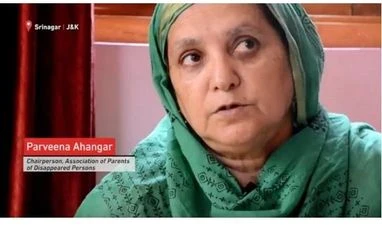 "Parveena Ahangar. Screenshot from YouTube Video by VideoVolunteers.")
Parveena Ahangar. Screenshot from YouTube Video by VideoVolunteers.
Losing a child is hard enough. But imagine not knowing where they might be and waiting for 27 years. One night in 1990, Parveena Ahangar’s 17-year-old son was captured by paramilitary personnel from Batamaloo locality of Srinagar, the capital of the Indian state of Jammu and Kashmir, on the suspicion of being a militant.
Parveena has waited ever since for some definitive news on her son's fate. And she is not alone. Unofficial estimates by human rights groups establish the figure of “disappeared people” at over 8,000. Alongside this is definitive proof of unmarked, mass graves in Kashmir holding the remains of over 7,000 people.
Muslim-majority Kashmir is geographically divided between India and Pakistan and claimed in entirety by both. Twelve million live in the Indian portion of Kashmir and many want independence. Since 1989, more than 68,000 people have been killed in sporadic uprisings and subsequent Indian military crackdowns. Today, it is the most densely militarised zone in the world, with a presence of more than half a million soldiers.
Social worker and Video Volunteers community correspondent Nadiya Shafi reported about the resistance of the parents of the disappeared, spearheaded by Parveena:
By 1994, Parveena’s dogged determination to get justice led to the formation of Association of Parents of Disappeared Persons (APDP). Parveena would travel to remote areas of rural Kashmir to seek out the families of people who had been abducted, mostly by the Indian military and paramilitary forces, never to be seen again. She commented: