


T20 squad: Suresh Raina's return to international cricket after a year
In South Africa, Raina scored 88 runs in three T20Is at average 29.33 and strike-rate 151.72
 "Suresh Raina")
premium
Suresh Raina
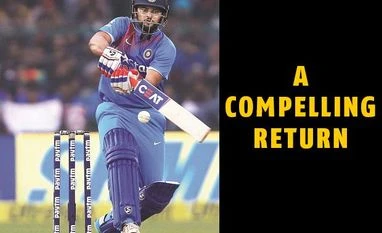
On February 18, at the Wanderers Stadium in Johannesburg, as India took on South Africa in the first of the three-match Twenty20 Internationals (T20I) series, something unusual transpired. As the attacking opening stand was broken, it wasn’t the known form of Virat Kohli walking out to bat at No 3. Much to the Bull Ring’s disappointment, Suresh Raina took strike instead, marking his return to international cricket after a year.
Kohli’s adventurism in chopping and changing team combinations as well as batting line-ups is now well documented. Even so, there was a compelling argument against this move — the star batsman averages a whopping 57.75 at No 3 in 42 T20Is. How does one consider demoting himself even if he is the captain?
This particular ploy was ushered in keeping India’s weakness in the shortest format in mind. Often, the Men in Blue come unstuck in the first six (powerplay) overs, and then are left playing catch up for the remainder of the innings. Onus then lies on Kohli to come up with a big knock, with the misfiring middle order not to be relied upon.
“In T20 cricket, the first six overs are very important and you have to attack the bowling. You have to take chances and when you decide to attack, then you have to play your shots,” Raina said mid-way during that T20I series. “Some time you get runs, at other times you don’t. But this move gave us depth in middle order and I am happy that Virat showed faith in me.”
Here, statistics jump in. In South Africa, Raina scored 88 runs in three T20Is at average 29.33 and strike-rate 151.72. The former figure argues against this change in plan — Raina averages 33.90 at No 3 in 23 T20Is (strike-rate 139.60), an impressive and acceptable return for any side in the shortest format, yet dwarfed only by Kohli’s genius. It is the latter figure that highlights how this plan succeeded and helped India win the T20I series.
The Proteas couldn’t comprehend the India top-order’s sustained attack in the first six overs. The series’ finale in Cape Town, wherein Kohli didn’t play because of a sore back, is a case in point. Despite a slow start on the two-paced Newlands’ pitch, India managed to score 172/7 in 20 overs with Raina smacking 43 off 27 balls. Even in the on-going tri-series in Sri Lanka (also featuring Bangladesh), Raina has come up with scores of 28 (27 balls) and 27 (15 balls) at No 4 and 47 (30 balls) at No 3 to help India progress to the final on Sunday.
Kohli’s adventurism in chopping and changing team combinations as well as batting line-ups is now well documented. Even so, there was a compelling argument against this move — the star batsman averages a whopping 57.75 at No 3 in 42 T20Is. How does one consider demoting himself even if he is the captain?
This particular ploy was ushered in keeping India’s weakness in the shortest format in mind. Often, the Men in Blue come unstuck in the first six (powerplay) overs, and then are left playing catch up for the remainder of the innings. Onus then lies on Kohli to come up with a big knock, with the misfiring middle order not to be relied upon.
“In T20 cricket, the first six overs are very important and you have to attack the bowling. You have to take chances and when you decide to attack, then you have to play your shots,” Raina said mid-way during that T20I series. “Some time you get runs, at other times you don’t. But this move gave us depth in middle order and I am happy that Virat showed faith in me.”
Here, statistics jump in. In South Africa, Raina scored 88 runs in three T20Is at average 29.33 and strike-rate 151.72. The former figure argues against this change in plan — Raina averages 33.90 at No 3 in 23 T20Is (strike-rate 139.60), an impressive and acceptable return for any side in the shortest format, yet dwarfed only by Kohli’s genius. It is the latter figure that highlights how this plan succeeded and helped India win the T20I series.
The Proteas couldn’t comprehend the India top-order’s sustained attack in the first six overs. The series’ finale in Cape Town, wherein Kohli didn’t play because of a sore back, is a case in point. Despite a slow start on the two-paced Newlands’ pitch, India managed to score 172/7 in 20 overs with Raina smacking 43 off 27 balls. Even in the on-going tri-series in Sri Lanka (also featuring Bangladesh), Raina has come up with scores of 28 (27 balls) and 27 (15 balls) at No 4 and 47 (30 balls) at No 3 to help India progress to the final on Sunday.
Suresh Raina