Earlier in the day, the subject expert committee (SEC) of the national drug regulator that is advising the Drug Controller General of India gave in-principle nod to SII for the Covid-19 vaccine.
Back in the ’60s, when Poonawala set up the laboratory, immuno-biologicals were in acute shortage in India and had to be imported at a high cost. Poonawalla’s initiative helped change that. So much so that in 2013, the Prince of Wales made a private visit to SII to know more about inexpensive yet high-quality vaccines manufactured in India.
Serum began its journey by taking on one of the most needed biologicals at that time, the tetanus anti-toxin. Soon, the biotech company began manufacturing several key and life-saving biologicals at affordable prices.
By 1974, SII began producing the diphtheria-tetanus-pertussis (DTP) group of vaccines, followed by a polyvalent anti-snake venom serum in 1981 and measles-mumps-rubella (MMR) in '80s and '90s.
Serum's strength is its ability to identify the market need quickly, and bring down prices of newer vaccine, which it did with Hepatitis-B (2001) and BCG (2002). And, in also launching market friendly variants of vaccines, such as the world’s only absorbed liquid HDC rabies vaccine (2004); or both the live and inactivated versions of the H1N1 Influenza — swine flu — vaccine (2010). With India on a polio-free mission, Serum also brought out an inactivated vaccine (2011) and then oral polio vaccine (2014).
In its bid to manufacture and market affordable immuno-biologicals, SII has also at times taken the inorganic route such as the acquisition in 2012. Making its first international acquisition, Serum took over Netherlands-based Bilthoven Biologicals that gave access to technology and expertise for making injectable polio vaccine (IPV). The acquisition also enhanced Serum Institute's offerings in the pediatric vaccine segment, apart from providing manufacturing base in Europe, with access to strategic European Markets.
Today, SII sells about 1.5 billion vaccine doses every year to 170 countries and is the largest producer of vaccines globally by number of doses. A good portion of that volume is thanks to Gavi, the vaccine alliance that uses donor money to help buy vaccines in bulk for poor countries.
Apart from the 1.5 billion doses being produced at Hadapsar, in September 2019, SII added a modern multi-functional production facility for vaccines at an investment of over Rs 3,000 crore. This new plant aims to make half a billion doses within three years.
According to Adar Poonawalla, chief executive officer of SII, while the institute has an annual capacity of over 1.5 billion doses, once the new facility is ready, the capacity will be around 1.95 billion doses. In order to optimise production at the facility along with technology and resources, the company has invested around $200 million for the Covid vaccine candidates.
However, with the work on Covid vaccine in full swing at its facility, SII has deferred production of other vaccines that were to be sold across Europe and the US. The company said it was able to quickly adapt and mitigate through these “unprecedented situations”, thanks to their “excessive planning of capacity ahead of demand”.
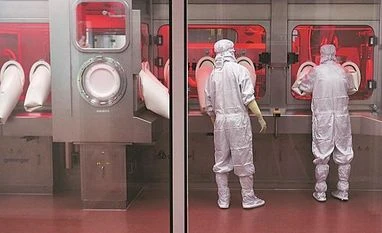
Meanwhile, the Hadapsar plant, besides plants of Zydus Cadila in Ahmedabad and Bharat Biotech in Hyderabad, has sophisticated tunnel systems, high-speed vial washing, filling, stoppering, and sealing machines capable of working at a speed of 500 containers per minute, installed with filling accuracy to the third digit of a decimal point to ensure accuracy and consistency.


 "serum institute, coronavirus, covid, vaccine, pharma")