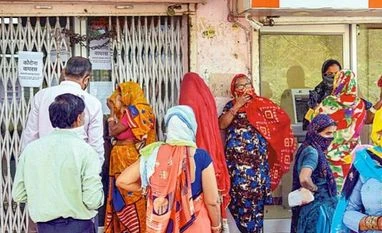
The Covid-19 disruption has hit almost all areas of the economy and the banking sector has not remained immune. In fact, the way bank deposits have evolved since 2020 says a lot about where the Indian economy is headed because banks are the chief source of finance.
Deposits grew fast in the period when consumption got hit due to restrictions and precautionary behaviour. But credit growth remains muted because of lower economic activity. In fact, the gap between non-food bank credit growth and aggregate deposits growth widened to the highest level since demonetisation in May (chart 1).
This is happening despite the interest rates on deposits being low and higher inflation affecting the real interest earned by depositors (chart 2). But the reduction in lending rates seems to have hit a wall. Lending rates are slowly inching up.
What is also interesting about these rising bank deposits is the way they are getting accumulated. Growth in deposits is high in cities and low in villages (chart 3). This trend has surfaced a year into the pandemic.
Further, long-term deposits are seeing slower growth than short-term deposits (chart 4).
Along with bank deposits, households have been putting money into insurance and provident funds (chart 5) since the pandemic began. Here again, it’s the urban population that contributes the most to both insurance and public provident funds.
But another crucial thing, as chart 5 shows, is that the bump in currency savings when the pandemic began (Q1 FY20) was washed away in Q3. That’s one reason for household savings to have come back to the usual level towards December 2020.
Household debt, on the other hand, is rising. In a contracting economy, the ratio of household debt as a percentage of gross domestic product (GDP) would naturally rise.
It was near 38 per cent of GDP as of December 2020 (chart 6).


 "bank deposit")