


After a year of the Trump show, US is as stupefied and transfixed as ever
With Trump's ascendancy, entertainment and politics are converging as never before
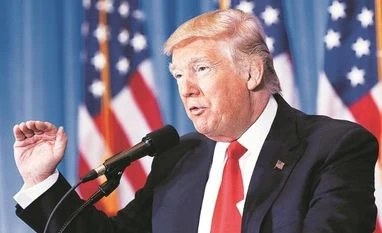 "Donald Trump")
Donald Trump
In the small hours of November 8 2016, in a state of some bewilderment, I wrote a piece on the result of the US election titled: “After poisoning and dividing America, Donald Trump has won an ugly victory.” And come his inauguration on January 20, I asked how to make sense of the Trump era. A year after he won the election, I’m still struggling – and so is nearly everyone else.
Like his campaign, Trump’s presidency is a reality show, one driven by disruption and distraction. As a political spectacle, it is nothing short of stupefying; it transfixes the US and much of the rest of the world alike. But if we can only tune out the noise and understand how this is happening, we can begin to pay attention to what’s going on outside the frame.
It’s tempting to view Trump’s election as a sudden rupture, a shocking schism in politics, culture and society that will in time be read as a defining break in American history. To be sure, it has all the shock value that would suggest, but deep undercurrents of discontent were detectable long before Trump channelled them to the surface.
In the years before Trump took centre stage, many commentators were trying hard to take the temperature of the body politic. Almost all agreed the patient was unwell, with a strong odour of malaise, but they couldn’t agree on a precise diagnosis. The most common refrain was that the “unwinding” of the social contract was reaching crisis point. Yet they struggled to fully pinpoint or clearly name this malaise or what it betokened for American politics and comity. Today, we might simply state it betokened Trump, but he remains only a symptom, not the pathogen.
The zero-sum politics of a hyper-polarised America are only just coming into focus. The strange thing about this political culture is that it’s not principally political; it reflects a form of partisanship that divides Americans even more sharply than the indicators of identity politics would suggest.
Cleft in twain
A recent Pew poll found American public opinion “more divided along partisan lines than along the lines of race, religion, age, gender, and educational background”. This may be new, it is certainly much more pronounced than in the recent past, and it is worrying for the future of a functioning democracy in the US.
The Pew report also showed that Americans’ social and cultural identities and interpersonal relations are more and more entwined with partisan beliefs. This tallies with growing evidence that Americans are associating more and more along tribal lines, clustering geographically in like-minded communities and taking comfort in shared worldviews. Trump is the perfect candidate for such an emotionally partisan era: a demagogue of the gut rather than of ideology.
While many liberal commentators worry about the stress Trump is placing on democratic institutions and values, some are tentatively confident that they are holding and that they will constrain and outlast the excessive energies of this presidency. Some dare to dream that the constitution holds the answer to their nightmare: that in the end, Trump can and will be impeached. But set against the reality of the new partisanship, this is a liberal fantasy, and yet another example of stupefaction.
Many onlookers and pundits are summing up Trump’s first year with more than a little schadenfreude, revelling in his failure to deliver on big campaign promises. Far fewer are detailing his incremental victories, most of which are being won offstage. Trump is making serious headway on low-key regulatory matters; federal rules are being remade, and regulations on the environment, the justice system, and immigration rewritten. This is revolutionary work being done in the shadows. As The Atlantic reported in August: