


All signs from Trump point to a coming conflict with Iran
Behind all of Trump's policies in the Middle East is an urge for confrontation with Iran
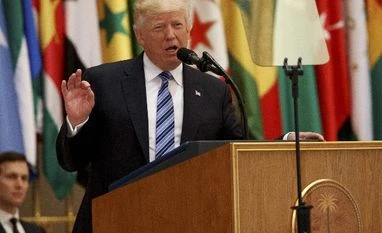 "Donald Trump, Trump")
US President Donald Trump delivers a speech at the King Abdulaziz Conference Centre in Riyadh, Saudi Arabia on Sunday. (Photo: PTI)
The Saudi war in Yemen is really directed at…Iran. Donald Trump’s first overseas visit to Saudi Arabia and Israel was specifically targeted at…Iran. The Saudi-led isolation of Qatar is actually about…Iran.
The escalation of U.S. military actions against the Syria government is… well, do I really need to spell this out any further?
Donald Trump has identified several number-one enemies to target. Throughout the campaign, he emphasized the importance of throwing the full weight of the Pentagon against the Islamic State. More recently, his secretary of defense, Jim Mattis, identified North Korea as “the most urgent and dangerous threat to peace and security.”
Other threats that have appeared at one time or another in the administration’s rotation include China, Cuba, the mainstream media, former FBI director James Comey, and Shakespeare (for writing Julius Caesar and then somehow, from the grave, persuading the Public Theater to run a scandalous version of it).
Through it all, however, Iran has loomed as the primary bogeyman of the Trump crowd. Fear of Iranian influence has prompted the administration to all but cancel the 2015 nuclear deal, intensify a number of proxy wars, consider pushing for regime change in Tehran, and even intervene in the mother of all battles between the Shia and Sunni variants of Islam.
You’re worried about Trump and the nuclear football? The prospect of blowback from an all-out U.S. assault on the Islamic State keeps you up at night? A preemptive strike against North Korea, which Mattis acknowledges would be disastrous, has you rethinking that upcoming trip to Seoul?
Sure, those are all dystopian possibilities. But if I had to choose a more likely catastrophe, it would be a direct confrontation between the United States and Iran. After all, everything seems to be pointing in that direction.
The Fate of the Deal
The nuclear deal that Iran signed with the five permanent members of the UN Security Council plus Germany and the European Union is hanging by a thread. Trump made no bones about his distaste for this Joint Comprehensive Plan of Action (JCPOA). He promised to tear it up.
He hasn’t done so. It’s not just that he’s gotten pushback from the usual suspects in Washington (diplomats, foreign policy mavens, talking heads, journalists). Even members of his inner circle seem to see value in the agreement. Mattis, who is otherwise hawkish on Iran, has stood by the JCPOA and diplomacy more generally. Secretary of State Rex Tillerson has, albeit reluctantly, acknowledged that Iran has lived up to its side of the agreement. Then there are all the American jobs on the line from the Iranian purchase of Boeing jets.
Even though Trump hasn’t torn up the agreement, he has certainly attempted to give it a good crumple. He has directed the Treasury Department to apply additional sanctions on Iran’s missile program. He’s considering the option of declaring the Revolutionary Guards a terrorist organization. Congress, meanwhile, is pursuing its own complementary set of sanctions against Iran (though, because it’s bundled with sanctions against Russia, the legislation may not meet Trump’s approval).
None of this violates the terms of the JCPOA. But it challenges the spirit of the accord.
Adding insult to injury, Trump damned Iran with faint condolences after the recent terrorist attacks in Tehran. “We grieve and pray for the innocent victims of the terrorist attacks in Iran, and for the Iranian people, who are going through such challenging times,” Trump wrote. “We underscore that states that sponsor terrorism risk falling victim to the evil they promote.”
Talk about bad taste. After September 11, Iranians gathered for candlelight vigils to mourn the mostly American victims of the attacks. The Iranian government didn’t say anything about chickens coming home to roost after U.S. military interventions in the Middle East, for that would have been inappropriate (though accurate).
But Iran might yet have to make a statement that echoes Trump’s tone-deaf remark: States that tear up international agreements risk falling victim to the evil they promote.
Proxy Wars
The conflict is escalating in Syria, where Iran backs the regime of Bashar al-Assad and the United States supports a shifting set of anti-regime groups.
Both countries could decide to team up against the Islamic State. And indeed, Iran launched a missile attack against ISIS in Syria this last weekend in retaliation for the terrorist attacks in Tehran. As after September 11, when Tehran and Washington briefly worked together, cooperation against Sunni extremists would seem a no-brainer.
But the would-be caliphate, having lost most of Mosul and now teetering on the verge of conceding its capital in Raqqa, is shrinking at a rapid clip. Which may well explain why the United States has been wading deeper into the Syrian conflict. For the first time since the war in Syria began, U.S. forces shot down a Syrian government plane this last weekend. It’s only the latest in a series of attacks on Assad’s forces, according to The Atlantic: