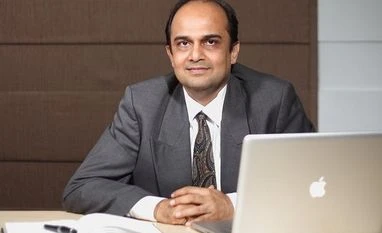
After beginning its journey in 2007 as an advisory, Equirus has diversified into institutional broking, investment banking and wealth management. According to reports, the financial services firm is looking to acquire IDFC Securities, which is on the block. While refraining from commenting on any specific deal, Ajay Garg, founder and managing director of Equirus Capital, tells Jash Kriplani about his company’s growth plans and how the market activity can play out. Edited excerpts:
What are the other businesses Equirus could diversify into?
We recently forayed into wealth management and portfolio management services because we are looking at equity-related capital market fee-income businesses. We will also increase our debt portfolio by getting into debt capital market. Our approach is to make Equirus a well-diversified capital market platform with strong business units that are known for their client-focus and relationship approach. Our growth aspirations are high and we will figure out ways to grow.
When do you see equity fund-raising activity recovering?
Although equities did not perform well last year and the performance of initial public offerings (IPOs) hasn’t been great, inflows have continued into mutual funds and other equity funds. Therefore, even though there is an overhang of the general election, we believe select deals of good companies at the right valuation will get done. Once the election uncertainty is over, fund-raising activity should be back in full swing.
How robust is the pipeline of IPOs and other fund-raising related issues at this juncture?
In terms of IPOs, there is an unprecedented pipeline of about 80 issues; they potentially amount to Rs 60,000 crore of fund-raising. These are at various stages of processing with Sebi. Several companies have continued to file over the past few months as they seek to raise capital.
With the market conditions still weak, are private equity (PE) players seeking exits through PE-PE deals?
PE exits through IPOs started declining, with 2018 seeing 11 PE-backed IPO exits worth around $800 million, against 21 exits worth around $1.2 billion in the previous year. Whenever there is a pushback from the capital markets, more companies and PEs evaluate alternative routes, which include PE or strategic investor. Recently, secondary market transactions have been on the rise. In 2018, there were 58 secondary exits worth $5.4 billion, against 57 secondary exits worth $3.3 billion in 2017. One must bear in mind that PEs themselves are flushed with liquidity as they have raised significant funds. Large PE funds are keen on broadening their investment portfolio in India.
Are there opportunities within mid-caps that could give healthy returns with a limited downside?
Mid-caps have had a rough ride in 2018 with benchmark indices falling more than 20 per cent. We believe that the shift to large-caps — to keep liquidity on the higher side — has been overdone. There are a lot of quality mid-caps available at a sharp discount to large-caps in the similar sector. The risk-reward is attractive for these names. We expect the valuation gap to narrow in 2019. Opportunities exist particularly in consumer-focused plays such as branded apparel and health care.
Is fund-raising in debt markets going to be a challenge, particularly for NBFCs?
While the market faced a liquidity crunch due to the Infrastructure Leasing & Financial Services crisis, mutual funds have maintained their exposure to non-banking financial companies (NBFCs). MFs have cut their exposure to riskier issuers and increased their exposure to healthy issuers with positive asset-liability management and robust liquidity buffers.
Well-rated NBFCs with healthy fundamentals should be able to raise money at ease. Contrary to the general perception, MFs have not cut their exposure to NBFCs. The MF exposure to debt instruments with a maturity of under three months was more or less stable at Rs 1.98 trillion.
The exposure of MFs to NBFCs is around 33 per cent, which is significantly less than the maximum 40 per cent limit. The rise in bank credit to NBFCs has allayed concerns over the commercial papers maturing in the December quarter.

)