


Covid-19 and the job crunch
Having realised that there is really no contradiction between "jaan" and "jahaan", states are gradually reopening their economies. But they are locking the stable doors after the horses have bolted
 "msme, jobs, workers, supply chain, industy, manufacturing, production")
premium
The question of a trade-off between saving lives and saving the economy is an irrelevant one. It is the government’s responsibility to ensure that we do both. Unfortunately, this question was posed by the Prime Minister himself when he said that the government would concentrate on saving lives. “Jaan hai to jahaan hai,” he said. The truth dawned on him later when he said that we had to save both “jaan” and “jahaan”. In the meanwhile, because of the most rigorous lockdown in the world enforced from the midnight of March 24, the economy plunged into crisis destroying livelihoods. The four lockdowns have failed to save lives but have succeeded in destroying the economy. Now the states have gotten into their own acts and the government of India is comfortable leaving the decision to them so that it can shift the blame to them.
Having realised that there is really no contradiction, several states are gradually lifting the lockdown and reopening their economies. But they are locking the stable doors after the horses have bolted. The migrant workers are spreading the virus wherever they are going but they cannot be blamed because they were left with nothing; no one bothered about them and when they were left with nothing, they started walking back to their villages hundreds of kilometres away. Their plight will be remembered in our history as one of its most sordid chapters. The fiscal package announced by the government is eminently forgettable as far as the present problems are concerned.
We are also in the midst of a global economic depression. The IMF (International Monetory Fund) earlier expected the global income to grow by 3 per cent but now expects it to fall by 3 per cent. In India, the economy could shrink by as much as 6.8 per cent, if not more. Economist Prof Nouriel Roubini of New York University said that there are some jobs that will not come back after this crisis. The global financial crisis of 2008 continued for three years when output fell sharply but the Covid-19 crisis is going to stay with us much longer. All the brave talk of the economy reviving in the second half of the fiscal or even later is nothing more than pure optimism.
The pandemic has increased income inequality and hurt employment prospects. An IMF research shows that the pandemic has widened the gap between the rich and the poor. The IMF’s net Gini coefficient — inequality measure — has increased by nearly 1.5 per cent for Covid-19 duration. This is due to loss of jobs and income. The jobless claim is increasing every week in the world. The US workers had filed 33.5 million applications for unemployment claims by the first week of May. South Africa’s lockdown has seen unemployment increase to 40 per cent.
The Indian economy which was already struggling before Covid-19 is now in the negative territory. The recovery of the economy will neither be ‘V’-shaped nor ‘U’-shaped; it is likely to be ‘L’-shaped, which means falling very fast and staying there for a long time. The RBI (Reserve Bank of India) in its monetary policy statement for 2020-21 has also said that the GDP (Gross Domestice Product) growth in FY21 will be negative.
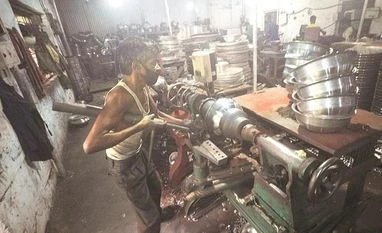
The complete lockdown has shrunk job opportunities. More than 100 million workers in restaurants, manufacturing, construction, and travel have lost their jobs. The ILO has already warned that 400 million people working in the informal sector will be forced into poverty in India. As per the survey of Azim Premji University, 67 per cent of the workers have lost their jobs during the lockdown. The average weekly earnings of non-farm, self-employed persons have dipped by 90 per cent from Rs 2,240 to Rs 218.
Having realised that there is really no contradiction, several states are gradually lifting the lockdown and reopening their economies. But they are locking the stable doors after the horses have bolted. The migrant workers are spreading the virus wherever they are going but they cannot be blamed because they were left with nothing; no one bothered about them and when they were left with nothing, they started walking back to their villages hundreds of kilometres away. Their plight will be remembered in our history as one of its most sordid chapters. The fiscal package announced by the government is eminently forgettable as far as the present problems are concerned.
We are also in the midst of a global economic depression. The IMF (International Monetory Fund) earlier expected the global income to grow by 3 per cent but now expects it to fall by 3 per cent. In India, the economy could shrink by as much as 6.8 per cent, if not more. Economist Prof Nouriel Roubini of New York University said that there are some jobs that will not come back after this crisis. The global financial crisis of 2008 continued for three years when output fell sharply but the Covid-19 crisis is going to stay with us much longer. All the brave talk of the economy reviving in the second half of the fiscal or even later is nothing more than pure optimism.
The pandemic has increased income inequality and hurt employment prospects. An IMF research shows that the pandemic has widened the gap between the rich and the poor. The IMF’s net Gini coefficient — inequality measure — has increased by nearly 1.5 per cent for Covid-19 duration. This is due to loss of jobs and income. The jobless claim is increasing every week in the world. The US workers had filed 33.5 million applications for unemployment claims by the first week of May. South Africa’s lockdown has seen unemployment increase to 40 per cent.
The Indian economy which was already struggling before Covid-19 is now in the negative territory. The recovery of the economy will neither be ‘V’-shaped nor ‘U’-shaped; it is likely to be ‘L’-shaped, which means falling very fast and staying there for a long time. The RBI (Reserve Bank of India) in its monetary policy statement for 2020-21 has also said that the GDP (Gross Domestice Product) growth in FY21 will be negative.
The complete lockdown has shrunk job opportunities. More than 100 million workers in restaurants, manufacturing, construction, and travel have lost their jobs. The ILO has already warned that 400 million people working in the informal sector will be forced into poverty in India. As per the survey of Azim Premji University, 67 per cent of the workers have lost their jobs during the lockdown. The average weekly earnings of non-farm, self-employed persons have dipped by 90 per cent from Rs 2,240 to Rs 218.
Disclaimer: These are personal views of the writer. They do not necessarily reflect the opinion of www.business-standard.com or the Business Standard newspaper