


Eat before reading
Book review of The Indian Pantry
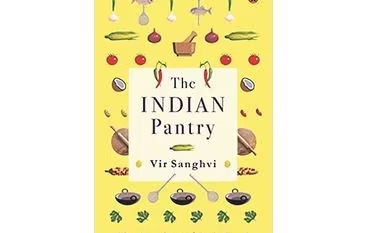 "book cover")
premium
Cover of The Indian Pantry
When reading The Indian Pantry, I remembered an important lesson I learned a few years ago: Don’t read Vir Sanghvi on an empty stomach. The book is a re-edited and rewritten collection of some of Mr Sanghvi’s best food columns, which have appeared for decades in the Sunday supplement of the Hindustan Times newspaper; some of them are familiar, presumably because I re-read them on the internet after devouring them some Sunday morning long ago. But all of them are likely to make you feel peckish.
Many years ago, in the early 2000s, I tried to work out precisely why I was starting the week sluggish. Why was I waking up late every Monday, and slow for most of the day? I worked backwards: I was slow because I slept too long, and I slept too long because I ate too much on Sunday, and I ate too much on Sunday because — and this was true — I was reading Vir Sanghvi’s column first thing in the morning. The useful consequence of this piece of deductive logic was that I postponed reading the Sunday papers to the afternoon, and thereby stopped going out for excessively vast Sunday lunches.
In The Indian Pantry, Mr Sanghvi discusses the Indian passion for big Sunday brunches. In the West, he points out, Sunday brunch is a bakwaas meal, cooked by apprentices while the real chef is sleeping in for the day. But in South East Asia, Sunday brunches had evolved into something grand and showy — and, in a theme he returns to often in the book, Indian restaurant and hotel culture takes its cues more often from the East than the West. But, he then points out, we don’t quite do it right. (This is another theme of the book.) We seem to spend too much time on bland eggs on grey toast instead of experimenting with some of the many great egg dishes we have in this country.
He then runs through some of them — from fried eggs on appams to kathi rolls — which reveals, if nothing else, the expansive and generous nature of the author’s taste. (He even has good words for Nargisi kofta, which in my experience tastes as if you stuck a week-old boiled egg in the middle of a mashed-up, over-spiced seekh kabab and then fried it.) Crucially, however, he doesn’t end there.
Having led you gently towards feeling an almost insatiable hunger — think of it as standing on the edge of a canyon, take one step and you surrender to the kind of gluttony that swallows your entire Sunday afternoon — he then tells you what to do about it, through simply giving you the recipe for eggs akuri.
When Vir Sanghvi writes about food, it is never just about food. It is also about how it used to taste; why it tastes differently now; and why. The fact that he seems to know every chef of consequence in this country, and most of them outside, lends a certain authority to his speculation about how food fashions rise and fall. For example, why precisely are avocados so popular today? Mr Sanghvi suggests, simply, this reflects a change in our attitude to fats. Once they were “the fatty of the vegetable kingdom” and so disdained; today, with a more relaxed attitude to fats, we can spread them on toast instead of butter and feel healthy.
One of the joys of The Indian Pantry is what it reveals about the idiosyncrasies of the Indian palate, and about what our restaurant culture gets right and what it gets wrong. For example, Mr Sanghvi expends a large portion of his rare disdain, justly, on chicken sausages — the paneer tikka of non-vegetarians, tasteless, uninspiring and mysteriously ubiquitous.
The presence of chicken sausages on so many buffet tables and menus in India would lead one to suppose that our restaurant scene is distinguished merely by a lack of creativity and a tendency towards minimal effort. But, in the chapter on the raan, the whole roasted goat leg that is the glorious centrepiece of many tandoori places, we learn how wrong that is. I had vaguely thought that the raan was simply a goat’s hind leg slathered with spices and bunged into a tandoor till it was edible. But, in fact, it is an extraordinarily complex dish that almost every chef seems to make differently.
As Mr Sanghvi points out, you can cook a leg of the lamb in the West according to a strict timetable and rules — it is scientific. The Indian raan is, in comparison, art.
Everyone knows food writing is deeply personal; but the fact is that it can be covertly political as well. A country’s identity is expressed not just in its literatures but its food. And India’s food is gloriously varied, as is its identity.
More, it is linked to the world — not just through the global trends that Mr Sanghvi painstakingly traces to their source, but through the tides of history and taste that have brought to our shores pao from the West, sambusaks from Central Asia, and momos from God knows where. He ends The Indian Pantry on a slightly sad note, however: Will our geographical variations become flattened out as time goes by, replacing regional pantries with one big Indian pantry? That would be a shame — both personally and politically.
Many years ago, in the early 2000s, I tried to work out precisely why I was starting the week sluggish. Why was I waking up late every Monday, and slow for most of the day? I worked backwards: I was slow because I slept too long, and I slept too long because I ate too much on Sunday, and I ate too much on Sunday because — and this was true — I was reading Vir Sanghvi’s column first thing in the morning. The useful consequence of this piece of deductive logic was that I postponed reading the Sunday papers to the afternoon, and thereby stopped going out for excessively vast Sunday lunches.
In The Indian Pantry, Mr Sanghvi discusses the Indian passion for big Sunday brunches. In the West, he points out, Sunday brunch is a bakwaas meal, cooked by apprentices while the real chef is sleeping in for the day. But in South East Asia, Sunday brunches had evolved into something grand and showy — and, in a theme he returns to often in the book, Indian restaurant and hotel culture takes its cues more often from the East than the West. But, he then points out, we don’t quite do it right. (This is another theme of the book.) We seem to spend too much time on bland eggs on grey toast instead of experimenting with some of the many great egg dishes we have in this country.
He then runs through some of them — from fried eggs on appams to kathi rolls — which reveals, if nothing else, the expansive and generous nature of the author’s taste. (He even has good words for Nargisi kofta, which in my experience tastes as if you stuck a week-old boiled egg in the middle of a mashed-up, over-spiced seekh kabab and then fried it.) Crucially, however, he doesn’t end there.
Having led you gently towards feeling an almost insatiable hunger — think of it as standing on the edge of a canyon, take one step and you surrender to the kind of gluttony that swallows your entire Sunday afternoon — he then tells you what to do about it, through simply giving you the recipe for eggs akuri.
When Vir Sanghvi writes about food, it is never just about food. It is also about how it used to taste; why it tastes differently now; and why. The fact that he seems to know every chef of consequence in this country, and most of them outside, lends a certain authority to his speculation about how food fashions rise and fall. For example, why precisely are avocados so popular today? Mr Sanghvi suggests, simply, this reflects a change in our attitude to fats. Once they were “the fatty of the vegetable kingdom” and so disdained; today, with a more relaxed attitude to fats, we can spread them on toast instead of butter and feel healthy.
One of the joys of The Indian Pantry is what it reveals about the idiosyncrasies of the Indian palate, and about what our restaurant culture gets right and what it gets wrong. For example, Mr Sanghvi expends a large portion of his rare disdain, justly, on chicken sausages — the paneer tikka of non-vegetarians, tasteless, uninspiring and mysteriously ubiquitous.
The presence of chicken sausages on so many buffet tables and menus in India would lead one to suppose that our restaurant scene is distinguished merely by a lack of creativity and a tendency towards minimal effort. But, in the chapter on the raan, the whole roasted goat leg that is the glorious centrepiece of many tandoori places, we learn how wrong that is. I had vaguely thought that the raan was simply a goat’s hind leg slathered with spices and bunged into a tandoor till it was edible. But, in fact, it is an extraordinarily complex dish that almost every chef seems to make differently.
As Mr Sanghvi points out, you can cook a leg of the lamb in the West according to a strict timetable and rules — it is scientific. The Indian raan is, in comparison, art.
Everyone knows food writing is deeply personal; but the fact is that it can be covertly political as well. A country’s identity is expressed not just in its literatures but its food. And India’s food is gloriously varied, as is its identity.
More, it is linked to the world — not just through the global trends that Mr Sanghvi painstakingly traces to their source, but through the tides of history and taste that have brought to our shores pao from the West, sambusaks from Central Asia, and momos from God knows where. He ends The Indian Pantry on a slightly sad note, however: Will our geographical variations become flattened out as time goes by, replacing regional pantries with one big Indian pantry? That would be a shame — both personally and politically.
The Indian Pantry
Disclaimer: These are personal views of the writer. They do not necessarily reflect the opinion of www.business-standard.com or the Business Standard newspaper
Topics : Indian food restaurants