


For sustained growth
Nobel prize winners expanded scope of macroeconomic analysis
 "For sustained growth")
premium
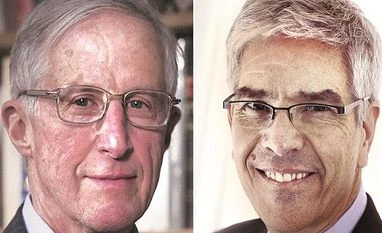
William D Nordhaus (left) and Paul Romer. Photo: Yale University/NYU Stern School of Business/Reuters
The Royal Swedish Academy of Sciences on Monday awarded the Sveriges Riksbank Prize in Economic Sciences — also known as the Nobel Prize for Economics — to William Nordhaus of Yale University and Paul Romer of the NYU Stern School of Business. While the two economists worked on completely different topics, their approach and contribution had similarities. Mr Nordhaus started out in the late sixties and early seventies, looking at the growing mountain of evidence of global warming. The macroeconomic modelling of that era did not have the tools to analyse this new component even though it was clear to him that climate change and the increasing temperature of the planet were going to have a significant impact on the trajectory of global economic growth. Mr Romer, on the other hand, was curious to understand why different countries grew at substantially varying rates. The traditional economic growth models, especially the dominant one provided by Robert Solow, who incidentally received the Economics Nobel in 1987, failed to explain the variance and instead attributed it to some exogenous technological change. What binds this year’s winners then is the fact that they used the existing growth theories to create new frameworks of analysis.