


Whither Singapore?
It may be the beginning of the end of the city-state's economic prowess
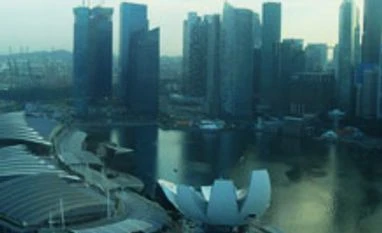)
There is a statue of Sir Stamford Raffles on the banks of the Singapore River that stares roughly in the direction of city-state’s Parliament. Its back squarely towards towering high-rises that comprise one of the world’s most celebrated business districts.
A plaque at the site, purportedly where Raffles landed in 1819, credits him for having “changed the destiny of Singapore from an obscure fishing village to a great seaport and modern metropolis”.
Yet, ironically it is there – roughly mid-way between two institutions that have crafted the Singapore-model, once the delight of bureaucrats and public policy wonks – that is probably the most appropriate place to contemplate whether, after some three decades of spectacular economic growth, the beginning of the end for this island-nation has arrived.

It is an instructive venue. Many of those who arrive from elsewhere to make a living in Singapore must come to Upper Circular Road, a short walk east of Raffles’ effigy.
The ministry of manpower hands out those sought after employment passes — EPs, to the acronym-loving locals — here, in a slick, air-conditioned office. Appointments are given online; the offline turnaround time is almost ridiculously short.
This is, in many ways, the epitome of the country’s efficiency, but increasingly for Singaporeans, also the most significant signal of fault lines that threaten their society.
So significant, in fact, that it triggered one of the largest protest rallies in the city-state’s recent history. Some 4,000-5,000 Singaporeans braved the rains this February to demonstrate against a government white paper that projects immigrants constituting about half of the country’s population by 2030. Such turnouts are unheard of in modern Singapore.
When the Occupy Wall Street movement reached the city’s central business district in 2011, there were no protestors there, only a couple of cops.
It isn’t merely about numbers. The larger implication is that of a silent citizenry finally speaking out against a political class that has little experience of dealing with dissent in the past few decades.
The People’s Action Party (PAP), in power since Singapore’s independence in 1965, has rarely had to deal with public outcry, sustained criticism or, for that matter, any significant political opposition. Until now.
It began changing, perceptibly, during 2011. First, the PAP won (only) 81 out of 87 seats in the general elections, its worst performance since coming into government. The city-state’s founding Prime Minister Lee Kuan Yew and his successor Goh Chok Tong moved out of the Cabinet after calling it “a watershed general election”, leaving Lee’s son Lee Hseing Loong, the incumbent prime minister, and his team to reverse the PAP’s slide in vote share from 75% in 2001 to 60% in 2011. That was in May.
By late August, things had got worse. Former Deputy Prime Minister Tony Tan, widely seen as the PAP’s man, won the presidential elections, held for the first time 18 years, by only 7,269 votes. Some 2.1 million Singaporeans had cast their ballot.
Two months later, lawyer-turned-politician Michael Palmer took over as the speaker of Parliament. Last December, he resigned after admitting to an extramarital affair. His constituency, Punggol East, then went to the hustings, and the PAP lost yet another seat.
“I respect the choice of Punggol East voters,” PM Lee said after the verdict.
Popular former Foreign Minister George Yeo, in a Facebook post, simply asked: “Whither Singapore?” It is a pertinent question, given that modern Singapore has never witnessed such politics. Few would have thought the PAP’s grip over the city-state would weaken this quickly. Yet, it is, and no one quite knows what it means.
At stake is not just a model Asian city-state, but one of the world’s richest metropolises. Fort Knox, a maximum-security vault not from the fabled Changi Airport, reportedly holds more art, antique cars, fine wines and gold than any other single place globally.
The Boston Consulting Group estimates that Singapore has the highest concentration of millionaire households anywhere in the world, with some 15.5% of all households in the island-nation having at least $1 million in assets under management.
Yet, Singapore’s monthly median income (excluding central provident fund contribution) is about $2,400, which really isn’t worth much considering it is the sixth most expensive city in the world, according to a recent Economist Intelligence Unit survey.
And as more money pours into Singapore, that divide – between locals sipping coffee at a street side Kopitiam and expats stepping out of a glitzy sports cars for drink at some of Asia's most expensive bars – is only getting starker. The city-state’s Gini coefficient – the most commonly used measure of inequality, with a higher number reflecting more disparity – was 0.478 in 2012, higher than that of China and India.
For the government, in turn, it is becoming an increasingly difficult balancing act. That tiny Singapore, which registers a mere 7.72 birth per thousand, needs immigration is clear. Its population is ageing, the local workforce cannot support the needs of a global financial centre that it has become today. But bringing in more foreign talent to keep the economic engine going, as the February protests showed, has political ramifications.
While the noise on the street against immigration is diverse and loud, the core issue is opportunity. Is it fair, for instance, for a Singaporean to compete with an immigrant for access to education, especially if nearly half of the island’s population could be composed of émigrés by 2030?
The most obvious path would be to tame growth, and instead seek a more equitable economic model. But that would also mean risking the city-state’s position as a global financial centre, imprudent given that Singapore has nothing in the way of natural resources and that almost 80% of its workforce is employed in the service industry.
It is also Singapore's economic prowess that gives the small island off the coast of Malaysia unusual geopolitical traction, particularly in Southeast Asia. Without its diplomatic clout in the region, Singapore would scarcely be country it is today, bridging three regional growth centres — Asean, China and India — while maintaining close ties with Australia, Europe and the US. That is a rare commodity in this part of the world.
Much of this, of course, has to do with Lee Kuan Yew and his vision for Singapore. And it was his emphasis on meritocracy in government, after the territory separated from Malaysia that ensured the creation of a bureaucracy and political class with unusual talent. That quality defined the PAP, for long. And Singapore.
Singapore now stands at the crossroads. The government will need to take difficult decisions that could, on one hand, limit immigration and hurt the economy, or continue on the same path and risk losing political traction. Whatever it is, it won’t be easy.
It might not seem so in the shadow of Raffles’ statue by the river, but behind the surface, Asia’s celebrated city-state is slowly unravelling. How long will the party last?
Disclaimer: These are personal views of the writer. They do not necessarily reflect the opinion of www.business-standard.com or the Business Standard newspaper
More From This Section
Don't miss the most important news and views of the day. Get them on our Telegram channel
First Published: May 02 2013 | 5:50 PM IST