


Home / India News / Uttar Pradesh's uneasy tryst with business
Uttar Pradesh's uneasy tryst with business
State govt is showcasing 'improved' law and order, but that alone won't be enough
 "Yogi Adityanath, UP, CM")
premium
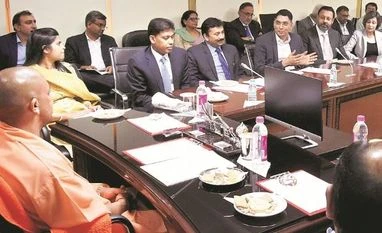
Uttar Pradesh Chief Minister Yogi Adityanath (left) and senior government officials at a meeting with a US business delegation in Lucknow on October 23 | Photo: PTI
Last Updated : Oct 29 2017 | 10:56 PM IST
On October 23, when the representatives of 26 US corporate majors — including Boeing, Facebook, Adobe, Oracle, and Cargill — met Uttar Pradesh Chief Minister Yogi Adityanath in Lucknow, tucked away between the old chestnuts about infrastructure in the dialogues were significant takeaways from the state government.
The upshots were the promise to effect a “flexible” labour policy that’s afoot and, more importantly, demonstrating with data the “transformed” law and order situation that had “slumped” to the nadir during the Samajwadi Party regime.
Health Minister Sidharth Nath Singh, who anchored the meeting under the banner of the US-India Strategic Partnership Forum, told Business Standard: “Many investors were pleased with the improved law and order.”
“Improved” is a double-edged sword. By the police’s admission, it came about after deploying conventional but controversial and coercive methods such as encounters; the Gangsters and Anti-Social Activities Prevention Act, 1986; the UP Control of Goondas Act, 1970; and impounding properties that could be legally susceptible.
ALSO READ: The tricky Ayodhya load
Police-criminal “encounters” were forgotten in a state once infamous for these. Not one “encounter” was staged in the 15 years that the BJP was out of power. The data obtained from the Director-General of Police’s office in Lucknow revealed, between March and mid-September this year 868 people were killed in 420 encounters.
Most of the “encounters” occurred in west UP, where the BJP had unleashed an aggressive campaign to “liquidate” the “goondas” and criminals allegedly patronised by the Samajwadi Party if elected to power. “The Yogi dispensation realised that rather than raise a special force to police the industrial zones, hit where it hurts the hardest,” a Lucknow bureaucrat said.
The sequel to the “encounters” was that fewer criminals sought bail and parole, knowing that freedom didn’t guarantee security. Instead of displaying statistics to buttress its claims, the UP police publicised “case studies” such as this one to “infuse confidence” among people.
On September 2, Sunil Sharma, who was a sharpshooter of the “dreaded” Salim-Sohrab-Rustom gang and had been on parole to attend a wedding, was killed by the police after he tried to escape from their custody while being produced in court. Another gang member, who sought bail to visit an ailing relative, was given one but he refused, fearing he might meet his associate’s fate. UP BJP spokesperson Chandra Mohan said: “We are committed to wiping out the last criminal on UP’s soil.”
The larger message emerging from the trigger-happy attacks was economic and political. Shyam Mohan, a Moradabad printing and packaging businessman and secretary to the Indian Industries Association, felt that the government had “successfully” checked the flight of “beleaguered Hindu” businessmen from west UP and put business “nearly back on track”.
However, spotlighting the “restoration” of law and order was not enough to draw investments and address the electorate, a minister conceded. “The infrastructure sector entails balancing tough decisions with populism,” he said. The government’s dilemma was evident in the management of the power ministry. The CM redeemed the pre-poll vow of “power to all” by clinching a pact with the Centre days after taking over. New Delhi assured largesse aplenty while UP, anticipating enhanced supply, scrapped bids carried out in 2016 to procure 3,800 Mw (megawatt) from independent producers to meet the commercial and domestic shortfall.
While the catchy “power for all” slogan remains chancy, Power Minister Shrikant Sharma listed his initiatives that smacked of populism rather than long-term recalibration. Hugely subsidised connections for below-poverty-line card-holders, online connections within seven days, “trust” billing filed by consumers (subject to penalty for wrongdoing), special police stations to fix power pilferage, and installing meters in all government houses to stem the misuse from unmetered connections. “The power sector has finally come out of the ICU, it’s on track,” said Sharma.
The Rs 30,000-crore Poorvanchal Expressway, intended to provide road connectivity to eastern UP and billed as the BJP’s answer to Akhilesh Yadav’s Lucknow-Agra Expressway, is critical to the development of the east and Bundelkhand as new industrial hubs, failing which industrial development could stagnate. “Greater Noida, Noida, and Ghaziabad are saturated. But the east and Bundelkhand lack a dedicated freight corridor, power and water. These parts have zero infrastructure,” a bureaucrat said.
Although the Centre has assured UP that it will underwrite the proposed expressway’s costs because Adityanath’s Gorakhpur and Narendra Modi’s Varanasi fall in the east, it is learnt that the state government was chary of kicking off megaprojects because of its “budgetary constraints”. The reason? It had to waive the crop loans given to small and marginal farmers and redeem a poll promise. The estimated amount of Rs 36,359 crore was projected to benefit 8.6 million farmers. From April to September, the government said it disbursed Rs 7,371 crore to set aside the loans of 1.193 million farmers in the first phase. “It’s like putting cumin seeds in a camel’s mouth,” said Chowdhury Pushpendra Singh, president of west UP’s Kisan Shakti Sangh.
What could have been propagated as an “achievement” has been undermined by the fact that the “one-time” settlements resulted in waivers of as low as Rs 1,000 and Rs 500 when the mandated amount was Rs 1 lakh. Until the loose ends are tied up, the Adityanath’s government is expected to keep hopes riding on law and order and the “emotive” issues.