


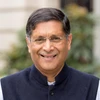
 "Arvind Subramanian")
Arvind Subramanian
Arvind Subramanian
Arvind Subramanian is former chief economic advisor to the Government of India, and is currently a senior fellow at the Watson Institute for International and Public Affairs at Brown University. He was earlier the assistant director in the research department of the International Monetary Fund, and has taught at Harvard University's Kennedy School of Government, Johns Hopkins School for Advanced International Studies, and has been a Professor of Economics at Ashoka University.
Arvind Subramanian is former chief economic advisor to the Government of India, and is currently a senior fellow at the Watson Institute for International and Public Affairs at Brown University. He was earlier the assistant director in the research department of the International Monetary Fund, and has taught at Harvard University's Kennedy School of Government, Johns Hopkins School for Advanced International Studies, and has been a Professor of Economics at Ashoka University.


Page 2 - Arvind Subramanian
Why Trump's return to the White House is an opportunity for India
A more principled response would be to initiate talks with the US on a bilateral deal or free-trade agreement. India stands to gain from trade liberalisation

 "Why Trump's return to the White House is an opportunity for India")
Explained: Has India's exchange rate regime changed for the worse?
Ever since the liberalisation in 1991, the RBI has pursued a flexible exchange rate policy
 "Explained: Has India's exchange rate regime changed for the worse?")
Institutions rule: COCD's path to the Nobel in economics this year
Why Colonial Origins of Comparative Development is Nobel-worthy
 "Institutions rule: COCD's path to the Nobel in economics this year")
India's manufacturing under-performance Part 1: New clue from multi-plants
One of the most intriguing and relatively undocumented developments of the last 20 yrs has been "multi-plants," whereby a single firm operates not one but multiple production facilities within a state
 "India's manufacturing under-performance Part 1: New clue from multi-plants")
India's manufacturing under-performance Part 2: New clue from multi-plants
In multi-plant units, flexibility in hiring & firing labour comes from fact of having many plants. In single plants, there is no such flexibility, which renders use of contract labour more important
 "India's manufacturing under-performance Part 2: New clue from multi-plants")
Why restrictive trade responses fail to halt China's export juggernaut
US and Europe should understand the issues and discuss them with China, tailoring responses to the underlying diagnosis, rather than taking knee-jerk protectionist measures that only stoke tensions
 "Why restrictive trade responses fail to halt China's export juggernaut")
Union Budget 2024-25: Three macro puzzles and policy implications
Why is consumption soft, employment growth weak, and core inflation low, when the economy is apparently growing strongly?
 "Union Budget 2024-25: Three macro puzzles and policy implications")
GST revenues: The fate of the compensation cess amid Centre-state row
There's no reason for the cess to be retained in its current form. That's because the cess rates themselves are monstrously complicated, varying not only in magnitude but also according to end-use
 "GST revenues: The fate of the compensation cess amid Centre-state row")
GST's revenue performance: Centre's sacrifice for cooperative federalism
Over the past few years, most commentators have rightly emphasised the tensions in Centre-state fiscal relations, pointing especially to the Centre's repeated recourse to non-sharable cesses
 "GST's revenue performance: Centre's sacrifice for cooperative federalism")
The Sino-American trade war benefits China's competitors
India offers a prime example. It has successfully attracted several Western firms exiting China since launching its 'China Plus One' strategy in 2014
 "The Sino-American trade war benefits China's competitors")
What does the NSS data imply for GDP estimates?
What can we learn from the latest survey? Before we answer this question, we need to recognise the limitations of comparing NSS figures with the ones from the NIA
 "What does the NSS data imply for GDP estimates?")
Manmohan vs Modi: False debate on both sides
The Modi government needs to thank previous governments for midwifing the GST and highlighting its value, which helped overcome Modi's own reservations about the reform
 "Manmohan vs Modi: False debate on both sides")
India's climate goals: Navigating a complex dilemma
Its experience underscores that unanimous advocacy for carbon taxation can be misguided, as it ignores country-specific realities
 "India's climate goals: Navigating a complex dilemma")
Understanding GST revenue performance
Contrary to belief, GST underperformed the old tax regime in its initial years but has now begun to exceed expectations, six years after implementation
 "Understanding GST revenue performance")
Is the economy surging or decelerating: Understanding India's growth rate
The nominal figures track the real numbers until the first half of FY23, but then decline by a whopping 14 percentage points over the past three quarters
 "Is the economy surging or decelerating: Understanding India's growth rate")
India should quit the Brics
Arvind Subramanian is a senior fellow at the Peterson Institute for International Economics. Josh Felman is a principal at JH Consulting
 "India should quit the Brics")
Understanding Biden's Big Bet on India
America has drawn India into a one-sided quasi-alliance: it seems to have taken one, at most one-and-a-half, to tango. The strategic rationale, of course, is the need to counter-balance China
 "Understanding Biden's Big Bet on India")
Djokovic the Unloved Greatest
Novak Djokovic could yet win the calendar Grand Slam this year, which would be the first since Rod Laver did so more than half a century ago
 "Djokovic the Unloved Greatest")
Ivan Menezes (1959-2023): A personal recollection of his journey
Over-successful men tend to inflict two types of collateral damage
 "Ivan Menezes (1959-2023): A personal recollection of his journey")
India's welfare balm
While many analysts have estimated India's potential annual GDP growth at 7-8 per cent, the most recent figures indicate a subdued rate of 4.4 per cent
 "India's welfare balm")