


 "Arvind Subramanian")
Arvind Subramanian
Arvind Subramanian
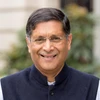
Arvind Subramanian is former chief economic advisor to the Government of India, and is currently a senior fellow at the Watson Institute for International and Public Affairs at Brown University. He was earlier the assistant director in the research department of the International Monetary Fund, and has taught at Harvard University's Kennedy School of Government, Johns Hopkins School for Advanced International Studies, and has been a Professor of Economics at Ashoka University.
Arvind Subramanian is former chief economic advisor to the Government of India, and is currently a senior fellow at the Watson Institute for International and Public Affairs at Brown University. He was earlier the assistant director in the research department of the International Monetary Fund, and has taught at Harvard University's Kennedy School of Government, Johns Hopkins School for Advanced International Studies, and has been a Professor of Economics at Ashoka University.


Page 4 - Arvind Subramanian
What COVID-19 means for international aid
Despite the clear balance of evidence, an overwhelming proportion of aid is devoted to country lending, with only a fraction allocated to financing GPGs

 "What COVID-19 means for international aid")
Understanding Budget policy
Its objectives are clear. But the reality in recent years has not cooperated with the government's plans
 "Understanding Budget policy")
Could consumption really have fallen?
The leaked NSS consumption numbers have provoked a debate. While arguments by various sides are not really convincing there are some broad lessons
 "Could consumption really have fallen?")
Is Sri Lanka the next Argentina?
Sri Lanka suffers from cleavages along many different lines, notably ideology, ethnicity, language, and religion
 "Is Sri Lanka the next Argentina?")
The battle of the fading hegemons
The outcome of the China-US struggle is far from inevitable, because the powers of both the aspirant and the incumbent are eroding
 "The battle of the fading hegemons")
Arun Jaitley: A personal tribute
The former finance minister's departure marks the end of an era, the age of moderation in civic life
 "Arun Jaitley: A personal tribute")
Losing steam: The coming China shock
Its internal debts are mounting to unsustainable heights, and domestic investment levels have passed the point of diminishing returns
 "Losing steam: The coming China shock")
Quasi-universal basic rural income: The way forward
The authors propose an alternative to build a new rural India where a basic income, regardless of agricultural vagaries, will be guaranteed
 "Quasi-universal basic rural income: The way forward")
Arvind Subramanian: Universal Basic Income in action
Adapting Rythu Bandhu to be the future of social and agricultural policies

Arvind Subramanian: Guarded optimism beats gloom
If we focus on the longue duree, there is promise for the developing world
Arvind Subramanian: Why the coupling has been broken
For long, currency and bank deposits have grown together. Inflation, nominal interest rates hold the key to why they are no longer doing so
 "Arvind Subramanian: Why the coupling has been broken")
D S Kolamkar & Arvind Subramanian: A common Indian agricultural market?
In the final part of a series, the authors explain the characteristics of agricultural markets in India and look at the possibilities of setting up a national market for commodities
 "D S Kolamkar & Arvind Subramanian: A common Indian agricultural market?")
Amrit Amirapu, Siddharth George & Arvind Subramanian: Transformational sectors - The Indian challenge
'Premature non-industrialisation' has led to industry absorbing scarce skilled labour instead of abundant unskilled labour
 "Amrit Amirapu, Siddharth George & Arvind Subramanian: Transformational sectors - The Indian challenge")
Rohit Lamba & Arvind Subramanian: Why India should focus on leverage not just capital adequacy
In part five of a series, the authors explain that if CRAR is proving to be tricky internationally, exclusive reliance on it in India is perhaps even more fraught with risks
 "Rohit Lamba & Arvind Subramanian: Why India should focus on leverage not just capital adequacy")
Arbind Modi & Arvind Subramanian: 'Make in India' not by protecting but by eliminating negative protectionism
In part four of a series, the author explain how scrapping the exemptions for the countervailing duty will eliminate the negative protection facing Indian manufacturers
Rangeet Ghosh, Aakanksha Arora, Sutirtha Roy & Arvind Subramanian: Track changes - The case for investing in railways
In part three of a series, the authors explain how the big numbers obscure some serious deficiencies in the 'lifeline of the nation'
 "Rangeet Ghosh, Aakanksha Arora, Sutirtha Roy & Arvind Subramanian: Track changes - The case for investing in railways")
Syed Zubair Naqvi, Kapil Patidar & Arvind Subramanian: India's real fiscal policy for FY16
In the second part of a series, the authors say it seems likely the debt situation of the states will exhibit an improvement greater than that of the Centre
 "Syed Zubair Naqvi, Kapil Patidar & Arvind Subramanian: India's real fiscal policy for FY16")
Rohit Lamba, Sutirtha Roy & Arvind Subramanian: Five questions on India's credit
India's credit and banking are neither too big nor too small
 "Rohit Lamba, Sutirtha Roy & Arvind Subramanian: Five questions on India's credit")
Arvind Subramanian: Moving towards the fiscal target
Chief Economic Adviser explains the Budget in an exclusive article
 "Arvind Subramanian: Moving towards the fiscal target")
Syed Zubair Naqvi, Kapil Patidar & Arvind Subramanian: A watershed 14th Finance Commission
It is clear that the far-reaching recommendations of the 14th Finance Commission, along with the creation of NITI Aayog, will radically alter Centre-state fiscal relations
 "Syed Zubair Naqvi, Kapil Patidar & Arvind Subramanian: A watershed 14th Finance Commission")