


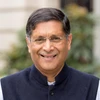
 "Arvind Subramanian")
Arvind Subramanian
Arvind Subramanian
Arvind Subramanian is former chief economic advisor to the Government of India, and is currently a senior fellow at the Watson Institute for International and Public Affairs at Brown University. He was earlier the assistant director in the research department of the International Monetary Fund, and has taught at Harvard University's Kennedy School of Government, Johns Hopkins School for Advanced International Studies, and has been a Professor of Economics at Ashoka University.
Arvind Subramanian is former chief economic advisor to the Government of India, and is currently a senior fellow at the Watson Institute for International and Public Affairs at Brown University. He was earlier the assistant director in the research department of the International Monetary Fund, and has taught at Harvard University's Kennedy School of Government, Johns Hopkins School for Advanced International Studies, and has been a Professor of Economics at Ashoka University.


Page 5 - Arvind Subramanian
Arvind Subramanian: A solution for the WTO
India is right to support its agriculture, but is going about it the wrong way


Devesh Kapur, T V Somanathan & Arvind Subramanian: Land-shackled - II
The authors prescribe the cures for India's problems with land
Devesh Kapur, T V Somanathan & Arvind Subramanian: Land-shackled - I
In the first of a two-part series, the authors diagnose India's problem with land
 "Devesh Kapur, T V Somanathan & Arvind Subramanian: Land-shackled - I")
A provisional scorecard for recent Modi govt measures
Arvind Subramanian, senior fellow, Peterson Institute for International Economics, analyses the government's track record for the past five weeks
 "A provisional scorecard for recent Modi govt measures")
Martin Kessler & Arvind Subramanian: Is the rupee fairly valued?
Applying the purchasing power parity approach, it is clear the rupee is persistently undervalued by 30 per cent or more
 "Martin Kessler & Arvind Subramanian: Is the rupee fairly valued?")
Arvind Subramanian: The Jaitley Budget - Planning for crisis
The finance minister would do well to plan his first Budget by attaching a reasonable probability to a food crisis this year
Amrit Amirapu & Arvind Subramanian: Manufacturing futures
For India, reversing the process of de-industrialisation will be hard
 "Amrit Amirapu & Arvind Subramanian: Manufacturing futures")
Arvind Subramanian: The paradox of Narendra Modi and the Indian economy
His electoral appeal is based on his ability to wield power ruthlessly - but his success in Delhi will depend on coming to grips with highly circumscribed power
The thorn in India-US business ties
As the Office of the US Trade Representative (USTR) turns its lens on India's intellectual property and patents regime, Business Standard brings you what Arvind Subramanian, columnist and economist, t
 "The thorn in India-US business ties")
Arvind Subramanian: Indian banking - Reform by death
Since the government cannot privatise public sector banks, the central bank should force it to let the bad ones fail
Devesh Kapur and Arvind Subramanian: A property tax proposal
Why taxing property for accountable local government is essential
Emerging markets' victimhood narrative
Heads of state and central bank governors allege the policies of central banks in industrial nations are wreaking havoc on emerging market economies
Devesh Kapur & Arvind Subramanian: Taxation's fatal neglect?
Obsessed with spending, the UPA has ignored the vital task of expanding the direct tax net
 "Devesh Kapur & Arvind Subramanian: Taxation's fatal neglect?")
Arvind Subramanian: An Indian trade paradox
India's economy is closed in terms of trade policy - but open in terms of trade outcomes
 "Arvind Subramanian: An Indian trade paradox")
Arvind Subramanian: India's troubling trilemma
The reason why macro-stability is so elusive for India
 "Arvind Subramanian: India's troubling trilemma")
Arvind Subramanian: The Reserve Bank's mission impossible?
Taming inflation may prove difficult because the social consensus in favour of moderate inflation appears to have eroded
Two theories about gold: Devesh Kapur, Marla Spivack, Arvind Subramanian & Milan Vaishnav
Swiss data secrecy suggests a sinister explanation for India's gold fetish
Arvind Subramanian: What saved the rupee?
Primarily external factors and an unconventional intervention by the RBI
Arvind Subramanian: Emerging markets and the world
The medium-term growth prospects of emerging markets have not been properly understood