


Behind bars with Palestinians
My Brother, My Land is a memoir of discontinuities, interruptions and confinements. Nasser Abu Srour's memoir, The Tale of a Wall, echoes the story of Iyad in disquieting fashion.
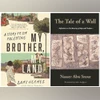 "MY BROTHER, MY LAND: A Story From Palestine")
MY BROTHER, MY LAND: A Story From Palestine
Author: Sami Hermez with Sireen Sawalha
Publisher: Redwood Press
Pages: 296
Price: $26.99
Also Read

The story of Palestine cannot be told smoothly, the critic Edward Said observes in After the Last Sky, a meditation on the complexities of being Palestinian. “Palestinian life is scattered, discontinuous, marked by the artificial and imposed arrangements of interrupted or confined space,” he writes. “No straight line leads from home to birthplace to school to maturity, all events are accidents, all progress is a digression, all residence is exile.”
My Brother, My Land is a memoir of discontinuities, interruptions and confinements. The story belongs to Sireen Sawalha, a Palestinian woman who recounts the short and troubled life of her younger brother, Iyad, a high-ranking member of the militant group Islamic Jihad. Sawalha’s family narratives are relayed to us by the anthropologist Sami Hermez, who weaves them into their historical context.
In early chapters, Sawalha, born in 1966, tells the story of her hardscrabble childhood in the village of Kufr Ra’i, northwest of Nablus. In 1967, Sawalha’s mother, Mayda, was travelling with three young daughters in Jordan when war broke out between Israel and its Arab neighbours. While thousands of Palestinians fled what is now the West Bank, Mayda returned to Kufr Ra’i, where she secured the family home and its small fruit orchard. In Sawalha’s accounts of the olive and plum harvests, the picking of za’atar and the never-ending cycle of chores, she evokes a largely vanished world of rural Palestine before its encirclement by the infrastructure of occupation.
These are the book’s most vivid pages. But it is the story of Iyad, the sixth of Mayda’s 13 children, which takes up most of the book. Born in 1974, Iyad had no experience of life before occupation. As a teenager, he witnessed the deaths of two schoolmates, killed by Israeli soldiers for throwing rocks during the first intifada. Soon after, he joined the paramilitary group Fahd al-Aswad (the Black Panthers) to take arms against the Israeli military.
In 1991, he was involved in the execution of four young men, supposed traitors. Hermez isn’t conclusive about the extent of Iyad’s participation, but notes that he came to regret his role. Iyad was captured, interrogated and sentenced to 215 years in prison.
Seven years after his arrest, he was released as part of the diplomatic measures taken in the wake of the Oslo Accords. In prison, Iyad encountered the teachings of Islamic Jihad. He planned a number of suicide bombing operations in Israel, one of which killed 13 soldiers and several civilians on a public bus. In 2002, Iyad was killed in Jenin by Israeli soldiers, who broke into his hide-out.
At its best, My Brother, My Land captures the tragic stuntedness of Iyad’s life and the sordidness of the occupation. But Hermez often struggles to inhabit his subject. His fascination with Iyad occasionally lapses into uncritical admiration. Hermez describes a desire to “follow the path of Che Guevara,” to connect his writerly work to the liberation of Palestine. “Romantic thoughts,” he admits. “But then there is no resistance without romance.”
There are times one wishes for less romance. The backbone of Hermez’s book is the Sawalha women. It is Mayda who returns to Kufr Ra’i and protects the family home (when Israeli forces demolish it, Iyad tells his sister, “God will build you a palace in heaven”). It is the women who raise the children, take care of the elderly and organise trips to prison. Perhaps there is nothing particularly romantic about such activities, but there would be no resistance without them.
Nasser Abu Srour’s memoir, The Tale of a Wall, echoes the story of Iyad in disquieting fashion. Born in 1969 in a refugee camp near Bethlehem, he was sentenced to life in prison in 1993 after confessing — apparently under torture — to involvement in the killing of an Israeli intelligence officer.
Abu Srour’s book is a disquisition on the toll of prolonged confinement as well as his methods of surviving it. “Don’t set your roots too deep in any world you inhabit,” he advises. “In prison,” he writes, “you are your liberation.”
Another liberation comes through reading. Abu Srour earned a master’s degree in political science while in prison and he scatters references to Kierkegaard, Kant and Derrida throughout the book. His ironic style owes something to the bitter comedies of the Israeli-Palestinian politician and writer Emile Habibi. His flights of lyricism, capably rendered into English by Luke Leafgren, turn each scene of prison life into a kind of prose poem — “rooms and courtyards so narrow that the sun grew tired of being confined within them and moved quickly on” — that recalls the memoirs of the Palestinian poet Mahmoud Darwish.
At times, the fancy prose style seems like an evasion. Abu Srour offers few details about his arrest, interrogation or court case. It is only the book’s back cover that mentions the killing of the Israeli agent. This conspicuous silence is debilitating to the memoir, since the reader can never quite trust Abu Srour’s version of events or account of his motives.
Reading both memoirs, I thought of Darwish’s short poem “No Walls to the Cell,” whose title describes so many sites of Palestinian life, from exile to the refugee camps to Gaza. It is sobering — and frightening — to imagine what stories will emerge from the current invasion, which has turned the prisons of Palestinian existence into slaughterhouses.
The reviewer teaches comparative literature at Yale ©2024 The New York Times News Service
Topics : BS Reads BOOK REVIEW
Don't miss the most important news and views of the day. Get them on our Telegram channel
First Published: May 05 2024 | 10:07 PM IST