


Zimbabwe's surge good for cricket, says UAE coach Lalchand Rajput
UAE coach Lalchand Rajput, who earlier coached Zimbabwe for five years, says their T20 World Cup surge is good for cricket, as he reflects on his current team UAE's progress and associate growth.
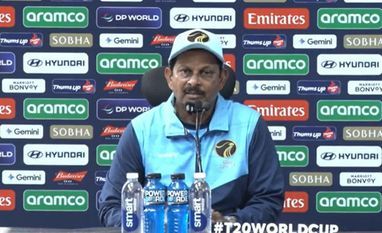 "Lalchand Rajput, current UAE head coach and former Zimbabwe head coach")
Lalchand Rajput, current UAE head coach and former Zimbabwe head coach
Listen to This Article
Zimbabwe’s push for a Super 8 spot at the ICC T20 World Cup 2026 has found an cheerleader in UAE head coach Lalchand Rajput, who previously spent five years as Zimbabwe’s coach.
Rajput said Zimbabwe’s run, highlighted by an upset win over Australia, was a timely reminder of the depth building outside the traditional power centres. “I’m really happy that they upset Australia, they beat Australia,” he said at a pre-match (South Africa vs UAE) press conference while speaking in his current role as UAE coach.
With Zimbabwe still in contention, Rajput framed their campaign as bigger than one tournament. “It will be good for Zimbabwe cricket as well,” he said, adding that after missing out on qualification last time, the World Cup offers a stage for them to show they remain stronger than perception suggests. “This will be a good platform for them to show that they are still in a better team than what is expected of them.”
He did not hide his hope that Zimbabwe would make the most of the moment. “If today, if they beat Ireland, I think Australia will be out,” he said, underlining how a single result could reshape the tournament’s narrative. However, the match between Zimbabwe and Ireland has not started yet due to inclement weather conditions. A washout will eliminated Australia out of the ICC T20 World Cup 2026.
UAE’s campaign: belief as the main takeaway

 "IRE vs ZIM live score T20 World Cup")
 "Top 10 wicket takers and run getters in T20 World Cup 2026")
 "Former Pakistan cricket captain Imran Khan")


For UAE, the immediate task is their final league match, with the side having lost all their previous three games. Rajput said the team’s confidence remained high after a close contest in their last outing against Afghanistan. “The mood is very high in the camp,” he said. “In T20 cricket anything can happen. So we will be going with a positive frame of mind and we will give our best effort (against South Africa).”
Assessing the broader campaign, he acknowledged a slow start but argued the team had shown growth. “Overall, if you look at UAE, I think our journey has been good so far,” he said. “Yes, the first game we never did well as a bowling unit… but the last two games we really proved that we are a better team than what is expected after the first game.”
He pointed to the exposure value of facing stronger opponents, including Afghanistan. “The positive from this tournament [is] that we can really play better cricket with better teams as well,” he said, adding that such games build self-belief in squads that rarely get sustained runs against elite competition.
Sohaib Khan’s rise in the middle order
Among the clearest positives for UAE has been the emergence of Sohaib Khan, who has anchored the middle order across the tournament. Rajput called him “a player who has been a revelation in the middle order,” and traced his pathway from domestic cricket to the World Cup.
“He just came into the team with his performance in the local cricket,” Rajput said. After being invited to camp, the batter impressed in intra-squad games. “So he showed a lot of positive intent and really batted well and he got the opportunity to play in the World Cup and… he has never looked back,” he said.
Rajput underlined Sohaib’s mindset as the defining trait. “He’s mentally strong and he plays fearless cricket,” he said. “To be very honest, he backs his skill… it’s fantastic.”
For UAE, finding a dependable middle-order option is more than a single-tournament story. “It’s a good thing for UAE cricket that we got a batsman who can bat in the middle order,” Rajput said, framing the development as a building block for the next cycle.
Why associate teams are competing closer than expected
The expanded 20-team format has sparked debate around competitiveness, but Rajput said the tournament has shown why associate participation matters. “I’m not surprised,” he said. “We play among associate teams… it is a big platform for these associates to show off their talent.”
He argued that emerging nations are increasingly capable of pushing top sides, and the World Cup has amplified that trend. “The smaller teams are really coming up. It is a good thing that cricket is growing,” he said, adding that associates have effectively told the bigger teams: “Don’t take us lightly.”
The fixture and funding problem
Rajput, however, warned that progress will stall without regular high-level match exposure. “Until you don’t play matches, you won’t be in that situation,” he said, explaining how net sessions cannot replicate pressure moments. He offered examples teams learn only through repetition: “How can you come out of tight situations like 80-5? Or how can you win a match if you need 30 runs in the last two overs?”
The solution, in his view, is simple but difficult to implement: more games against stronger opponents. Even if results lag initially, the experience changes players. “You might win only one out of five games, but it will grow your confidence,” he said.
He also acknowledged the economics behind the imbalance. “The calendar doesn’t allow that thing to happen,” he said, pointing to how commercial pull tends to sit with the top teams. “It’s a TV right… the sponsorship is all because everyone is going for the top 10 teams.”
Still, he believes tournaments like this can shift perceptions and, in turn, funding. “This World Cup will definitely show that the associate countries are good enough so that they always get more funding so that they can play more matches,” he said.
T20 as the leveller, ODI as the next hurdle
Rajput described T20 as the most realistic route for associates to challenge bigger teams. “Any team that can perform better on that particular day will win,” he said, calling it a format where teams cannot afford complacency.
But he was equally clear that UAE’s ambitions extend beyond T20. Qualification for the 50-over World Cup is a stated target, and the preparation required is different. Players need to learn to bat longer, bowl extended spells, and manage phases. “That adaptation will be done only if you play a lot of longer format game,” he said.
To address this gap, Rajput said he has pushed to introduce longer-format cricket domestically in the UAE. “Even in UAE, I started red ball cricket for two days,” he said, explaining it as a way to train patience and endurance that T20 does not demand.
Managing a multicultural squad
As UAE coach, Rajput also spoke about the complexities of leading a diverse squad and the importance of unity. “Challenges will be there, definitely,” he said. The key, he added, is building a cohesive dressing room. “When they come to the ground, it’s one team… we just come as UAE team.”
His method begins with understanding cultural backgrounds and deliberately mixing groups on tour to build bonds. “Once you know the culture, that is very easy to get them together,” he said. Respect, he argued, is the glue. “Once you respect each other’s performance, then the team performs better.”
ILT20 and infrastructure: opportunity, not a shortcut
Rajput credited the ILT20 with helping UAE players gain confidence by sharing environments with elite professionals. “ILT20 has definitely helped the UAE players because they rub shoulders with the top players,” he said, naming several cricketers he described as products of the league.
He also acknowledged the high standard of facilities available in the UAE, aided by the ICC’s presence. “Facilities are excellent,” he said. But infrastructure, he stressed, cannot replace match exposure — especially in longer formats, where endurance and rhythm are learned over time.
More From This Section

 "Australia cricket team will be eliminated if IRE vs ZIM gets washed out")
 "T20 WC Group D points table")
 "IRE vs ZIM T20 World Cup live streaming")
 "NZ vs CAN T20 World Cup live score")
Topics : ICC T20 World Cup Cricket News Zimbabwe
Don't miss the most important news and views of the day. Get them on our Telegram channel
First Published: Feb 17 2026 | 5:21 PM IST