


India, EU seek to reduce strategic dependencies amid uncertainty
13 agreements signed at the India-EU summit underline a joint push to reduce strategic dependencies, deepen trade and defence cooperation, and strengthen supply chains amid a fragmenting global order
 "India EU trade deal, modi, ursla")
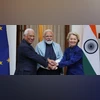
European Council President Antonio Costa, European Commission President Ursula von der Leyen and Indian Prime Minister Narendra Modi ahead of their meeting at the Hyderabad House in New Delhi. Photo: Reuters
Listen to This Article
Neither European Union (EU) leaders Ursula von der Leyen and Antonio Costa nor Prime Minister (PM) Narendra Modi specifically mentioned either the US or China during the course of the day, even as the two sides signed 13 agreements, including a free trade deal.
Yet the joint press conference addressed by the three leaders at Hyderabad House, their respective speeches at the India-EU Business Forum later in the day, and the texts of the agreements signed pointed to a shared effort by India and the EU to reduce dependence on the US and China — as trade partners, strategic partners, or both.
At the joint press conference, European Commission President von der Leyen said the EU and India would, by combining their strengths, “reduce strategic dependencies, at a time when trade is increasingly weaponised”.
Addressing the India-EU Business Forum at Bharat Mandapam in the evening, von der Leyen described the India-EU free trade agreement (FTA) as “a clear strategic choice — a choice for certainty and predictability in an uncertain world”. She said the FTA “signals that Europe and India are choosing cooperation over fragmentation, and partnership over uncertainty”.
On the need for safe and reliable supply chains, the EU leader stressed “the need to reduce dependencies and increase diversification”, including in semiconductors. She also spoke about a new initiative, Blue Valleys, aimed at boosting industrial cooperation in strategic sectors by connecting businesses, regulators, and investors. A small but successful pilot project had been tested in Assam, she said.
Also Read

 "India IT industry, IT services, automation, artificial intelligence, AI, generative AI, Gen AI, skill transformation, organisational structure, entry-level engineers, pyramid structure, diamond-shaped workforce, mid-tier workforce, IT hiring trends,")
 "information technology, IT Sector, IT Service")
 "Apple iPhone, iPhone")
 "spirits, wine, alcohol")
 "RC Bhargava, Chairman Maruti Suzuki")
At Hyderabad House, Costa said the India-EU summit sent a clear message that “at a time when the global order is being fundamentally reshaped, the EU and India stand together as strategic, reliable partners”. He said prosperity does not exist without security, and highlighted EU-India strategic and defence cooperation in the Indo-Pacific, Europe, and beyond.
The India-EU joint statement said the three leaders “underscored the importance of close cooperation on regional and global security matters, acknowledging that the security and prosperity of Europe and the Indo-Pacific are interconnected”.
India and the EU will soon hold the inaugural round of consultations on the Indo-Pacific in New Delhi. They also looked forward to joint activities under the Indo-Pacific Oceans Initiative and to strengthening cooperation in the Indian Ocean Rim Association, under India’s chairship.
Modi said it was a happy coincidence that on the 27th day of the month, India was entering into an FTA with the EU’s 27 member states. He said the defence pact would strengthen cooperation in the Indo-Pacific region, “and our defence companies will gain new opportunities to work together on co-development and co-production”. He added that the India-EU partnership would bolster stability in the international system at a time of profound global turbulence.
“In the course of relations among nations, there are moments when history itself declares that this is where the direction changed, that this is where a new era began. Today’s historic summit between India and the EU represents such a moment,” the PM said.
The three leaders also discussed the Russia-Ukraine conflict, with Costa seeking Modi’s help in creating conditions for a just and sustainable peace through dialogue and diplomacy. Later in the day, when asked about India-Russia ties in the context of these discussions, Foreign Secretary Vikram Misri said New Delhi-Moscow relations have a historical context.
In his address at the India-EU Business Forum, Modi flagged the “weaponisation of trade, technology, and critical minerals”. He said closer engagement between Indian and European businesses could help reduce dependence on others for electric vehicles, batteries, chips, and APIs.
The leaders asked officials to conclude agreements on investment protection and geographical indications at the earliest. They also decided to strengthen the resilience of semiconductor supply chains, promote collaboration in research and development for chip design, deepen cooperation on early-warning systems for APIs, and improve contingency planning for agrifood supply chains.
Von der Leyen said, “India has risen. And Europe is truly glad about it. Because when India succeeds, the world is more stable, more prosperous and more secure. And we all benefit.” She said India and the EU had “delivered the mother of all deals”, which would cut up to €4 billion in annual tariffs for exporters of all sizes and create jobs in both India and Europe.
The joint press conference was marked by visible bonhomie among the three leaders. Modi said Costa is widely admired for his simple way of life and deep commitment to society, earning him the affectionate title of the ‘Gandhi of Lisbon’. He added that von der Leyen — Germany’s first woman defence minister and the first woman president of the European Commission — is a source of inspiration worldwide.
In her speech, von der Leyen referred to the PM as her “dear and distinguished friend Narendra”, while Costa displayed his Overseas Citizen of India card and said he was “very proud” of his Goan roots.
“There is an Indian quote which I like,” von der Leyen said. “Wisdom grows through listening. This is what we did here today, and what we should do in the future.”
More From This Section
 "Modi, Narendra Modi, Antonio Costa, Ursula von der Leyen, Ursula, von der Leyen, Leyen")
 "pharmaceutical sector, pharma")
 "knitwear, textile")
 "gems, jewellery")
 "Union Budget, Nirmala Sitharaman, Fiscal consolidation")
Topics : India European Union FTA
Don't miss the most important news and views of the day. Get them on our Telegram channel
First Published: Jan 27 2026 | 10:38 PM IST