


India-EU trade agreement: Key highlights from 'Mother of all deals'
Prime Minister Narendra Modi said that the free-trade deal accounts for 25 per cent of global gross domestic product and about one-third of global trade
 "Modi, Narendra Modi, Antonio Costa, Ursula von der Leyen, Ursula, von der Leyen, Leyen")
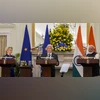
PM Narendra Modi with European Council President Antonio Costa, centre, and European Commission President Ursula von der Leyen during a joint press statement after their meeting at the Hyderabad House, in New Delhi, Tuesday, Jan. 27, 2026.(Photo:PTI)
Listen to This Article
India and the European Union (EU) on Tuesday finalised a major free trade agreement (FTA) at the 16th India–EU Summit in New Delhi. The trade deal, which is being called the 'mother of all deals', will strengthen economic and political ties between the world's second and fourth largest economies at a time of rising geopolitical tensions and global economic challenges.
Prime Minister Narendra Modi said that the free-trade deal accounts for 25 per cent of global gross domestic product (GDP) and about one-third of global trade. The agreement is likely to come into force within a year. Here are the key features of the trade deal:
- Easier trade: The deal will make it easier for both sides to buy and sell goods and services by lowering or removing many trade barriers.
- More exports for India: Over 99 per cent of Indian exports by value will get better access to EU markets, while the EU expects its exports to double by 2032.
- Boost for key Indian sectors: Industries like textiles, apparel, leather, footwear, marine products, gems and jewellery, handicrafts, engineering goods and automobiles will benefit the most.
- Lower duties: Tariffs of up to 10 per cent on about $33 billion worth of Indian exports will be reduced to zero once the agreement comes into effect.
- Support for jobs and small businesses: The deal will help create jobs and support workers, artisans, women, youth, and small businesses.
- Automobile sector: EU carmakers will have limited entry into India, while cars made in India will have better access to EU markets. Indian buyers will get more choices.
- Agriculture sector: Products including tea, coffee, spices, fruits, vegetables and processed food will get better access to the EU, while sensitive areas like dairy and cereals are protected.
- Services trade boost: Strong benefits for IT, IT-enabled services, professional services, education, finance, tourism and construction.
- Easier movement of people: Skilled Indian professionals, business visitors, students and researchers will find it easier to move between India and EU countries. Better options for study, post-study work and professional services in Europe.
- Traditional medicine access: Practitioners of Indian traditional medicine can work in some EU countries.
- Climate support: The agreement includes cooperation to deal with EU carbon rules and help Indian exporters adapt.
- IP protection: Protects intellectual property, including India’s Traditional Knowledge Digital Library.
More From This Section

 "crude oil, oil")
 "Wines")
 "Tim Hodgson, Canada's energy and natural resources minister, center")
 "Modi, Narendra Modi")
 "Modi, Narendra Modi, Antonio Costa, Ursula von der Leyen, Ursula, von der Leyen, Leyen")
Topics : India EU summit EU-India free trade agreement EU-India trade EU-India summit BS Web Reports
Don't miss the most important news and views of the day. Get them on our Telegram channel
First Published: Jan 27 2026 | 3:45 PM IST