


Before Trump, there was Bush Sr: How India dodged US tariffs in 1990s
In the early 1990s, George HW Bush's trade officials threatened sanctions that could have squeezed Indian exports, but cautious reforms helped New Delhi avoid a tariff war
 "US President Donald Trump, PM Narendra Modi, India-US")
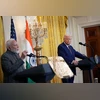
Trump’s 'reciprocal tariff' regime marks a far more expansive use of tariffs as a first-line tool, framed as addressing deficits and reciprocity.| Image: Bloomberg
Listen to This Article
As stormily as US President Donald Trump has revived tariffs in 2025 through his “reciprocal” duties, sparking global concerns, trade tensions between India and the United States are not new. However, India has navigated this terrain before.
An earlier flashpoint came over three decades ago under George HW Bush, when Washington threatened sanctions that raised alarms in New Delhi. At that time, the US was frustrated with India’s closed economy, high tariffs, import bans on consumer goods, and weak intellectual property (IP) rules. Bush Sr’s officials invoked legal provisions under the Omnibus Trade and Competitiveness Act of 1988, which had created 'Super 301' and strengthened 'Special 301' powers for the US Trade Representative (USTR).
What followed was a tense back-and-forth, targeted suspensions of trade benefits from the US side, cautious liberalisation and bargaining from India in 1991 that helped the two sides avoid an all-out tariff war.
What triggered US tariff threats against India?
In 1989, under Super 301, USTR opened probes into India’s restrictive trade regime. By June 1990, India’s insurance policies were ruled “unreasonable” and burdensome to US commerce. Retaliation was deferred as services and investment issues were negotiated in the Uruguay Round of the General Agreement on Tariffs and Trade (GATT).
The sharper escalation came in April 1991 under Special 301. USTR designated India as a "priority foreign country", the toughest category, citing lack of product patents for pharmaceuticals and agricultural chemicals. After a nine-month probe, USTR concluded in February 1992 that India’s IP regime was “unreasonable” and restricted US commerce.
Also Read

 "stem cell therapy mice")
 "Goods and Services Tax, GST")
 "dengue,mosquito")
 "money, cash, currency")
 "elderly, old age")
In April 1992, Bush suspended duty-free Generalised System of Preferences (GSP) benefits on $60 million worth of Indian exports, mainly pharma and chemicals. This was later widened to about $80 million. It marked the most concrete US step against India, but remained targeted rather than sweeping tariffs across the board.
How did India respond to the US actions?
India responded with a mix of domestic reform and sector-specific deals. In mid-1991, facing a balance-of-payments crisis, then prime minister PV Narasimha Rao and finance minister Manmohan Singh began liberalising the economy, resulting in cutting some tariffs, easing licensing and signalling a more transparent regime.
The July 1991 reforms eliminated import licensing for most capital goods and raw materials, opening the economy to foreign inputs. These reforms were key to satisfying demands from the US and the broader international community, and allowed India to sidestep severe US retaliation through a combination of structural change, engagement, and international legal recourse.
In parallel, India engaged in negotiations on IP and film imports. New Delhi made commitments in February 1992 to ease film import restrictions whose implementation started in August 1992.
While product patents for medicines were not adopted then, copyright laws were strengthened by 1994–95, leading to India being downgraded from "priority foreign country" to the "priority watch list" by the USTR.
Did the US ultimately impose broad tariffs on India?
The Bush administration stopped short of sweeping tariffs. Broader retaliation flagged in 1990 did not proceed, and the dispute shifted into multilateral tracks, including the Uruguay Round and eventual WTO-linked TRIPS negotiations. This combination of selective concessions, structural reforms, and global negotiations lowered tensions and allowed India to sidestep wider sanctions.
Implications for India and lessons for today
For India, the episode underscored that market-access barriers and weak IP rules could carry real costs even short of tariffs. The 1992 GSP suspension hit sensitive sectors and signalled to investors that rules would tighten over time. It also intersected with domestic reform needs, nudging steps toward transparency, sectoral openings and eventual TRIPS-related commitments later in the 1990s.
Now Trump’s 'reciprocal tariff' regime marks a far more expansive use of tariffs as a first-line tool, framed as addressing deficits and reciprocity. Amid market turbulence and negotiations, the White House has repeatedly modified the schedule and, as of August 11, extended a truce with China for 90 days. By contrast, the Bush Sr era relied on targeted programme suspensions (like GSP) and case-by-case pressure to secure reforms, while keeping larger tariff escalation in reserve.
The 1990-92 playbook suggests New Delhi can limit damage by addressing pinpoint grievances, keeping channels open and avoiding confrontational escalation that invites blanket tariffs. Back then, selective concessions and broader reforms helped India dodge wider sanctions. With global conditions more volatile today and US tools sharper, the margin for error is thinner.
More From This Section
 "Former Reserve Bank of India governor D Subbarao")
 "cars, toyota")
 "White House")
 "India US Trade")
 "ss")
Don't miss the most important news and views of the day. Get them on our Telegram channel
First Published: Aug 18 2025 | 5:28 PM IST