


All our pilots are back home; Op Sindoor objectives achieved: Armed forces
Indian armed forces to respond 'fiercely' and 'punitively' if Pakistan continues violations of understanding to stop all firing and military action
 "Operation Sindoor")
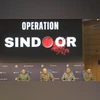
DGMO Lieutenant General Rajeev Ghai, Director General of Air Operations Air Marshal AK Bharti, and Director General of Naval Operations Vice Admiral A N Pramod on Sunday disclosed the details of 'Operation Sindoor'
Listen to This Article
India on Sunday said that all pilots of the Indian Air Force (IAF) that took part in Operation Sindoor, which began with precision strikes on nine terror camps in Pakistan's Punjab province and Pakistan-occupied Jammu and Kashmir in response to the April 22 Pahalgam terrorist attack, were back home, although the air force did not provide a specific response to any loss of Indian aircraft. The armed forces did not deny losses, but underscored that the aim of the operation had been achieved.
The Director General of Military Operations Lieutenant General Rajiv Ghai, Director General of Air Operations Air Marshal AK Bharti, and Director General of Naval Operations Vice Admiral AN Pramod on Sunday disclosed the details of 'Operation Sindoor', even as the tenuous understanding to stop all firing and military action on land and in the air and sea, arrived at between the militaries of the two countries on Saturday afternoon, held, despite violations by the Pakistani side just hours after the agreement came into effect on Saturday.
Responding to a media query on the possible loss of IAF aircraft in the operation and subsequent military exchanges with Pakistan, Air Marshal AK Bharti did not provide a specific response, but maintained that all Indian pilots were back home. "We are in a combat scenario, and losses are a part of combat. The question you must ask us is, have we achieved our objective of decimating the terrorist camps? And the answer is a thumping yes. And the results are for the whole world to see," said Air Marshal Bharti, adding, "As for the details of how many numbers or which platform did we lose, at this point of time, I would not like to comment on that because we are still in a combat situation. If I comment on anything, it will only be an advantage for the adversary. We don't want to give them any advantage at this stage." He ended his answer by confirming, "All I can say is that we have achieved the objectives that we selected and all our pilots are back home."
Responding to another media query, Air Marshal Bharti also said that the armed forces had successfully downed a few Pakistani aircraft during Operation Sindoor. "Their planes were prevented from coming inside our border. So, we don't have the wreckage with us. But, we have definitely downed a few Pakistani planes. We would not like to hazard a guess on the numbers," said Air Marshal Bharti. However, he added that the IAF did have an estimate on the number of Pakistani planes shot down and was working to establish the facts.
Also Read

 "Air Marshal AK Bharti")
 "Su 30MKI, Sukhoi, IAF")
 "Amitabh Bachchan,Amitabh")
 "Bhagwant Mann, Bhagwant, Punjab CM")
 "ICAI India")
At the beifing, Director General of Military Operations Lt. Gen. Ghai said that over 100 terrorists were eliminated in the May 7 operation. Lt Gen Ghai also said that the nine terror camps targeted were identified after careful deliberations. He added that the Pakistan Army had lost between 35 to 40 personnel between May 7 and 10 in the military exchanges between the two sides.
He added that Operation Sindoor was conceptualised with a precise military aim to "punish the perpetrators and planners of the Pahalgam terror attack". Lt Gen Ghai also underlined that the May 7 strikes killed "high-value targets" such as Yusuf Azhar, Abdul Malik Rauf, and Mudassir Ahmad, who were involved in the hijacking of IC 814, and the Pulwama attack, where 40 CRPF jawans were killed in 2019.
The Director General of Military Operations of Pakistan had called Lt Gen Ghai on Saturday afternoon, after which it was agreed between them that both sides would stop all firing and military action on land and in the air and sea with effect from 1700 hours Indian Standard Time that same day. While instructions had already been given on both sides to give effect to the understanding, violations from the Pakistani side occurred within hours.
"However, disappointingly, and should I add, expectedly, it took only a couple of hours for the Pakistan Army to violate these arrangements by cross-border and Line of Control firing, followed by drone intrusions across the expanse of the Western Front, through last night and in the early hours of the morning today. These violations were responded to robustly and dealt with as they must be," said Lt Gen Ghai. "We have earlier today sent across a hotline message to the Pakistan DGMO, highlighting their violation of the understanding and our firm and clear intent to respond to these [violations] fiercely and punitively, if repeated tonight or later," he underscored.
The Director Generals of Military Operations were also slated to talk again on Monday, which would go ahead as planned.
Lt Gen Ghai also revealed that five armed forces personnel had been killed in the operations ongoing since May 7. "In the end, I pay my solemn homage to my five fallen colleagues and brothers from the armed forces and civilians who have tragically lost their lives in Operation Sindoor. Our hearts go out to the bereaved families and we express our solidarity to them...," he said. "We have thus far exercised immense restraint and our actions have been focused, measured and non-escalatory. However, any threat to the sovereignty, territorial integrity, or safety of our citizens will be met with decisive force," he added.
Director General of Naval Operations Vice Admiral Pramod said that in the aftermath of the Pahalgam terror attack, the Navy's Carrier Battle Group, surface forces, submarines, and aviation assets were immediately deployed at sea with full combat readiness, in concert with the joint operational plan of the Indian Defence Forces. "You may be aware that we tested and refined tactics and procedures at sea during multiple weapon firings in the Arabian Sea, within 96 hours of the terrorist attack. The aim was to revalidate our crew, armament, equipment and platform readiness to deliver various ordnance on selected targets precisely," he said.
Vice Admiral Pramod added that subsequently, Indian naval forces remained forward deployed in the Northern Arabian Sea in a "dissuasive and deterrent posture, with full readiness and capacity to strike select targets at sea, and on land, including Karachi, at time of our choosing".
"The forward deployment of the Indian Navy compelled Pakistani Naval and air units to be in a defensive posture, mostly inside harbours or very close to their coast, which we monitored continuously," he said, adding, "The Indian Navy maintained seamless Maritime Domain Awareness throughout the duration and was entirely aware of the location and movement of Pakistani units."
Vice Admiral Pramod underscored that along with the kinetic actions by the Indian Army and the IAF, the "overwhelming operational edge of the Indian Navy at sea", contributed towards Pakistan's "urgent request for a ceasefire yesterday".
He also assured that the Navy remained deployed at sea in a credible deterrent posture, to respond decisively to any inimical action by Pakistan, or Pakistan-based terrorist.
Earlier on Sunday, Army Chief Gen Upendra Dwivedi gave full authority to the Army commanders for kinetic response to any violation of the understanding reached between the Indian and Pakistani militaries.
"Consequent to the ceasefire and airspace violations on the night of May 10-11, the Chief of Army Staff reviewed the security situation with the Army Commanders of the Western Borders," the Army said.
The Army Chief "has granted full authority to the Army Commanders for counteraction in the kinetic domain to any violation of the understanding reached vide the DGMO talks of May 10", it said.
More From This Section
 "Operation Sindoor")
 "Modi, Narendra Modi")
 "APJ Abdul Kalam")
 "Lieutenant General Rajiv Ghai")
 "Terrorist attack, Terrorism, Kathua Terrorist attack, Army, Indian Army")
Topics : Indian Navy Operation Sindoor News Operation Sindoor Indian Air Force Indian military Indian Army terrorist attacks
Don't miss the most important news and views of the day. Get them on our Telegram channel
First Published: May 11 2025 | 10:29 PM IST