


Will make 'wonderful' trade deal: Donald Trump as he meets PM Modi
India, US look to negotiate agreement in 7-8 months, eye $500 bn bilateral trade by 2030
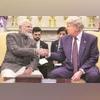 "MEGA PARTNERSHIP: Prime Minister Narendra Modi (left) with US President Donald Trump at the White House late on Thursday photo: pti")
MEGA PARTNERSHIP: Prime Minister Narendra Modi (left) with US President Donald Trump at the White House late on Thursday photo: pti


Listen to This Article
Prime Minister Narendra Modi and US President Donald Trump agreed Thursday night to begin negotiations and finalise a “mutually beneficial” bilateral trade agreement (BTA) within the next seven to eight months. The announcement came just hours after the US unveiled a plan to impose reciprocal tariffs on its trading partners starting in April, a move that could significantly impact countries like India.
Shortly after announcing the reciprocal tariff policy, and before the two leaders commenced their talks at the White House, Trump responded to a media question by saying: “We have separate big trade deals to announce in the very near future. We are going to make some wonderful trade deals for India and for the US.”
At a joint press conference with Modi, Trump justified the US’ decision to impose reciprocal tariffs as a mechanism of fairness. “Whatever India charges, we charge them. So frankly, it doesn’t matter to us that much what they charge. I had discussions with India in my first term about the fact that their tariff was very high. I was unable to get a concession. We are just going to do it the easy way and say: Whatever you charge, we charge. That’s fair for the people of the US, and I think it is fair for India,” Trump said.
In a factsheet, the White House identified India, along with Brazil and the European Union, as high-tariff economies. “The US average applied Most Favoured Nation (MFN) tariff on agricultural goods is 5 per cent, but India’s average applied MFN tariff is 39 per cent. India also charges a 100 per cent tariff on US motorcycles, while we only charge a 2.4 per cent tariff on Indian motorcycles,” it stated.
Both sides launched a new initiative — the US-India COMPACT (Catalyzing Opportunities for Military Partnership, Accelerated Commerce & Technology) for the 21st Century — to drive transformative change across key areas of cooperation. Under this initiative, the two countries committed to a results-driven agenda, with initial outcomes expected this year, to reinforce trust in their partnership.
Also Read

 "Modi, Narendra Modi, Donald Trump, Trump")
 "Modi, Narendra Modi, Donald Trump, Trump")
 "Pralhad Joshi")
 "Modi, Narendra Modi, Donald Trump, Trump")
 "Rajiv Kumar, CEC")
India and the US also set a new bilateral trade target —Mission 500 —aiming to more than double total trade to $500 billion by 2030.
“Recognising that this level of ambition would require new, fair-trade terms, the leaders announced plans to negotiate the first tranche of a mutually beneficial, multi-sector bilateral trade agreement (BTA) by fall of 2025. The leaders committed to designate senior representatives to advance these negotiations and to ensure that the trade relationship fully reflects the aspirations of the COMPACT. To advance this innovative, wide-ranging BTA, the US and India will take an integrated approach to strengthen and deepen bilateral trade across the goods and services sector, and will work towards increasing market access, reducing tariff and non-tariff barriers, and deepening supply chain integration,” both sides said in a joint statement.
Briefing reporters in Washington, DC, after the leaders’ meeting, Foreign Secretary Vikram Misri said both sides are looking at the next “seven to eight months” to complete BTA negotiations. “Today, both teams have received instructions from the highest level to start engaging on this, and work will begin as quickly as possible,” he said.
On reciprocal tariffs, Misri added: “We have indicated, and the two leaders have agreed, to start discussions on trade and tariff-related issues. I will let those discussions begin before commenting on what may happen regarding
the plans that have been announced by the US administration.”
The US welcomed India’s recent steps to lower tariffs on American products, including bourbon whisky (on which the government halved agri cess to 50 per cent on Friday), motorcycles, ICT products, and metals. It also acknowledged India’s efforts to enhance market access for US agricultural goods such as alfalfa hay, duck meat, and medical devices. “Both sides also pledged to collaborate to enhance bilateral trade by increasing US exports of industrial goods to India and Indian exports of labour-intensive manufactured products to the United States. The two sides will also work together to increase trade in agricultural goods,” the joint statement said.
The leaders committed to creating opportunities for American and Indian companies to make greenfield investments in high-value industries in each other’s markets.
To advance defence ties, Modi and Trump announced plans to sign a new 10-year “Framework for the US-India Major Defense Partnership in the 21st Century”. They agreed that the US would expand defence sales and co-production with India to strengthen interoperability and industrial cooperation.
During the press conference, Trump said the US would increase military sales to India by “many billions of dollars”, including the F-35 stealth fighters. However, Misri later clarified that the process had not yet started. “This is currently at the stage of a proposal,” he said.
The joint statement also reaffirmed the commitment to establishing the US as a leading supplier of crude oil, petroleum products, and liquefied natural gas (LNG) to India.
Misri noted that India is already a significant importer of US energy, with purchases totalling $15 billion last year. “There is a good chance this figure will rise to as much as $25 billion in the near future. Today’s discussions focused considerably on increasing energy purchases and these energy purchases will contribute to impacting the deficit between the two countries, as well,” he added.
The leaders announced their commitment to fully implementing the US-India 123 Civil Nuclear Agreement by working together to build US-designed nuclear reactors in India through large-scale localisation and possible technology transfer.
Additionally, they launched the US-India TRUST (Transforming the Relationship Utilizing Strategic Technology) initiative to foster collaboration among governments, academia, and private sectors in areas such as defence, artificial intelligence, semiconductors, quantum computing, biotechnology, energy, and space. As a key pillar of the TRUST initiative, the two countries committed to delivering a "US-India Roadmap on Accelerating AI Infrastructure” by the end of the year. This roadmap will identify constraints to financing, building, powering, and connecting large-scale US-origin AI infrastructure in India, along with milestones and future actions.
Recognizing the strategic importance of critical minerals for emerging technologies and advanced manufacturing, Modi and Trump also announced the launch of the Strategic Mineral Recovery Initiative, a new US-India programme to recover and process critical minerals — including lithium, cobalt, and rare earths — from heavy industries such as aluminium, coal mining, and oil and gas.
More From This Section
 "Manohar Lal Khattar, Manohar Lal, Khattar, Manohar")
 "Modi, Narendra Modi, Donald Trump, Trump")
 "Alex zino, executive vice-president, business development and future programmes, Rolls-Royce (Defence)")
 "IAF, Indian Air Force, Air Force Day, IAF Chennai")
 "US military C-17 aircraft")
Don't miss the most important news and views of the day. Get them on our Telegram channel
First Published: Feb 14 2025 | 10:22 PM IST