


IAF chief says 2047 roadmap ready, manned jets still vital amid drone push
Air Chief Marshal AP Singh said that the air force is actively monitoring global advancements in air power, which could inform updates to the roadmap over time
 "AP Singh")
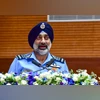
Chief of the Air Staff (CAS) Air Chief Marshal AP Singh. (Photo: PTI)
Listen to This Article
Chief of the Air Staff (CAS), Air Chief Marshal AP Singh, said on Friday that the Indian Air Force (IAF) has formulated a technology and capability roadmap titled ‘Vision 2047’ and is actively working towards its realisation to prepare for the evolving nature of warfare. He also emphasised that unmanned systems are not expected to fully replace manned fighter jets in the foreseeable future.
Speaking at a press conference in the national capital ahead of the 93rd Air Force Day, the IAF chief outlined the roadmap’s overarching goal: “We are transforming ourselves into a multi-domain aerospace force — one that can safeguard national interests and serve as a capable military instrument of choice across the entire spectrum of conflict.” Clarifying that the roadmap is not a finalised document, he also explained that it represents the IAF’s current assessment of how technologies and capabilities are expected to evolve. He added that the air force is actively monitoring global advancements in air power, which could inform updates to the roadmap over time. The IAF chief added that the roadmap is anchored in self-reliance (Aatmanirbharta), without which the timely procurement and effective exploitation of equipment — as and when required — is not possible.
While declining to disclose specifics of the roadmap, the IAF chief offered an indication of the service’s future priorities by noting that all the handful of sixth-generation combat aircraft programmes underway globally are manned platforms. “The importance of manned platforms, as I see it in the foreseeable future — and I am not talking just eight to ten years, but even beyond that — is not going to fade away,” he said.
He acknowledged that automation and artificial intelligence are advancing rapidly and that more unmanned systems will become available. However, these systems, he stressed, would need to work in collaboration with manned platforms or remain under human control. “Some decisions will still have to be taken by a human, so the relevance of fighters will remain in the years to come,” he said, adding: “Saying that my next generation will see only unmanned systems… it will not happen like that. Manned platforms will remain.”
However, the CAS emphasised that the IAF is fully supporting the Ghatak unmanned combat aerial vehicle (UCAV) being developed by the Defence Research and Development Organisation (DRDO). “Yes, we have to work towards unmanned systems as well,” he said. “There are certain areas where you don’t want to risk human life, where unmanned systems are necessary — places where they can operate ahead of your manned systems. So, work is underway in that direction, and a number of R&D projects are ongoing.”
Also Read

 "Amar Preet Singh, Amar Preet, Air Chief MarshalAmar Preet Singh, Amar Preet, Air Chief Marshal")
 "MiG-21 aircraft")
 "AMCA")
 "Rajnath Singh")
 "Anil Chauhan, Anil, CDS")
He added that, in addition to conventional UAVs, processes for acquiring combat- and weapon-capable UAVs are also in place. “The UCAV programme is already on, and we are fully supporting it. We understand it has to be part of our overall force structure. The Vision 2047 document also talks about it,” he said, before reiterating: “But taking (manned) fighters out will not happen.”
Underscoring the need for a forward-looking roadmap, the IAF chief remarked, “We cannot rest on our past laurels, including Operation Sindoor… The character of war is ever-changing… and the next war is not going to be exactly like the previous one.”
Responding to a question on how the IAF was addressing challenges along the northern borders, the CAS said that new infrastructure was coming up in the forward areas almost every day. “New advanced landing grounds, new air bases are being built and developed. New options are being considered on how we can take our resources to the forward areas, how we can support our troops there. Along with that, we’re addressing the challenges of the terrain, which is quite different from that faced on the western front in terms of elevation.” He added, “In terms of our weapon systems, our aircraft… our tactics are being optimised for those challenges — for that terrain and the equipment the adversary has. It’s a continuous process that is underway.”
Asked about Pakistan’s losses during Operation Sindoor, the IAF chief said the Pakistan Air Force (PAF) may have lost as many as 13 platforms — including a number of its prized American F-16 fighter jets — during the nearly four-day conflict.
He said the IAF’s strikes damaged or destroyed radars at around four locations, command and control centres at two others, and runways at two. He added that three PAF hangars across three separate stations were also hit, damaging or destroying two large platforms — likely in the class of the American C-130 transport aircraft and an airborne early warning and control (AEW&C) platform.
Also destroyed or damaged are at least four-five fighter aircraft, most likely F-16s that were under maintenance on the ground.
According to the IAF chief, one Pakistani surface-to-air missile (SAM) system was also destroyed.
Reiterating his earlier remarks, the IAF chief said there was clear evidence of one long-range SAM strike that hit either an AEW&C or another signals intelligence aircraft more than 300 kilometres away — the longest-ever such strike by the IAF.
He added that five high-tech fighters — either F-16s, Chinese-origin JF-17s, or both — were also struck in the air.
More From This Section
 "United Nations Human Rights Council, UNHRC")
 "Rajnath Singh")
 "China-Taiwan drills, China-Taiwan, Taiwan")
 "Ministry of External Affairs official spokesperson Randhir Jaiswal")
 "indigo airlines, indigo")
Topics : Indian Air Force Indian Army Fighter jet
Don't miss the most important news and views of the day. Get them on our Telegram channel
First Published: Oct 03 2025 | 6:13 PM IST