


MiG-21 jet flies into the sunset after six decades of distinguished service
As the Indian Air Force retires MiG-21 jets today, take a look at India's first supersonic fighter that catapulted India into the jet age with a combat record that is both celebrated and controversial
 "MiG-21 aircraft")
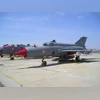
The last MiG-21 jets, from Squadron No 23 nicknamed ‘Panthers’, will bid farewell in Chandigarh. (Photo/Wikipedia)
Listen to This Article
Defence Minister Rajnath Singh arrived in Chandigarh on Friday (September 26) to take part in the Indian Air Force’s (IAF) ceremony marking the retirement of MiG-21 fighter jets.
Bidding farewell to the Russian-made aircraft, Singh highlighted its symbolic value in India-Russia relations. "MiG 21 is not only an aircraft or a machine but it is also a proof of deep ties between India and Russia," he said.
He also noted the aircraft’s unique place in aviation history, adding, "In the history of the world's military aviation, there has not been any fighter jet which was made in such a big number."
Also Read

 "The MiG-21 is used for defensive sorties in the war against Pakistan")
 "MiG 21, MiG21")
 "Rajnath Singh")
 "Caption: Indian Air Force's Light Combat Aircraft (LCA) Tejas Mk-I. Image Credit: PIB")
 "Mig-21 Bison")
Inducted in 1963, the MiG-21 served the IAF for nearly 60 years. Known as India’s first supersonic fighter, its first squadron — the 28 Squadron — was raised in Chandigarh and earned the nickname ‘First Supersonics’.
Over decades, the MiG-21 became the backbone of India’s aerial combat strength, flying in every major conflict, including the 1965 and 1971 wars, the 1999 Kargil conflict, and the 2019 Balakot airstrikes.
Historic combat record
The MiG-21 proved its worth on the battlefield. In the 1971 war, it bombed the Governor’s residence in Dhaka, hastening Pakistan’s surrender. It shot down Pakistan’s F-104 fighters in the same war and even an F-16 in 2019, cementing its reputation as one of the IAF’s most battle-tested jets.
Despite its successes, the aircraft earned criticism for its poor safety record, with many crashes over the years. Yet, veterans argue that calling it a “flying coffin” undermines its legacy and the morale of pilots who flew it.
Final flight for the ‘Panthers’
The last MiG-21 jets, from Squadron No 23 nicknamed ‘Panthers’, will bid farewell in Chandigarh. Ahead of the ceremony, a full-dress rehearsal featured stunning aerobatic displays, intercept operations and a ceremonial water-cannon salute.
The Surya Kiran aerobatic team and Akash Ganga skydivers also performed, showcasing the aircraft’s enduring spirit.
Transition to new generation jets
The retirement of the MiG-21 reduces the IAF’s fighter squadron strength to 29, against the sanctioned 42. The force plans to replace the jet with the indigenous Tejas Light Combat Aircraft (LCA) Mark-1A.
The Defence Ministry signed a ₹48,000 crore deal in 2021 with Hindustan Aeronautics Ltd (HAL) for 83 Tejas aircraft, and another ₹67,000 crore deal for 97 more is in the works.
Pilots recall challenges and triumphs
Veteran pilots shared their memories in a special IAF podcast. Former Air Chief Marshal AY Tipnis recalled flying the MiG-21 without trainers or simulators when it was first inducted, and dealing with Russian-language cockpit instruments. “The MiG-21 taught us how to be innovative and produce results,” he said.
Other officers described the aircraft as an “icon, trusted companion in war and peace, and proving ground for generations of fighter pilots”. On X, the IAF paid tribute, calling the MiG-21 a “warhorse that carried the pride of a nation into the skies”.
As the jets roar for one last time over Chandigarh on Friday, the MiG-21’s unmatched service, combat record, and training legacy will remain etched in India’s aviation history.
[With agency inputs]
More From This Section
 "G4 Foreign Ministers Meeting")
 "S Jaishankar, Jaishankar")
 "oil import")
 "agni prime missile, rail launcher")
 "tejas, defence, lca")
Don't miss the most important news and views of the day. Get them on our Telegram channel
First Published: Sep 26 2025 | 11:36 AM IST