


India seen as 'reorienting' bilateral defence relations with Russia
Both sides agreed to encourage joint manufacturing in India of spare parts, components, aggregates and other products for the maintenance of Russian-origin arms and equipment
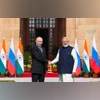 "Russian President Putin, PM Modi")
Prime Minister Narendra Modi and Russian President Vladimir Putin | Image: DD News
Listen to This Article
The joint statement released by the Indian government after summit talks between Prime Minister Narendra Modi and Russian President Vladimir Putin in New Delhi on Friday included four paragraphs on military and military-technical cooperation, described as the traditional pillar of India-Russia strategic relations.
Bilateral ties covering military-technical collaboration, security, nuclear energy and outer space were formalised as a “strategic” partnership during Putin’s India visit in 2000, and upgraded to “special and privileged” in 2021. At a joint media appearance on Friday, Modi said Putin had laid the foundations of the strategic partnership 25 years ago.
Although no specific details of the defence discussions during Putin’s visit were mentioned in Friday’s document or in Thursday’s statement after the defence ministers’ meeting, the language in both appeared to signal a shift — with “coproduction” emerging as a clear goal for India.
“Responding to India’s quest for self-reliance, the partnership is reorienting presently to joint research and development, co-development and coproduction of advanced defence technology and systems,” Friday’s joint statement said.
Both sides agreed to encourage joint manufacturing in India of spare parts, components, aggregates and other products for the maintenance of Russian-origin arms and equipment under the Make in India programme, through technology transfer and the setting up of joint ventures. These would meet the requirements of the Indian armed forces and allow for export to mutually friendly third countries, the statement added.
Also Read

 "India Russia Trade")
 "Modi, Narendra Modi, Vladimir Putin")
 "Woman in a hospital")
 "An unarmed Minuteman III intercontinental ballistic missile during a test at Vandenberg Space Force Base, California, on November 5, 2025 (Photo: United States Space Force)")
 "agrochemical")
“Russia and India have traditionally maintained close cooperation in the military-technical sphere. For more than half a century, our country has assisted in equipping and modernizing the Indian armed forces, including air defence, aviation and the navy,” Putin said in remarks to the media, as translated by the Russian embassy in New Delhi.
The two leaders “welcomed the outcomes” of Thursday’s session of the India-Russia Intergovernmental Commission on Military and Military-Technical Cooperation, co-chaired by Defence Minister Rajnath Singh and his Russian counterpart Andrei Belousov. However, no specific outcome was cited on either day. Singh said India remained determined to build domestically for defence production and export.
“Putin’s visit is important, in the sense of the larger picture, that of a diplomatic ‘split- screen’,” Lieutenant General Raj Shukla said, referring to the India-Russia and India-US relations at the same time.
India’s relations with the US have frayed since President Donald Trump announced 50 per cent tariffs on Indian goods in August. Half of it is considered “punishment tariff” for India’s purchases of Russian crude oil.
The Indian Army veteran said legacy defence platforms that India sourced from Russia for decades have now given way to emerging critical technologies that India needs — and which the US, for instance, can provide. Even so, Russia remains a key strategic partner, Shukla said.
While no major defence deals were announced ahead of Putin’s visit, Indian military sources had said India was likely to discuss acquiring additional S-400 missile systems. Two pending batteries of the five contracted from Russia for $5.43 billion in 2018 have been delayed by the Ukraine war and are expected by 2026–27.
Looking ahead, if India decides to procure the Russian-made S-500 missile system — which would provide greater air-defence coverage than the S-400, used effectively by India in the four-day conflict with Pakistan in May — then the S-500 should be jointly produced in India, Shukla said.
India’s defence imports from Russia fell from 76 per cent over 2009–13 to 36 per cent over 2019-23, according to the Stockholm International Peace Research Institute (Sipri).
More From This Section
 "India US trade, US import tariffs 2025, reciprocal tariffs India, Indian exporters US, apparel export India, 90-day tariff pause, US India trade relations, export challenges tailor-made goods, US tariff impact India, Indo-US apparel trade")
 "Russian President Putin, PM Modi")
 "Russian President Vladimir Putin walks past guards of honour during a ceremonial reception prior to his meetings with Indian officials in New Delhi, India, December 5, 2025 | REUTERS")
 "Modi-Putin")
 "Russian President Vladimir Putin with Prime Minister Narendra Modi (Photo: PTI)")
Don't miss the most important news and views of the day. Get them on our Telegram channel
First Published: Dec 05 2025 | 8:53 PM IST