


US calls for stronger ties with India to bolster Indo-Pacific security
The White House's new national security strategy urges deeper ties with India to reinforce Indo-Pacific stability, citing the region's rising economic weight
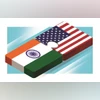 "India US trade, US import tariffs 2025, reciprocal tariffs India, Indian exporters US, apparel export India, 90-day tariff pause, US India trade relations, export challenges tailor-made goods, US tariff impact India, Indo-US apparel trade")
India, the world’s most populous nation and the fifth-largest economy, is identified as central to sustaining balance and stability in the Ind0-Pacific region..
Listen to This Article
The White House has called for stronger ties with India to help ensure security in the Indo-Pacific, a region it described as economically indispensable to the United States.
In its November edition of 'The National Security Strategy of the United States of America' report, Washington underlined the need to "deepen cooperation with New Delhi" across commercial, strategic and multilateral frameworks.
“We must continue to improve commercial (and other) relations with India to encourage New Delhi to contribute to Indo-Pacific security, including through continued quadrilateral cooperation (The Quad) with Australia, Japan, and the US,” the report said.
The strategy highlighted the need to align US allies and partners to prevent dominance in the region by any single competitor nation.
Also Read

 "Spicejet")
 "DGCA")
 "Canada, Canada visa, canada immigration")
 "EB-5 visa")
 "Tax")
Why the Indo-Pacific matters to the US
The Indo-Pacific, the report noted, already accounts for almost half of global GDP based on purchasing power parity and around one-third based on nominal GDP.
“That share is certain to grow over the 21st century... the Indo-Pacific is already and will continue to be among the next century’s key economic and geopolitical battlegrounds,” the document said. “To thrive at home, we must successfully compete there—and we are.”
The document explicitly frames the Indo-Pacific as the region where the US must:
- Compete economically with China
- Deter military conflict, especially over Taiwan
- Strengthen alliances and partnerships, particularly with India, Japan, Australia, South Korea and others
Where India fits into the strategy
India, the world’s most populous nation and the fifth-largest economy, is identified as central to sustaining balance and stability in the region. The report arrives as New Delhi and Washington negotiate a trade pact that officials say is nearing completion.
The first tranche of the deal is “more or less near closure”, and is expected to address reciprocal tariffs imposed by Washington on several Indian products. The US currently levies 50 per cent tariffs on India, including a punitive 25 per cent duty linked to New Delhi’s Russian oil imports.
Energy ties reshape as flows shift
Indian refiners have recently cut back on Russian oil imports and increased purchases of US crude. India’s crude imports from the US rose in October to 593,000 barrels per day, the highest since March 2021.
Russian imports, however, remained sizeable. In November, India imported around 1.8 million barrels per day, accounting for more than 35 per cent of its crude basket. The increase reflected refiners front-loading purchases ahead of a November 21 deadline; flows later eased to around 1.27 million barrels per day, according to Kpler.
More From This Section
 "Russian President Putin, PM Modi")
 "Russian President Vladimir Putin walks past guards of honour during a ceremonial reception prior to his meetings with Indian officials in New Delhi, India, December 5, 2025 | REUTERS")
 "Modi-Putin")
 "Russian President Vladimir Putin with Prime Minister Narendra Modi (Photo: PTI)")
 "Vladimir Putin, Putin")
Don't miss the most important news and views of the day. Get them on our Telegram channel
First Published: Dec 05 2025 | 5:14 PM IST