


Working hard? This smart tattoo on forehead could soon let your boss know
Researchers at the University of Texas have developed a soft, wireless 'electronic tattoo' that tracks brainwaves in real time-promising safer, smarter monitoring in fields like aviation and surgery
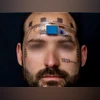 "tattoo")
The brain-reading tattoo, a transparent patch on the forehead, raises major concerns about mental privacy in the workplace.
Listen to This Article
Imagine a wearable device so light and flexible it sticks to your skin like a temporary tattoo, yet it knows exactly how hard your brain is working. That’s exactly what a group of researchers at the University of Texas at Austin have developed: a wireless, skin-soft ‘electronic tattoo’ that tracks brainwaves and eye movements in real-time, offering a window into our mental workload.
The team, led by Nanshu Lu, says the device could be a game-changer for monitoring cognitive effort, especially in high-stakes jobs like aviation, surgery, and defence, where fatigue and mental overload can lead to catastrophic mistakes.
But there’s a catch, and it’s not small.
The brain-reading tattoo, which looks like a transparent patch with delicate black lines feeding into a tiny blue chip at the centre of the forehead, raises serious questions about mental privacy in the workplace.
Experts warn that the technology, while promising, could be used to monitor not just performance but a person’s mood, stress levels, or even mental health — all without clear rules on how such intimate data should be handled.
Also Read

 "mental health, teenageers")
 "Negative thinking, mental health")
 "medtech, medical technology, healthcare, medical")
 "heart health, healthy men, man, sad man, men's health")
 "Frustration, office, employee, mental health, stress")
The research, published last week in the journal Device, was funded in part by the US Army Research Office. The wearable collects electroencephalogram (EEG) and electrooculogram (EOG) data — brainwave and eye movement patterns — which are fed into machine-learning models to estimate how hard a person is thinking. The breakthrough is in the form: traditional EEG setups require bulky, wired headgear. This one, at just $200, is ultra-thin, stick-on, and designed to move with the face.
In a pilot test, six volunteers wore versions customised to their facial contours. As they performed memory tasks of increasing complexity, the system accurately detected rising mental effort — and it did so in real-time, as they moved. It could be a huge leap for industries where human focus is critical.
Stephen Damianos, executive director of the Neurorights Foundation, says that while there may be genuine safety benefits, the rush to deploy brain-monitoring tech is outpacing regulation.
“There’s a real risk of coerced mental surveillance in the workplace,” Damianos was quoted as saying by the Financial Times.
“Without clear protections, people might find themselves excluded from jobs, penalised by insurers, or monitored at work — not for performance, but for what their brains reveal about their mental health, fatigue, or stress.”
Damianos also emphasises that neurodata (data from our brains) is not the same as a step count or heart rate. It reveals something much more personal. Yet a 2024 review of 30 neurotech companies found most lacked transparency on who actually owns users’ brain data.
It’s a cautionary tale with echoes of the downfall of 23andMe, the genetic testing firm whose users later struggled to delete their data, with little clarity on who controlled it.
And while the forehead tattoo only captures signals from the front of the brain — and works best on hairless, sweat-free skin — it’s a clear sign of where the field is headed: smaller, cheaper, faster tools that look inside our minds.
Whether this revolution empowers or exploits workers will depend not on the technology but on the laws and ethics we build around it. “Neurodata is personal data,” Damianos says. “And unless we act now, we may lose ownership of our inner lives before we even realise it.”
More From This Section
 "covid, coronavirus, covid-19")
 "covid corona mask")
 "Revenge bedtime procrastination, screen-addiction, sleep disorders")
 "eyes, summer eyes care tips")
 "covid")
Topics : Mental health Stress tattoos BS Web Reports
Don't miss the most important news and views of the day. Get them on our Telegram channel
First Published: Jun 04 2025 | 4:01 PM IST