


Why office chairs and two-wheelers may be silently hurting your back
From slouching at your desk to scooter commutes, everyday habits may silently damage your spine. An orthopaedic expert shares what young professionals must watch out for
 "back pain causes, posture mistakes")
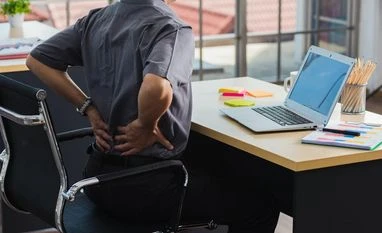
Back pain relief begins with small lifestyle corrections, says orthopaedic surgeon. (Photo: AdobeStock)
Listen to This Article
Most of us battle lower back pain every single day. Whether it is after hours at the desk, during the commute, or just bending down at home. What feels like a minor ache is, in fact, one of the world’s biggest causes of disability, according to orthopaedic surgeon Dr Obaidur Rahman.
In a recent Instagram post, Dr Rahman shared three daily habits, something so “mundane” as your posture might be sneaking up and crippling your performance, day by day.
Slouching or sitting cross-legged strains the spine
Imagine your lumbar spine as a curved arch with soft discs in between. When you slouch or sit cross-legged, you flatten or bend this arch too much. Over time, that excessive bending (called lumbar flexion) places stress on the posterior (back) part of the disc and ligaments.
In lay terms: your discs get squeezed in the wrong direction. Dr Rahman warns this posture “aggravates your back pain” and can even contribute to disc herniation.
If you are an office worker, here is what it may look like for you: you cross your legs, lean to one side, slump forward, maybe even lean on one elbow while you type. Over hours, muscles fatigue, ligaments stretch, and your spine loses support.
Also Read

 "Labourers,Labourer, onion, onions")
 "JSW")
 "Portugal")
 "Bali, indonesia")
 "Google")
What to try instead
- Sit upright with your back against the chair, feet flat on the floor (or use a footrest)
- Maintain a slight natural curve (lordosis) in your lower back
- Use a lumbar roll or cushion if your office chair lacks support
- Take micro-breaks every 30 minutes: stand, stretch, walk for 30 seconds
Two-wheeler commutes compress the spine
Dr Rahman flags riding a bike or scooter as a sneaky offender. When you ride a two-wheeler, your spine is under vertical compression, and the discs can shift backwards (posteriorly) under load.
Think of your discs as gel-filled shock absorbers. Under compression, the fluid can be squeezed, and the disc walls must resist. Factor in vibration, bumps, and slight torso twisting while riding, and the discs get taxed more than expected.
Make these tweaks
- Use a well-cushioned, upright seat and avoid leaning forward too much
- Engage your core before you ride (try a 30-second core activation)
- Use anti-vibration gear if possible
- Alternate with other commutes occasionally
- Stretch your lower back and hips after rides
Forward bending and lifting increase disc stress
According to Dr Rahman, bending forward repeatedly — picking up heavy bags, lifting groceries, tying shoelaces, or poor form during weight training — prevents the back from healing properly.
Each forward bend loads the front (anterior) portion of the disc, pushing the inner disc material backwards. Over time, that stresses the rear fibres, potentially triggering microtears or herniation.
What to do instead
- Hinge at the hips, not the back, when lifting
- Keep loads close to the body
- Limit forward-bending repetitions; vary your body mechanics
- Use extension-based stretches to counterbalance pressure
- Avoid heavy lifting during pain episodes (under physiotherapist’s guidance)
Watch:
For more health updates, follow #HealthWithBS
This content is for informational purposes only and is not a substitute for professional medical advice.
More From This Section
 "Mediterranean diet")
 "fact check, immunity")
 "Woman in a hospital")
 "cancer research")
 "Katrina Kaif pregnancy")
Don't miss the most important news and views of the day. Get them on our Telegram channel
First Published: Sep 26 2025 | 11:08 AM IST