


Trump wants 15% cap on foreign students: What it means for Indians
Trump suggests a 15% cap on foreign students at Harvard. Indian students worry about study plans as US policy shifts spark concerns over access and opportunity
 "Donald Trump")
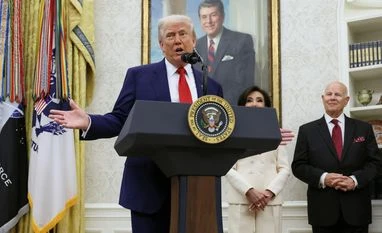
US President Donald Trump at the White House in Washington, May 28, 2025. REUTERS/Leah Millis
Listen to This Article
US President Donald Trump wants Harvard to limit foreign student enrolment to 15%, a change that could impact thousands of Indian students hoping to study in the US.
“I think they should have a cap of maybe around 15%, not 31%,” Trump said on Wednesday at the White House, taking direct aim at the institution’s current admissions practices. “We have people who want to go to Harvard and other schools, they can’t get in because we have foreign students there.”
This new target follows Trump’s attempt last week to stop Harvard from enrolling any foreign students. His push against Harvard and other universities has become part of a wider drive to reshape policies on everything from admissions to hiring. Officials say the move is part of efforts to tackle antisemitism linked to protests against Israel’s war in Gaza.
Funding freezes and lawsuits
Trump’s remarks come as the administration has frozen more than $2.6 billion in federal research funding for Harvard.
Also Read

 "Donald Trump, Trump")
 "Donald Trump")
 "Donald Trump, Trump")
 "Class, Classroom, Education, School")
 "Donald Trump, Trump")
Harvard has responded by suing the government over the funding cuts and secured a temporary court order stopping the administration from banning international students altogether.
At Harvard, nearly 6,800 students — 27% of the student body — come from overseas, up from 20% in 2006, according to the university. When including fellows, non-degree participants and their dependents, the number of international people on campus exceeds 10,000.
“I want to make sure that the foreign students are people that can love our country,” Trump said.
Foreign students are a key source of revenue for US universities, typically paying full tuition fees. Harvard offers financial aid to international undergraduates.
Trump has also repeated calls for Harvard to lose its tax-exempt status, despite its endowment of $53 billion. His administration is moving to end all federal contracts with the university.
Impact on Indian students
Among those watching closely are the roughly 788 Indian students currently enrolled at Harvard.
“This development is particularly concerning given that India has become the leading source of international students in the US,” noted Sanjog Anand, co-founder of Rostrum Education. He pointed out that over 331,600 Indian students were enrolled in the US during the 2023–24 academic year, making up nearly 30% of the international student body.
Anand told Business Standard, “While the situation is concerning, it’s important to remember that universities and advocacy groups are already working towards swift resolutions. The Trump administration has given Harvard six conditions that need to be fulfilled. Instead of jumping to conclusions, we should allow the matter to unfold further.”
Saurabh Arora, founder and CEO of University Living, weighed in: “The US Department of Homeland Security’s move to pause Harvard’s ability to enrol new international students comes amid concerns around campus climate and administrative oversight.
“The United States remains a top choice for Indian students, thanks to its world-class universities, research opportunities, and professional pathways. However, these developments may prompt families to more carefully weigh their options, especially those prioritising policy consistency and transparency.
“It’s important to remember that international students contribute more than just tuition. They bring global perspectives that enrich classrooms and research. According to our Indian Student Mobility Report 2024, Indian students are projected to spend $17.4 billion annually, including $10.1 billion on academic expenses alone.”
A mixed picture
For Rahul Subramaniam, co-founder of Athena Education, the recent policy signals should be seen in a wider context. “International students — especially those from India — are integral to the US higher education ecosystem. Many public universities rely on their presence for both academic strength and financial sustainability,” he said.
He continued: “We see the current developments as a moment of flux, not a structural shift. While some recent measures may appear restrictive, similar actions in the past have been swiftly reversed or modified to avoid long-term impact. At the same time, there have been contrasting proposals aimed at attracting top international talent, including suggestions like automatic green cards for high-achieving graduates. These reaffirm the United States’ continued recognition of global talent.”
Nikhil Mudgal, founder and CEO of Lorien Finance, noted: “It’s important to remember that this is a developing story. A federal judge in California has already issued an injunction, providing temporary relief by blocking the administration’s efforts to revoke the legal status of thousands of international students.
“That said, the situation highlights the need to stay informed and prepared. Students should maintain close communication with university officials, seek expert immigration advice and be open to alternative pathways if necessary.”
Sripal Jain, co-founder of Simandhar Education, cautioned that the situation could have far-reaching consequences: “While national security and institutional accountability are important considerations, the sweeping nature of this action, impacting nearly 6,800 international students, raises concerns about proportionality and the broader implications for global academic collaboration.
“It is crucial that affected students seek timely guidance from educational counsellors and relevant authorities to manage this evolving situation. We remain hopeful that constructive dialogue will lead to a resolution that upholds both national interests and the foundational values of academic freedom and international exchange.”
Subramaniam, reflecting on the situation, added: “Today, Indian students remain among the most sought-after in the world. We remain confident and do not foresee any major barriers to their academic ambitions in the US.”
More From This Section
 "Donald Trump,Trump")
 "germany, berlin")
 "education, degree, visa")
 "Philippines")
 "US Visa")
Topics : Donald Trump US education immigration
Don't miss the most important news and views of the day. Get them on our Telegram channel
First Published: May 29 2025 | 3:09 PM IST