


Amid NEP row, Tamil Nadu government rolls out new State Education Policy
The DMK-led government has long opposed the three-language policy introduced under the National Education Policy (NEP), insisting that Tamil Nadu will continue with its two-language system
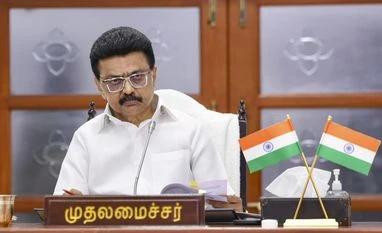 "MK Stalin, Stalin")
The Tamil Nadu government has consistently rejected the NEP (Photo: PTI)
Listen to This Article
Tamil Nadu Chief Minister M K Stalin released the State Education Policy (SEP) on Friday at the Anna Centenary Library Auditorium in Kotturpuram, Chennai. The SEP was prepared by a committee appointed by the state government and chaired by retired High Court Judge Justice D Murugesan, who submitted the report in 2024.
Speaking at the event, Stalin said the education policy was curated keeping in mind the unique character of the state and announced that the state will only follow a two-language policy. “Through this education policy, we don’t want students just to mug up, but think and get educated. Physical education will be taught along with studies,” Stalin said. Also read: Decoded: Why Tamil Nadu is engaged in a tussle with Centre over NEP
Opposition to NEP 2020
The announcement follows months of protests against the National Education Policy 2020 (NEP) promoted by the Centre. The Dravida Munnetra Kazhagam (DMK)-led Tamil Nadu government has consistently rejected the NEP, describing it as an attempt to impose Hindi on the state. Tamil Nadu has refused to adopt the policy.
In May, the state government filed a petition in the Supreme Court regarding the alleged withholding of around ₹2,200 crore in central funds, which it linked to its decision not to implement the NEP. The petition asks the court to declare that the NEP 2020 and the PM Shri Schools Scheme are not binding on the state without its formal consent.
Also Read

 "Supreme Court, SC")
 "Nityanand Rai")
 "Supreme Court, SC")
 "DMK minister Ponmudi")
 "Kanimozhi Karunanidhi, Kanimozhi, Karunanidhi")
The DMK government has argued that funds under the Samagra Shiksha Scheme have been unlawfully tied to these central schemes, describing the move as “unconstitutional, arbitrary, and illegal”.
Language policy dispute
The NEP 2020 proposes a three-language formula, requiring students to learn three languages, with at least two being native to India. Tamil Nadu has traditionally followed a two-language policy, teaching only Tamil and English in schools. The state views the introduction of a third language as an attempt to impose Hindi, an issue sensitive since the anti-Hindi agitations of the 20th century.
Both the ruling DMK and the opposition AIADMK have voiced strong objections to this element of the NEP, stressing the preservation of Tamil linguistic heritage and rejecting any form of Hindi imposition.
State's autonomy and concerns over centralisation
The DMK government maintains that the NEP framework weakens the state’s autonomy over educational policy. Education is a concurrent subject in India, allowing both state and central governments to legislate. The state argues that the NEP enforces a uniform national approach that disregards regional socio-economic and cultural variations.
Centre’s position
Union Education Minister Dharmendra Pradhan has argued that the opposition to the NEP 2020 was denying students, teachers, and educational institutions in Tamil Nadu the opportunities and resources the policy offered.
More From This Section
 "Bombay High Court")
 "Supreme Court")
 "cloudburst, Uttarakhand cloudburst")
 "heat waves, heat wave, summer, hot")
Topics : Narendra Modi DMK three language formula BJP
Don't miss the most important news and views of the day. Get them on our Telegram channel
First Published: Aug 08 2025 | 12:45 PM IST