


Only BS-VI CNG goods vehicles to enter Delhi from Nov 2025, Centre tells SC
Only BS-VI CNG, LNG, EV goods vehicles to be allowed into Delhi from November 1, 2025; ban will not apply to vehicles registered in Delhi, Centre tells SC
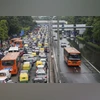 "Traffic, Traffic jam, New Delhi Traffic Jam")
Non-BS VI compliant goods vehicles carrying essential supplies will be granted entry only until October 31, 2026. (Photo: PTI)


Listen to This Article
The Centre informed the Supreme Court on Tuesday that only BS-VI compliant CNG, LNG, and electric goods vehicles — light, medium, and heavy — will be permitted entry into Delhi starting November 1, 2025. This restriction, however, will not apply to vehicles registered in Delhi, LiveLaw reported.
Additional Solicitor General (ASG) Aishwarya Bhati, appearing for the Centre, made the announcement during the hearing of the MC Mehta case, which deals with pollution issues in Delhi-NCR. The case was heard by a SC Bench comprising Justice Abhay S Oka and Justice Ujjal Bhuyan.
Commission’s efforts and restrictions detailed
Senior advocate Aparajita Singh, serving as amicus curiae, informed the Bench that the Commission for Air Quality Management (CAQM) has submitted a comprehensive affidavit outlining a series of actions to address vehicular emissions. ASG Bhati elaborated on Direction 88 (regulating vehicle entry) and Direction 89 (phasing out end-of-life vehicles), highlighting CAQM’s focus on cleaner fuel adoption.
Bhati said that from November 1, there will be no entry of light goods vehicles (LGVs), medium goods vehicles (MGVs), and heavy goods vehicles (HGVs) other than BS6 CNG, LNG and EVs into Delhi except vehicles registered in Delhi. She further clarified that non-BS VI compliant goods vehicles carrying essential supplies will be granted entry only until October 31, 2026. Thereafter, entry will be limited to CNG, LNG, and electric vehicles, the news report said.
Also Read

 "Masood Azhar")
 "Federal Bank net profit up 18%")
 "US Department")
 "Vyomika Singh")
 "Bihar Mock Drill, Mock Drill, Drill")
Delhi-NCR to soon deny fuel to End of Life (EoL) Vehicles. As per Direction No. 89, the Commission has directed that all EoL vehicles identified through the ANPR cameras or other such systems installed at the fuel pump stations shall be denied fueling w.e.f. 01.07.2025 in the… pic.twitter.com/ZasWfAsqx2
— Commission for Air Quality Management (@CAQM_Official) April 28, 2025
Crackdown on end-of-life vehicles
On the issue of older polluting vehicles, Bhati referred to Direction 89, which mandates phasing out of diesel vehicles over 10 years old and petrol vehicles over 15 years old. She noted that the NCR still has 6.1 million overage vehicles in Delhi, 2.7 million in Haryana, 1.2 million in Uttar Pradesh, and 600,000 in Rajasthan.
To enforce the ban, automated number plate recognition (ANPR) systems have been installed at fuel stations to identify these vehicles and deny them refuelling. “All EoL vehicles identified through the ANPR cameras or other such systems installed at the fuel pump stations shall be denied fuelling with effect from July 1, 2025 in the NCT of Delhi, with effect from November 1, 2025 in 5 HVD districts... and with effect from April 1, 2026 in the rest of NCR,” said the CAQM directive. Additional measures include support from traffic police and integrated command centres for enforcement.
However, Bhati clarified that these rules would not apply to vehicles exempted by court orders or specific legal provisions.
Push for EV adoption gains momentum
ASG Bhati presented Advisory No. 17 from the CAQM, which urges NCR states and Union ministries to amend or notify EV policies, set adoption targets, and provide incentives to shift to cleaner fuel technologies. “The Commission desires that the governments, public sector undertakings (PSUs) and public institutions in Delhi-NCR may take a lead... and mandate future purchase and hiring/ leasing of only such cleaner mode vehicles,” the CAQM said.
The Ministry of Finance has also advised central departments to replace leased petrol and diesel vehicles with electric ones. Bhati told the court that the Ministry of Road Transport and Highways has set standards for EV safety and approval, while the Heavy Industries Ministry has increased EV use in government hiring. The Department of Expenditure is reviewing EV adoption across ministries and PSUs, the news report said.
Justice Oka directed officials to present a practical implementation plan and asked all states and institutions to submit EV procurement data from the last five years.
More From This Section
 "Nirmala Sitharaman, Nirmala")
 "School")
 "RSS, Rashtriya Swayam Sewak Sangh, Sangh Parivar, Path Sanchalan")
 "Burnt cash at Justice Yashwant Varma house")
 "Delhi mock drill, blackout")
Topics : BS Web Reports CNG LNG BS VI Delhi
Don't miss the most important news and views of the day. Get them on our Telegram channel
First Published: May 07 2025 | 1:37 PM IST