


Who is Wing Commander Vyomika Singh, officer who briefed on Op Sindoor?
As India struck back with Operation Sindoor, Wing Commander Vyomika Singh stood at the forefront, briefing the nation after the killing of 26 tourists in Pahalgam
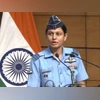 "Vyomika Singh")
Wing Commander Vyomika Singh led the Indian government's briefing on 'Operation Sindoor'.
Listen to This Article
Wing Commander Vyomika Singh, a decorated helicopter pilot in the Indian Air Force (IAF), played a key role in the official media briefing on ‘Operation Sindoor’, India’s precision strike on terror camps in Pakistan and Pakistan-occupied Kashmir (PoK). The operation was launched in response to the killing of 26 Indian tourists in a terrorist attack in J&K's Pahalgam on April 22.
She was joined at the press briefing by Colonel Sophia Qureshi of the Indian Army and Foreign Secretary Vikram Misri. This marked a rare instance of two senior women officers representing the armed forces in a high-level joint media interaction. The Ministry of Defence said the operation targeted nine terror-linked sites and was conducted jointly by the Army, Navy, and the Air Force.
Wing Commander Singh, speaking alongside Army and Navy representatives, detailed the objectives achieved during the cross-border missile strike. Officials said the targets were associated with groups responsible for recent attacks in Jammu and Kashmir and were actively planning further operations.
About Wing Commander Vyomika Singh
Wing Commander Vyomika Singh is one of the few women officers to have represented the Indian Armed Forces in such a high-level joint interaction. Her career began with a childhood dream to fly. She joined the National Cadet Corps (NCC) during her school years and later completed her engineering degree.

 "Stock broker, broker, trader, market, markets, stock markets, stock, market crash, market fall, loss")
 "Bihar Mock Drill, Mock Drill, Drill")
 "Donald Trump, Trump")
 "India Pakistan")
 "India Pakistan, India, Pakistan")
She was commissioned into the Indian Air Force as a helicopter pilot and received a permanent commission in the flying branch on December 18, 2019. She has logged over 2,500 flying hours, operating aircraft like the Chetak and Cheetah in high-risk zones including Jammu and Kashmir and the Northeast, reported The Economic Times.
She has led multiple search and rescue missions, including a critical high-altitude operation in Arunachal Pradesh in November 2020. In 2021, she participated in an all-women tri-services expedition to Mount Manirang (21,650 feet), recognised by senior defence leadership including the Chief of Air Staff.
Precision strikes target terror strongholds
India used precision-guided munitions, air-to-ground missiles, and drones to carry out the strikes. The most significant hits occurred in Bahawalpur and Muridke, key strongholds of Jaish-e-Mohammed (JeM) and Lashkar-e-Taiba (LeT), respectively.
According to Indian intelligence, 25–30 terrorists were killed at each of these locations. Initial estimates suggest 80 to 90 terrorists were neutralised in total.
Pakistan acknowledged explosions in the targeted areas but denied the existence of terror camps and condemned the operation as a “blatant act of war”, claiming civilian casualties. Indian officials, on the other hand, reiterated that no Pakistani military facilities were targeted and described the operation as an act of self-defence.
Four of the nine targeted sites were inside Pakistan, with the remaining five in PoK. Among them were LeT’s Masjid wa Markaz Taiba in Muridke, Markaz Abbas in Kotli, Syedna Bilal camp and Shwawai Nalla camp in Muzaffarabad, and Hizbul Mujahideen’s Makaz Raheel Shahid in Kotli and Mehmoona Joya in Sialkot.
Following the strikes, Pakistan initiated heavy cross-border shelling across the Line of Control (LoC) and International border, killing three Indian civilians. The Indian side responded with equivalent firepower.
[With agency inputs]
ALSO READ: Operation Sindoor: Why India named its strike after Pahalgam attack widowsMore From This Section
 "School")
 "RSS, Rashtriya Swayam Sewak Sangh, Sangh Parivar, Path Sanchalan")
 "Burnt cash at Justice Yashwant Varma house")
 "Delhi mock drill, blackout")
 "Manoj Sinha, Manoj")
Don't miss the most important news and views of the day. Get them on our Telegram channel
First Published: May 07 2025 | 12:46 PM IST