


Remembering Jayant Narlikar, astrophysicist who challenged Big Bang theory
Prof Jayant Vishnu Narlikar was best known for his pioneering contributions to cosmology and for advocating alternative models to the widely accepted Big Bang theory
 "Jayant Vishnu Narlikar, Jayant Vishnu")
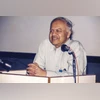
Astrophysicist Jayant Vishnu Narlikar passed away on Tuesday, May 20, 2025.(Photo:PTI)
Listen to This Article
Renowned astrophysicist Professor Jayant Vishnu Narlikar passed away peacefully in his sleep on Tuesday at his home in Pune at the age of 86. Professor Narlikar had been recuperating from hip surgery performed two weeks prior. He is survived by his three daughters.
Who was Jayant Narlikar and what was his contribution to cosmology?
Prof Narlikar was best known for his pioneering contributions to cosmology and for advocating alternative models to the widely accepted Big Bang theory. He also made significant contributions to science education and communication in India. As the founder-director of the Inter-University Centre for Astronomy and Astrophysics (IUCAA) in Pune, he helped build it into a globally respected centre for research and teaching in astronomy and astrophysics.
Even after his retirement in 2003, he continued to be associated with IUCAA as an Emeritus Professor.
What was Jayant Narlikar’s background and early academic journey?
Jayant Narlikar was born on July 19, 1938, in Kolhapur, Maharashtra, and grew up in a family that valued intellectual pursuits. His father, Vishnu Vasudev Narlikar, was a distinguished mathematician and served as Head of the Mathematics Department at Banaras Hindu University (BHU). His mother, Sumati Narlikar, was a respected scholar of Sanskrit.
Also Read

 "semiconductors chipmakers")
 "women day achievers")
 "CV Raman")
 "Asteroid Bennu")
 "Dr. Rajagopala Chidambaram")
Narlikar earned his Bachelor of Science degree from BHU in 1957 and later pursued advanced studies at the University of Cambridge, where he received his PhD in 1963, followed by a ScD in 1976.
How did Narlikar and Fred Hoyle challenge the Big Bang theory?
While at Cambridge, he began a long and successful collaboration with British astrophysicist Sir Fred Hoyle, laying the foundation for his lifelong research in cosmology. His work during this period earned him several honours, including the Smith’s Prize and the Adams Prize. He was also a Fellow of King’s College and a founding staff member of the Institute of Theoretical Astronomy.
What is the Hoyle–Narlikar theory and how does it differ from the Big Bang?
Jayant Narlikar and Fred Hoyle proposed the Hoyle–Narlikar theory of conformal gravity as an alternative to the Big Bang theory. Unlike the Big Bang model, which suggests the universe began from a singular explosive event, their theory posits that the universe has no beginning or end in time—it has always existed in a steady state.
To account for the universe’s expansion, they introduced the idea of continuous matter creation, which allowed the overall density to remain unchanged over time.
What is quasi-steady state cosmology and why is it significant?
Their theory also incorporated Mach’s principle, proposing that an object’s inertia is influenced by the distribution of mass across the universe. Later, Narlikar developed this further into the quasi-steady state cosmology (QSSC), which included periodic mini-creation events rather than one Big Bang.
Although strong observational evidence continues to support the Big Bang theory, the Hoyle–Narlikar theory remains a significant and influential contribution to theoretical cosmology.
How did Jayant Narlikar contribute to India’s scientific institutions?
Prof Narlikar returned to India in 1972 to join the Tata Institute of Fundamental Research (TIFR), where he played a key role in developing the Theoretical Astrophysics Group. In 1988, he was invited by the University Grants Commission to establish IUCAA in Pune, marking a new chapter in collaborative academic research in India.
Which national honours and awards did Narlikar receive in his lifetime?
A recipient of several prestigious honours, Narlikar was awarded the Padma Bhushan in 1965, the Padma Vibhushan in 2004, and the Maharashtra Bhushan in 2011. In 2014, his autobiography received the Sahitya Akademi Award for best writing in a regional language (Marathi).
How did Narlikar promote science communication in India?
Apart from his scientific work, Narlikar was passionate about making science accessible to the public and improving science communication in India. He authored several books in English and Marathi aimed at popularising science among young readers and general audiences.
What is unique about the Narlikar family’s personal film archive?
He was married to Dr Mangala Narlikar, a mathematician and fellow academic. Together, they had three daughters—Geeta, Girija, and Leelavati—all of whom have pursued careers in scientific research. The Narlikars also shared a love for documenting family and academic life through film. They donated 41 home movies to the National Film Archive of India (NFAI). The collection includes rare personal footage from Cambridge, the USA, family travels, and their wedding in 1966.
The visual archive offers intimate glimpses into Prof Narlikar’s personal life, including scenes with his mentor Fred Hoyle and his father VV Narlikar.
How is Jayant Narlikar remembered by India’s scientific community?
In a career spanning more than five decades, Jayant Narlikar remained a committed scientist, educator, and public intellectual—someone who inspired generations through both academic rigour and a passion for bringing science closer to the people.
Upon his passing, Prime Minister Narendra Modi wrote on X, “The passing of Dr Jayant Narlikar is a monumental loss to the scientific community. He was a luminary, especially in the field of astrophysics. His pioneering works, especially key theoretical frameworks, will be valued by generations of researchers. He made a mark as an institution builder, grooming centres of learning and innovation for young minds. His writings have also gone a long way in making science accessible to common citizens. Condolences to his family and friends in this hour of grief. Om Shanti.”
More From This Section
 "Rekha Gupta, Delhi CM")
 "Rain, Shimla Rains, monsoon")
 "Nishant Pitti")
 "Renu Bharia, Ashoka University professor")
 "Landslide in Pithoragarh, Uttarakhand")
Don't miss the most important news and views of the day. Get them on our Telegram channel
First Published: May 20 2025 | 3:59 PM IST