


JPC report on Waqf Amendment Bill tabled in Parliament amid Oppn protests
The panel had adopted the report on the draft legislation by a 15-11 majority vote, and submitted it to the Lok Sabha Speaker on January 30
 "Parliament")
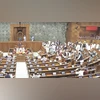
In the Lok Sabha, JPC Chairman Jagdambika Pal tabled the report, which was met with Opposition members shouting slogans and staging a walkout. (Photo: PTI)
Listen to This Article
The Joint Parliamentary Committee (JPC) report on the Waqf Amendment Bill, 2024 was tabled in Parliament on Thursday amid Opposition’s protests that the report redacted portions of the dissent notes that its committee members had submitted to the panel.
The panel had adopted the report on the draft legislation by a 15-11 majority vote, and submitted it to the Lok Sabha Speaker on January 30. It would now need the government to study the report and incorporate, if it so deems fit, its recommendations. The government introduced the Waqf Amendment Bill in the Lok Sabha on August 8 last year, which was then referred to the JPC.
The Bill had sought to change the composition of the Central Waqf Council and Waqf Boards to include non-Muslim members. It also sought to replace the Survey Commissioner by the Collector, granting them powers to conduct surveys of Waqf properties. It stated that government property identified as Waqf will cease to be Waqf and the finality of the tribunal's decision was revoked, and provided for direct appeal to High Courts.
In the Lok Sabha, JPC chairman Jagdambika Pal tabled the report, which was met with Opposition members shouting slogans and staging a walkout. Amid noisy protests by the Opposition, Union Home Minister Amit Shah said, “Some Opposition members have objected to their dissent notes not annexed fully. I wish to request to you on behalf of my party that whatever their objections, you can attach the same to the report as per parliamentary practice… My party has no objection to it.”
When the report was tabled in the Rajya Sabha at 11am, Opposition protests led to Chairman Jagdeep Dhankhar adjourning the House. When it reconvened 20 minutes later, and Opposition protests continued. Dhankhar named Samirul Islam, Nadimul Haque, and M Mohamed Abdulla for creating “chaos and disruption in the House”.
Also Read

 "Kiren Rijiju, Kiren, Rijiju")
 "Mallikarjun Kharge, Kharge, Mallikarjun")
 "Mallikarjun Kharge, Kharge, Mallikarjun")
 "Amanatullah Khan")
 "Congress leaders Jairam Ramesh and Gaurav Gogoi address a press conference at AICC headquarters, in New Delhi, Tuesday, Sept. 5, 2023. (PTI Photo/Vijay Verma)")
Congress’ Mallikarjun Kharge, the Leader of Opposition in the Upper House, termed the redacting of the dissent notes as anti-democratic, and called it a “fake report”. Union Minister for Environment Bhupender Yadav quoted rules and said the JPC chairman can expunge words, expressions, and phrases from the dissent note if they are inappropriate and unparliamentary. However, Minister for Parliamentary Affairs Kiren Rijiju rejected the Opposition's allegations and said everything has been kept on the floor of the House and nothing has been removed from the report.
Later, Leader of the House J P Nadda accused the Opposition of being “anti-national” and indulging in politics of appeasement. However, a corrigendum to Appendix 5 of the report was also tabled in the House during the post-lunch sitting, prompting the Opposition to claim that it was done under their pressure. Chapter 5 of the Appendices of the report pertains to "notes/minutes of dissent received from the Members of the Joint Committee", and contains the notes that were redacted in the earlier tabled report.
Earlier in the day, Dhankhar compared the report on the Waqf Amendment Bill with the Mandal Commission report, and said: "A major change in social justice occurred when the Mandal Commission report was implemented in a way. The Waqf issue is becoming a similar chapter.” Later, he thanked the government for the corrigendum. “I express my gratitude to the government because the matter was brought to my notice,” he said.
The All India Muslim Personal Law Board (AIMPLB) on Thursday alleged that the panel completely ignored the opinion of Indian Muslims and unilaterally moved ahead with an "arbitrary, undemocratic process". The AIMPLB said if the Waqf Bill is passed, it will run a nationwide movement against it within the framework of the Constitution. AIMPLB President Khalid Saifullah Rahmani said the organisation had conveyed its message to BJP’s allies Janata Dal (United) chief Nitish Kumar and Telugu Desam Party President N Chandrababu Naidu, to not support the Bill and side with justice.
More From This Section
 "Dharavi Redevelopment Project")
 "Modi Trump")
 "Ranveer Allahbadia")
 "Sarwan Singh Pandher")
 "N Biren Singh, accompanied by 14 legislators, submits resignation as CM to Manipur Governor Ajay Kumar Bhalla, in Imphal. (Photo: PTI)")
Topics : Waqf Board JPC Parliament
Don't miss the most important news and views of the day. Get them on our Telegram channel
First Published: Feb 13 2025 | 9:55 PM IST