


Ladakh protests: What led to the violent clashes that killed 4 in Leh
The protests followed a 15-day hunger strike over the statehood demand, led by environmental activist Sonam Wangchuk
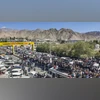 "ladakh protests, bjp")
The government said that the situation was brought under control by 4 pm on Wednesday. Photo: PTI
Listen to This Article
Violent clashes erupted in Ladakh with protestors torching the Bharatiya Janata Party's (BJPs) office in Leh on Wednesday over demands for Sixth Schedule status. According to media reports, at least four people died in the clashes and over 50 were injured.
Ladakh protests: What happened so far
The protests followed a 15-day hunger strike over the statehood demand, led by activist Sonam Wangchuk. On Tuesday, the condition of two members who participated in the strike deteriorated, leading to their hospitalisation.
Angered by this, demonstrators took to the streets and clashed with the police. The police retaliated with tear gas and baton charges to keep the crowd under control.
Leaders including Wangchuk and Apex Body Leh Chairman Thupstan Chhewang appealed for peace and calm, with Wangchuk also calling off the hunger strike on Wednesday.
Also Read

 "Leh Protest")
 "Sambit Patra, sambit")
 "leh protests")
 "Lamayuru Ladakh, mountains, Ladakh, Union territory")
 "Sonam Wangchuk, Sonam, Wangchuk")
The government said that the situation was brought under control by 4 pm on Wednesday. At least 30 police personnel were injured during the incident.
According to PTI, paramilitary forces strictly implemented curfew on Thursday and at least 50 people were detained. Strict restrictions banning groups of five or more persons were placed in major towns, including Kargil.
A series of allegations
While the government said the situation is under control in Ladakh, a series of allegations were exchanged between the parties.
The government blamed Wangchuk for provoking the crowd through his comments. In a statement, the Ministry of Home Affairs (MHA) said, "In spite of many leaders urging him to call off the hunger strike, Wangchuk continued with it and misled the people through provocative mentions of Arab Spring-style protests and references to Gen Z protests in Nepal."
"Amid these violent developments, he broke his fast and left for his village in an ambulance without making serious efforts to control the situation," it added.
Several BJP MPs also blamed the Opposition for creating chaos. BJP MP Sambit Patra claimed that upon investigation, it was found that the protests in Leh were not led by Gen Z but by the Congress party.
According to ANI, Wangchuk said that they were getting indications from the youth that they thought the path of peace was not working. "Today's incident was the precipitation of such things... No party is so strong in Leh that it can mobilise youth in large numbers. This was protest by the youth was only due to larger issues of umemployment and others...We saw Gen-Z's frenzy today...l understand their frustration over the last five years, but I condemn their way of protest," he said.
What is Ladakh demanding?
To address the demands for job reservations, language recognition, and political representation, the Centre issued a few regulations for Ladakh under Article 240 instead of granting Sixth Schedule status, which was widely requested.
However, the people were not satisfied. They are demanding Sixth Schedule status because of the following reasons:
- Constitutional protection: Regulations under Article 240 can be revoked or amended unilaterally by the Centre, but Sixth Schedule status is constitutionally protected, ensuring stronger autonomy and security for local governance.
- Safeguards for land rights: It can restrict non-domiciles from buying land in Ladakh, which people consider crucial for protecting Ladakh’s fragile ecosystem from unregulated tourism and infrastructure expansion.
- Legislative autonomy: It provides for Autonomous District Councils (ADCs) with powers to legislate on land, forests, water resources, education, and customary laws.
- Cultural and linguistic recognition: The status would help preserve Ladakh’s indigenous languages, such as Bhoti and Purgi. It ensures education in local languages and allows their use in official communication.
What does the government say?
The government said it has been actively engaging with Apex Body Leh and the Kargil Democratic Alliance on the issues of statehood. The MHA said the dialogues have yielded "phenomenal results" by increasing reservations for Ladakh’s Scheduled Tribe population from 45 per cent to 84 per cent, providing one-third reservations for women in the councils, and declaring Bhoti and Purgi as official languages. Alongside this, recruitment for 1,800 posts was also commenced.
Next round of talks on Oct 6
The next meeting of the High-Powered Committee has been scheduled for October 6. Meetings with leaders from Ladakh are also planned for September 25–26, the government said.
More From This Section
 "Rekha Gupta")
 "Cheetah Kuno")
 "Anil Chauhan, Anil, CDS")
 "ECI, election commission of india, election commission")
 "Himanta Biswa Sarma, Himanta Biswa, Himanta")
Topics : Sonam Wangchuk Ladakh Leh Protest BJP MHA BS Web Reports
Don't miss the most important news and views of the day. Get them on our Telegram channel
First Published: Sep 25 2025 | 9:54 AM IST