


4 killed in Ladakh as statehood protests turn violent, LG clamps curfew
Four killed; 45, including 22 police personnel, injured
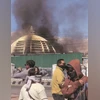 "Leh Protest")
Council Secretariat building set on fire by protesters demanding statehood for Ladakh and its inclusion under the Sixth Schedule, in Leh, on Tuesday.| Photo: PTI)
Listen to This Article
An agitation demanding statehood for Ladakh turned violent in Leh on Wednesday, following which at least four people were killed, and 45 injured, including 22 police personnel. This is one of the worst incidents of violence reported in the sensitive border region of the country.
The protesters had answered a bandh call demanding the Centre to hold dialogue at the earliest to discuss statehood for Ladakh, extension of the Sixth Schedule, separate Lok Sabha seats for Leh and Kargil and reservation in government jobs. Meanwhile, Ladakh Lieutenant Governor (LG) Kavinder Gupta on Wednesday blamed “vested interests” for the violence, as he announced a curfew to prevent more bloodshed and vowed action against the guilty. He said violence will not be tolerated and those behind it will be identified and prosecuted. “All necessary measures will be taken to prevent more casualties,” Gupta said.
Climate activist Sonam Wangchuk had started a 35-day hunger strike on September 10 to urge the Centre to resume dialogues on the local people’s demands. However, he withdrew his hunger strike after 15 days on Wednesday, and urged the youths to not resort to violence. He attributed the violence to the youth venting their “frustration” on the Centre for ignoring their demands and reneging on its promises. In a video message posted on X, Wangchuk termed it a “Gen Z revolution”. Accusing the administration run by the LG and bureaucrats of indulging in “rampant corruption”, he alleged there was a lack of jobs for the youth and democratic rights were being snatched. The denial of rights and the government’s insensitivity became a “recipe for social unrest”, he emphasised.
The Union Territory of Ladakh, which includes the Kargil region, was carved out of the erstwhile state of Jammu and Kashmir after the passage of the J&K Reorganisation Act in 2019.
According to a PTI report from Leh, several of the injured were in a critical condition, and the toll is likely to go up. Police have booked Congress leader and councillor Phuntsog Stanzin Tsepag for allegedly making a provocative speech at the hunger strike venue on Tuesday.
Also Read

 "Sambit Patra, sambit")
 "leh protests")
 "Lamayuru Ladakh, mountains, Ladakh, Union territory")
 "Sonam Wangchuk, Sonam, Wangchuk")
 "BSF, Army, India Bangladesh border")
The Ladakh Apex Body (LAB) youth wing had called for the protest after two of 15 people who were on the hunger strike, were shifted to a hospital after their condition deteriorated on Tuesday evening. At an online press conference, Wangchuk said the immediate trigger for the protests turning violent was the hospitalisation of Tsering Angchuk (72) and Tashi Dolma (60).
Wangchuk termed it unfortunate that the government has not heeded to the non-violent agitation the locals have pursued for the past five years. “We held hunger strikes on five occasions and walked from Leh to Delhi but today we are seeing our message of peace failing because of the incidents of violence and arson,” he said in a message posted on X, but urged protesters not to work against the country’s interests.
A fresh round of talks is scheduled between the Union Ministry of Home Affairs, members of the LAB and the Kargil Democratic Alliance (KDA), on October 6. The two bodies have been jointly spearheading an agitation over the past four years in support of their demands and have held several rounds of talks with the government in the past. Wangchuk said the government had sent a special plane to fly down the leaders to Delhi for talks when protests had erupted in 2020, but on this occasion it gave a date that was a fortnight away.
Former MP and LAB chairperson Thupstan Chhewang, who had resigned from the body after the last round of talks on May 27, has returned to the helm and is likely to lead the joint delegation during the negotiations.
The Congress opted out of the LAB after some constituents expressed the view that the LAB delegation should be non-political in view of the Leh Hill Council elections next month.
The Constitution’s Sixth Schedule, meant for the tribal population of the four northeast states of Tripura, Meghalaya, Mizoram and Assam, makes special provisions in terms of governance, powers of president and the governor, type of local bodies, alternate judicial mechanisms and financial powers exercised through autonomous councils.
More From This Section
 "Union minister Jitendra Singh")
 "Amit Shah, Home Minister")
 "Heavy rainfall, Kolkata rainfall, waterlogging")
 "Modi, Narendra Modi")
 "BMC")
Topics : Sonam Wangchuk Ladakh Protest Curfew
Don't miss the most important news and views of the day. Get them on our Telegram channel
First Published: Sep 24 2025 | 11:23 PM IST