


WAVES: Vaishnaw calls for co-production treaties, bridging digital divide
Vaishnaw also said in his opening remarks that culture inspires creativity which connects people across borders
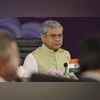 "Ashwini Vaishnaw, Ashwini, Vaishnaw")
Mumbai: Railway Minister Ashwini Vaishnaw attends the Global Media Dialogue session at the World Audio Visual and Entertainment Summit (WAVES) 2025, in Mumbai, Friday, May 2, 2025. (Photo: PTI)


Listen to This Article
At the Global Media Dialogue between 77 countries at World Audio Visual and Entertainment Summit (WAVES), Union Minister of Information & Broadcasting Ashwini Vaishnaw said that the focus should be on co-production treaties, joint funds and a declaration which helps bridge the digital divide, foster brotherhood, global peace and harmony.
“We need to thus widen the global bridge of creativity to an expressway of ideas,” Vaishnaw said.
Some member nations shared concerns on the need to enhance “responsible journalism”, which they felt can be addressed by mutual collaborations on the forum of WAVES, Press Information Bureau (PIB) said in a release.
Vaishnaw also said in his opening remarks that culture inspires creativity which connects people across borders.
He also stressed on the crucial role of collaborations for common success. “We need to focus on co-production treaties, joint funds and a declaration which helps us bridge the digital divide, foster brotherhood, global peace and harmony,” he said.
Also Read

 "Aamir Khan")
 "Raid 2, starring Ajay Devgn")
 "HIT: The third case")
 "OTT releases for this week. May 2, 2025")
 "Retro movie")
During the deliberations, senior-level delegations expressed their views and said that India informed participating nations about the 32 Create in India challenges, which resulted in identification of over 700 top creators from across the globe in the first season of WAVES.
“India informed the members that from the next edition, these challenges will be conducted in 25 global languages so that creative talent can be identified from across the globe in different languages. This will help them showcase their creative content at WAVES forum,” PIB said in its release.
External Affairs Minister S Jaishankar said that the summit brings together content creators, policy makers, actors, writers, producers and visual artists on a common platform for discussing a future roadmap for the media and entertainment sector.
He also touched upon the broad contours under consideration at the Global Media Dialogue.
He noted that the world order, which has a strong cultural dimension, is under transformation.
“It is essential that we give voice to our traditions, heritage, ideas, practices and creativity”, he said.
He also stated that technology and tradition must go hand in hand as technology can strengthen awareness of India’s vast heritage and deepen consciousness about it, especially for the younger generations.
“It is crucial that young talent is made ready for an age of creative collaborations through relevant skill development. Innovation is key to the leapfrogging that will build Viksit Bharat”, he highlighted.
While the possibilities are beyond imagination, Jaishankar said that “There is a need for a responsible use of emerging technologies, while reducing bias, democratising content and prioritising its ethics.”
“For a global workforce, there is a need for a shift in mindsets, frameworks, policies and practices,” he added.
He expressed his confidence in WAVES as a platform to deliberate on key issues before the global media and entertainment sector.
Chief Minister of Maharashtra Devendra Fadnavis, while addressing the media at WAVES, said that people who have come have said that the scale and quality of this platform has been created for the first time in the media and entertainment industry.
“This is an area in which we can lead. There is economic growth in this, that is employment, and also because this has a multiplier effect,” the CM said.
He further added that for the first time, the National Stock Exchange (NSE) has started a WAVES Index. This index consists of 43 companies related to Animation, Visual Effects, Gaming, Comics, and Extended Reality.
“This will be very beneficial for the development of the investment ecosystem in this area (media and entertainment industry),” he said.
Apart from this, the government of Maharashtra has worked with two universities. In the new education system, the prime minister has opened doors for foreign universities, he added.
“Through CIDCO, in Navi Mumbai, the government of Maharashtra is preparing a new Edu-City. It is expected to have 10 to 12 foreign universities. The state government has already signed two pacts with the University of Western Australia and the University of York in the UK,” he said.
“...we (the government of Maharashtra) have held MoUs with two of them and there are three more MoUs in the pipeline. We are also negotiating with five more,” Fadnavis said.
These MoUs are worth ₹8,000 crore.
Additionally, the government of Maharashtra and Prime Focus, (a motion picture and video production company) have made an agreement to establish an advanced studio film city.
“In this, about ₹2,500 crore will be invested and it will have state-of-the-art, advanced technology. Along with this, Godrej is also developing a similar studio film city in Panvel where about ₹2,000 crore will be invested,” he said.
He added that with these two studios, India will have world-class post-production facilities, and on a larger scale, employment will be created.
More From This Section
 "Sitharaman")
 "Supreme Court, SC")
 "Flight")
 "Modi, Narendra Modi")
 "Nayab Singh Saini, Nayab Singh, Nayab, Haryana CM")
Topics : Entertainment media industry Films
Don't miss the most important news and views of the day. Get them on our Telegram channel
First Published: May 02 2025 | 10:21 PM IST