


AI Impact Summit: Age-based social media curbs on table, says Vaishnaw
AI investments in India expected to exceed $200 bn in two years
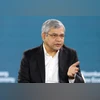 "India's Technology Minister Ashwini Vaishnaw")
Union Minister of Electronics and Information Technology Ashwini Vaishnaw | Image Credit: Bloomberg
Listen to This Article
The government has started discussions with social media intermediaries on enforcing a blanket, age-based ban preventing children below a specified threshold from accessing social media, said Ashwini Vaishnaw, Union minister for electronics and information technology, on Tuesday. He also underscored India’s surging ambitions in artificial intelligence (AI), projecting that investments in the fast-expanding space could exceed $200 billion over the next two years.
“This is something which has now been accepted by many countries that age-based regulation has to be there. It was part of our DPDP (Digital Personal Data Protection) Act when we created this age-based differentiation on the content which is accessible to young people,” Vaishnaw told reporters at a press conference on the sidelines of the five-day India AI Impact Summit here.
Alongside proposals to restrict children’s access, the government is weighing solutions with intermediaries to curb the spread of deepfakes, he said.
Vaishnaw said global technology platforms must function within India’s constitutional framework. “It's very important for the multinationals to understand the cultural context of the country in which they are operating,” he said, a week after the government directed social media companies to remove harmful, unlawful content within three hours of notification.
Calls for an age-based social media ban have gathered momentum since Australia became one of the first countries to implement such restrictions nationwide. Several others, including the United Kingdom, Spain, Italy and Malaysia, are exploring comparable measures.
Also Read

 "Ramdev")
 "India's data centre industry reached a major milestone in October when Google announced plans to set up a 1 gigawatt AI data centre in Visakhapatnam, investing $15 billion over the next five years")
 "Meta, Meta India, Manish Chopra resigns")
 "Keir Starmer, Keir, Starmer, UK")
 "AI Impact summit 2026")
In India, Andhra Pradesh’s IT minister Nara Lokesh had earlier hinted at adopting a similar rule, prompting other states such as Kerala and Goa to signal they could consider following suit.
Addressing investment prospects in artificial intelligence, Vaishnaw said India has so far secured commitments worth about $90 billion from companies and venture capital funds, with total AI investments potentially exceeding $200 billion over the next two years.
A substantial share of that investment is expected to flow into data centres, an area that already counts capital deployment commitments from technology majors Google, Amazon and Microsoft, alongside domestic players such as Adani Connex and Bharti Nxtra. The Adani group has announced investments of $250 billion over the next decade in renewable-energy-powered, hyperscale, AI-ready data centres.
Vaishnaw said the investment push would extend across all five layers of the AI stack. “We have seen VCs committing funds for deep-tech startups, we have seen VCs and other players committing funds for big solutions and big applications, we have seen VCs committing funds for further research in cutting-edge models.”
The projected $200 billion investments already include the $70 billion pledged by Google, Amazon and Microsoft late last year. The minister said a further $17 billion could be directed into deep-tech and application layers as demand accelerates.
He also noted that Nvidia is collaborating with Indian firms on significant investments in AI infrastructure and software, while declining to elaborate. Beyond capital inflows, the second phase of India’s AI mission will prioritise research and development, innovation, AI diffusion and strengthening common compute resources created under the government’s AI Mission 1.0.
The ministry is set to place orders next week for an additional 20,000 graphics processing units (GPUs), supplementing the 38,000 already secured. “We will be placing orders for another 20,000 GPUs, and they will be deployed within the next six months, so it’s a constant endeavour to provide high-quality gold resources to our startups, researchers and students.”
Asked about the message for IT services companies, shares of which have tumbled in recent days, Vaishnaw said technological transitions must be navigated through close collaboration between industry and academia. “Reskilling, upskilling and creating a new talent pipeline should be the priority,” he said.
Apology for hiccups on Day 1 of the summit
Vaishnaw apologised for the issues faced by attendees on the opening day of the AI summit, calling the turnout "phenomenal" and promising a smoother experience in the coming days. Addressing criticism over overcrowding, he said more than 70,000 people attended the summit on Monday.
"This is the biggest AI summit in the entire world. The response is phenomenal. The energy is palpable. We can see the organisation is very smooth now. If anybody has faced any problems yesterday, we apologise for that," he said at the press conference in the summit venue, Bharat Mandapam. He said a war room is now operating to address any issues being faced.
(Inputs from Udisha Srivastav, & PTI)
More From This Section
 "Gunveena Chadha")
 "Artificial intelligence")
 "SC, Supreme Court")
 "Carrier Air Conditioning and Refrigeration Ltd, Carrier Global (Photo: Company website)")
 "artificial intelligence, AI Models")
Don't miss the most important news and views of the day. Get them on our Telegram channel
First Published: Feb 17 2026 | 9:00 PM IST