Saturday, December 27, 2025 | 11:22 AM ISTहिंदी में पढें
Business Standard
Notification Icon
userprofile IconSearch

Analysts cautious on OMCs; fuel price cut, uneven oil demand key overhangs

According to ICICI Securities, OMCs will have to adjust retail prices by Rs 0.53/litre to maintain margins at current levels, if international prices change by $1/barrel
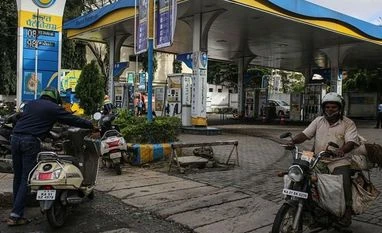
Photo: Bloomberg
premium

Photo: Bloomberg

Nikita Vashisht New Delhi

Listen to This Article

The government's suggestion to oil marketing companies, that they should cut pump prices of petrol and diesel amid robust profitability, has cast a cloud over their earnings visibility, analysts said.

"Many state elections will be held in the second half of CY23, followed by general elections in 2024. The government would want to reduce fuel prices before that. Thus, OMCs will have to forego their profit margins if prices are cut after Q1FY24 results," said G Chokkalingam, founder and head of research at Equinomics Research and Advisory.

In the January to March quarter of FY23 (Q4FY23), Bharat Petroleum Corporation (BPCL), Indian Oil Corporation (IOCL), and Hindustan Petroleum Corporation (HPCL) posted gross refining margins (GRMs) of $21, $15, and $14 per barrel, respectively.

The state-owned refiners, without quantifying, said their marketing margins – the margin earned on retail sales -- were suppressed during the quarter and whole FY23 which offset gains from GRMs.

BPCL's net profit for the quarter stood at Rs 7,563 crore (up 168 per cent year-on-year), IOCL’s Rs 10,059 crore (up 52 per cent YoY), and HPCL’s Rs 3,223 crore (a nine-year high and up 80 per cent YoY).

According to ICICI Securities, OMCs will have to adjust retail prices by Rs 0.53/litre to maintain margins at current levels, if international prices change by $1/barrel.

"Thus, if prices are reduced by Rs 4-5/litre, the margin cushion will go away, leaving OMCs vulnerable in case of a sudden spike in crude prices over the next 6 months," it said in a recent report.

That said, much would depend on how the global oil demand pans out in the financial year 2023-24 (FY24) and FY25, especially in China and the USA. The eurozone has already entered a technical recession for the first three months of 2023.

"If the US economy, too, tips into a recession by the end of 2023, it would affect global demand, and therefore put pressure on oil prices. On the flipside, if the US economy avoids a recession, oil prices will rise. In such a scenario, OMCs will not be able to reduce pump prices," said VK Vijaykumar, chief investment strategist at Geojit Financial Services.


So far in the calendar year 2023, Brent crude price has fallen around 16 per cent.

On the bourses, shares of IOCL, HPCL, and BPCL have surged between 13 per cent and 20 per cent on the BSE during the period, ACE Equity data shows. By comparison, the benchmark S&P BSE Sensex has risen around 4 per cent, while the S&P BSE Oil & Gas index has shed 11 per cent.

Against this performance, Chokkalingam of Equinomics Research believes investors should, gradually, book profit in the counters as earnings outlook may turn uncertain after Q1FY24.

Kotak Institutional Equities said there will be a case to re-rate OMCs if they are able to sustain such strong refining performance (versus benchmarks and other refiners) when marketing margins normalize (pricing freedom back). 

It maintains REDUCE on BPCL/IOCL and SELL on HPCL.

Abhijeet Bora, associate vice president at Sharekhan, too, has lowered FY24-25 earnings estimate by 6-7 per cent for IOCL; by 3 per cent for FY24 for BPCL; and by 5-7 per cent for for FY24-25 for HPCL to factor in lower GRM.

He, however, maintains 'buy' on all three stocks due to valuation comfort.

"Valuation of IOCL/BPCL/HPCL is attractive at 5x/8x/4x its FY25E EPS and 0.8x/1.4x/1x FY24E P/BV. In a normalised earnings scenario, they would offer a healthy dividend yield of 10 per cent/4 per cent/8 per cent, respectively, in FY24," he said.