


Budget impact: Gokaldas, Kitex, Trident, Arvind soar up to 8%; here's why
Textile-related stocks rally: Finance Minister Nirmala Sitharaman in Budget 2026 proposed to set-up mega textile parks to focus on value addition in technical textiles.
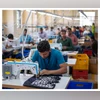 "Budget impact: Gokaldas, Kitex, Trident, Arvind soar up to 8%; here's why")
Budget impact: Gokaldas, Kitex, Trident, Arvind soar up to 8%; here's why (Photo: Shutterstock)
Listen to This Article
Share prices of textile companies today
Shares of textile companies surged up to 8 per cent on the BSE in Sunday’s intra-day trade after the finance minister (FM) Sitharamn proposed an integrated programme to boost the Labour-Intensive textile sector.
Among individual stocks, Kitex Garments (₹185) and Trident (₹28.17) rallied 8 per cent each on the BSE in intra-day trade. The stock price of KPR Mill jumped 6 per cent to ₹919.20, while Gokaldas Exports (₹581.90), Arvind (₹328) and Alok Industries (₹15.83) were up 5 per cent each.
At 11:17 AM; these stocks were up in the range of 3 per cent to 4 per cent, as compared to 0.4 per cent rise in the BSE Sensex.
However, most of these stocks have underperformed the market by falling up to 50 per cent from their respective 52-week highs due to weak operational performance due to US tariffs.
Why are textile stocks in focus on Sunday?
During her Budget 2026 speech, Finance Minister Nirmala Sitharaman said that the government proposes to set up mega textile parks to focus on value addition in technical textiles. Alongside this, the Budget proposed an integrated textile programme with five sub-parts, bringing various existing schemes under one umbrella to improve efficiency and coordination. Read Union Budget 2026 LIVE
Also Read

 "Stock Market today LIVE on Budget 2026 Announcement")
 "FM sitharaman presenting Budget 2026")
 "Budget 2026")
 "Budget 2026")
 "Budget 2026")
India European Union (EU) free trade agreement
India and the European Union (EU) have signed into a free trade agreement (FTA), after negotiation which lasted for more than a decade. The FTA, after it becomes operational, will eliminate import tariffs to zero on Indian textiles and apparel products. This provides critical relief to Indian textile exporters that currently face 10-12 per cent duties in the EU, placing them at a significant disadvantage compared with Bangladesh, Turkey, Vietnam, and Pakistan that enjoy zero-tariff access.
India has experienced consistent market share losses in major EU textile import categories over 2018-24 to competitors that enjoy duty-free imports. Bangladesh emerged as the primary beneficiary in apparel, while Pakistan captured gains in home textiles products. The EU recently suspended GSP benefits for India, Indonesia, and Kenya for a three-year period (2026-28), representing a complete withdrawal of tariff concessions following the EU's periodic reductions in these benefits.
According to analysts at Elara Capital the India-EU FTA is likely to act as a strong catalyst for Indian textile exporters, as the removal of import duties improves price competitiveness and drives volume growth. The brokerage firm opines that the garment exporters would get into expansion mode going forward with import duties in the EU and UK markets being favorable for India. =================================== Disclaimer: View and outlook shared on the stock belong to the respective brokerages and are not endorsed by Business Standard. Readers discretion is advised.
More From This Section
 "Container Corporation stock rose 4% after Budget 2026 proposed ₹10,000 outlay for container manufacturing.")
 "BSE, CDSL, Angel share prices today")
 "pinaka rocket launcher")
 "Meesho")
 "Gold, Silver ETFs drop sharply today")
Topics : Nirmala Sitharaman stock market trading Budget 2026 Arvind textile Market trends Gokaldas Exports Vardhman Textiles European Union
Don't miss the most important news and views of the day. Get them on our Telegram channel
First Published: Feb 01 2026 | 12:02 PM IST